Engineering Trust into an Agentic Bid Orchestration System for a Global Market Research Leader
22 Apr, 2026
Share On


Tech Stack
Microsoft

Microsoft
Microsoft Azure

Azure
MS Teams

MS Teams
Cosmos DB

Cosmos DB
PostgreSQL / PostgreSQL DB

PostgreSQL
Azure Functions + AKS

Azure Functions + AKS
AutoGen

AutoGen
Home
 Insights
Case study
Engineering Trust into an Agentic...
Insights
Case study
Engineering Trust into an Agentic...
Executive Summary
Creating an agentic system is only step one—confidence in its outcomes is the real gap.
This case study covers how Zuci engineered quality into a multi-agent bid orchestration system for a global market research leader — not as a final-stage audit, but as a design principle embedded across every component from the start. Because the system makes revenue-critical decisions probabilistically, traditional testing frameworks cannot validate it. A different approach was needed.
The outcome was not just a system that performed in testing. It was a system whose outputs — across bid pricing, RFP extraction, and submission generation — the client could rely on in production, with full traceability, measurable confidence, and drift controls that sustain trust over time.
The Zuci Solution
Engineering trust into a system that reasons, not just executes
Zuci designed and built a multi-agent bid orchestration system for a global market research leader — a system that extracts structured inputs from incoming RFP emails, computes optimal bid pricing, and generates submission-ready responses end to end. Read how the system was built →
Every output this system produces carries commercial weight. A bid price feeds directly into a client commitment. An extraction error corrupts the pricing that follows it. A submission email that deviates from approved data fails a contract. Because the system reasons probabilistically across all three operations, traditional quality engineering built for deterministic software — cannot validate it.
Zuci engineered trust into the system by design, across three layers of assurance.
Layer 1: System Output Quality
Evaluating what the AI agents produce — across factuality, reproducibility, drift, bias/tone alignment, and explainability.
Layer 2: Cognitive Quality
Testing how the AI agents reason — prompt robustness, variance across scenarios, stability of reasoning patterns.
Layer 3: Architectural Quality
Ensuring determinism by design — clear boundaries between deterministic and probabilistic components, guardrails, validation layers, and escalation logic.
Layer 1: System Output Quality — Validating what the AI agents produce
The bid orchestration system handles three operations:
- RFP email extraction
- Price calculation
- Bid submission email generation.
Each produces a different kind of output. Each carries different quality dimensions. And each demands a different validation strategy.
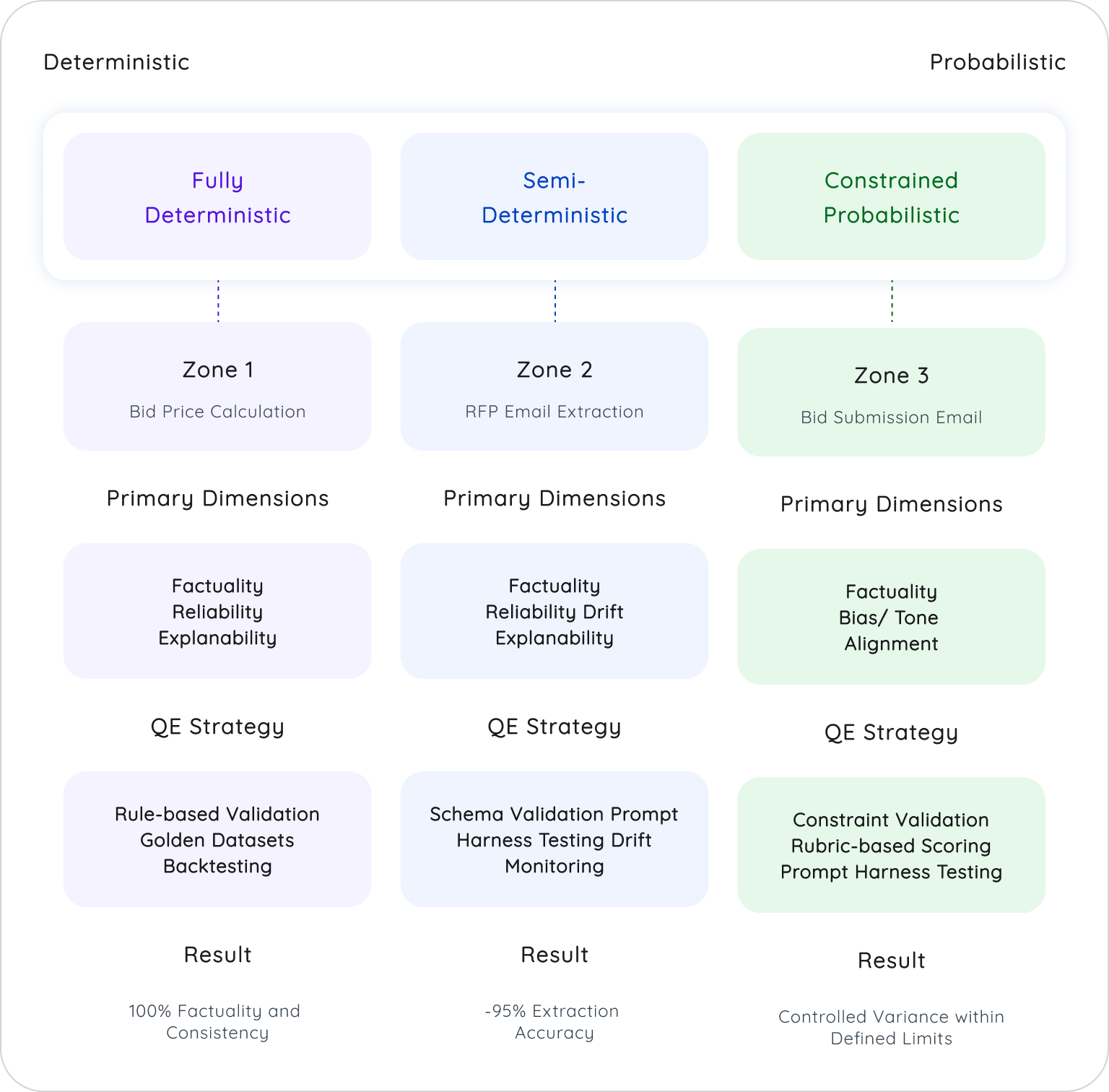
The same methodology applied across all three would either over-constrain the system’s intelligence or under-assure the reliability of its outputs. Using Zuci’s Determinism Spectrum framework, we decomposed the system into three output zones, each requiring distinct QE strategy.
| Zone | Nature | Component | QE Implication |
| Zone 1 – Deterministic | Rule-driven | Bid Price Calculation | Exact validation possible |
| Zone 2 – Semi-Deterministic | Structured interpretation | RFP Email Extraction | Controlled variability with schema validation |
| Zone 3 – Semi -Probabilistic | Constrained generation | Bid Submission Email | Bounded creativity with constraint validation |
Not all AI behaves the same way — and testing it as if it does is where most quality frameworks break down.
Zuci’s Determinism Spectrum gives teams a rigorous way to classify AI components by how they actually behave, and match validation strategy to each.
System Output Quality — Dimension-wise Application
Layer 2: Cognitive Quality -Testing how the AI agents reason
Output quality confirms what the system produced. Cognitive quality confirms whether the reasoning behind it holds up.
A system can generate acceptable outputs while its reasoning is fragile — consistent on common inputs, unreliable at the edges. Zuci tested the intelligence layer independently of its outputs, because that is the only way to catch reasoning failures before production does.
We conducted prompt harness testing across RFP variations, edge cases, and incomplete or ambiguous inputs — measuring output variance, extraction stability, and constraint adherence under conditions that depart from the training distribution. Multiple passes of identical inputs established variance thresholds for each component. Where the system is probabilistic by design, the standard is not zero variance — it is bounded variance the business can rely on.
How reliable is your AI system?
Get your personalized AI Quality Report in 10 minutes. See your scores across 5 dimensions, identify your biggest risks, and get a tailored roadmap—all emailed instantly.
Layer 3: Architectural Quality — Ensuring determinism by design
Output quality and cognitive quality validate what the system does. Architectural quality determines whether the system is built to stay trustworthy — under load, over time, and as conditions change.
We addressed architectural quality before configuring any agents. The team drew clear boundaries between deterministic and probabilistic components, and built guardrails, validation layers, and escalation logic into the system’s structure from the start — ensuring human oversight engaged at high-value bids, low-confidence outputs, and edge cases outside the system’s validated range. We governed agent orchestration through the PRIMAL Core framework, which handles multi-agent coordination, escalation, and continuous assurance in production.
Trust went in by design, not retrofitted.
Read: PRIMAL Core — A Framework for Designing Multi-Agent Intelligence →
Share On