Quality Engineering for AI
AI’s probabilistic behavior destroys predictability, and hence, the confidence to scale. Shift from verifying correctness to quantifying confidence.
Can you explain your AI’s decisions and trust its performance in production?
We make AI predictable, measurable, and trustworthy by engineering determinism where it matters, and governing variability where it doesn’t. By classifying AI systems across our Determinism Spectrum, we engineer quality strategies matched to the system’s probabilistic behavior.

Ensuring the quality and reliability of Al systems continue to be one of the biggest challenges for enterprises. Traditional QE frameworks built for deterministic systems are not equipped to handle the dynamic, probabilistic nature of Al.
Everest Group
2024 and 2025 Reports
Zuci’s Determinism Spectrum Approach To AI Quality
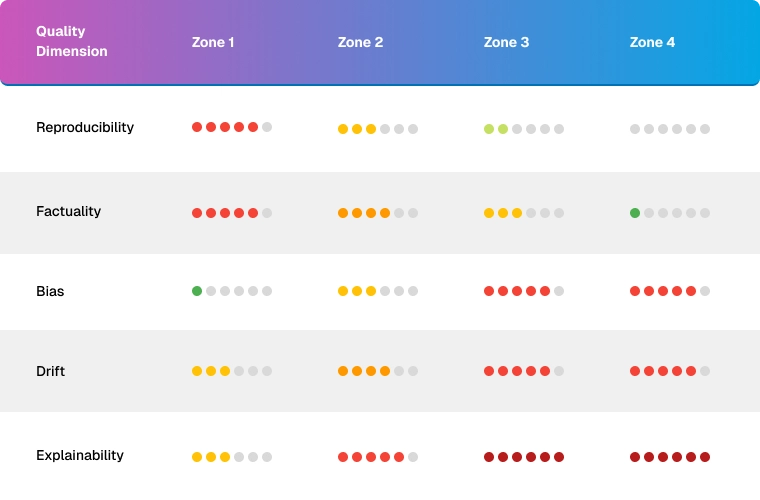
AI systems exhibit varying levels of predictability depending on the problem they solve. Our Determinism Spectrum classifies AI applications into four zones and defines how quality must be engineered at each level.
Deterministic
Probablilistic
Deterministic
Zone 1
Predictable
Stable and repeatable outputs with minimal variation.
Zone 1

QE Focus
Consistency validation
Regression confidence
Integration stability
Zone 2
Controlled Variability
Variable outputs within predefined and acceptable ranges.
Zone 2
QE Focus
Reproducibility scoring
Variance thresholds
Prompt/output baselining
Zone 3
Context-Driven Variability
Variable outputs based on prompts, context, and user interactions.
Zone 3
QE Focus
Factuality assurance
Bias detection
Reasoning coherence
Explainability
Zone 4
Generative Variability
Open-ended variable outputs across runs.
Zone 4
QE Focus
Safety guardrails
Harmful-output prevention
Continuous monitoring
Probablilistic
Our QE for AI Services
AI Output Quality Assurance


AI Assurance Strategy
AI Business Value Assurance
Traditional ML Model Testing and Validation
QE Automation for AI Systems
AI Output Quality Assurance
A holistic, multidimensional evaluation of your AI system’s outputs that goes beyond functional testing, to deliver an enterprise grade AI system with all quality dimensions assured.
We will test for:
- Reproducibility & stability of outputs
- Factual alignment & hallucination risk
- Bias and fairness (technical + behavioural skew)
- Drift (data, model, prompt, retrieval)
- Explainability & reasoning traceability
- Accuracy, completeness & robustness under perturbation
- Variance, consistency & cost-performance behaviour
AI Assurance Strategy
A tailored assurance strategy that matches your AI system’s determinism level – avoiding both over-testing and under-testing. We classify your use case into the right determinism zone (1–4) and build a matching assurance plan.
Our approach:
- Place your use case on the Determinism Spectrum (Zone 1–4)
- Identify the correct QE focus: Verification → Validation → Evaluation → Assessment
- Define variance thresholds, quality rubrics, and acceptance ranges
- Build golden sets and structured evaluation datasets
- Design test harnesses & quality metrics aligned to probabilistic behavior
AI Business Value Assurance
Independent UAT-style validation of AI systems for a decision-grade validation of whether the AI system is ready for production or not.
Our value assurance framework will test:
- Whether the AI system delivers intended business outcomes
- Whether outputs are reliable, reproducible, factual, and stable
- Whether safety guardrails & HITL flows work
- Whether risks like drift, hallucination, and bias are controlled
- Whether claimed ROI/efficiency assumptions hold in practice
Traditional ML Model Testing and Validation
Ensure that machine-learning models behave accurately, and consistently before they are deployed at scale.
Our validation approach includes:
- Data quality & feature integrity
- Model accuracy, precision, recall, AUC
- Hyperparameter & retraining consistency
- Explainability of predictions
- Stability across environments & inference pipelines
QE Automation for AI Systems
Automated testing pipelines that validate your AI system’s outputs end to end, to deliver production-ready AI with factual grounding, prompt stability, drift detection, and reproducibility assured at scale.
Our validation approach includes:
- Factuality checks & grounding validations
- Variance and reproducibility testing pipelines
- Prompt regression suites
- Drift detection workflows
- Continuous assurance dashboards
AI Output Quality Assurance
A holistic, multidimensional evaluation of your AI system’s outputs that goes beyond functional testing, to deliver an enterprise grade AI system with all quality dimensions assured.
We will test for:
- Reproducibility & stability of outputs
- Factual alignment & hallucination risk
- Bias and fairness (technical + behavioural skew)
- Drift (data, model, prompt, retrieval)
- Explainability & reasoning traceability
- Accuracy, completeness & robustness under perturbation
- Variance, consistency & cost-performance behaviour
AI Assurance Strategy
A tailored assurance strategy that matches your AI system’s determinism level – avoiding both over-testing and under-testing. We classify your use case into the right determinism zone (1–4) and build a matching assurance plan.
Our approach:
- Place your use case on the Determinism Spectrum (Zone 1–4)
- Identify the correct QE focus: Verification → Validation → Evaluation → Assessment
- Define variance thresholds, quality rubrics, and acceptance ranges
- Build golden sets and structured evaluation datasets
- Design test harnesses & quality metrics aligned to probabilistic behavior
AI Business Value Assurance
Independent UAT-style validation of AI systems for a decision-grade validation of whether the AI system is ready for production or not.
Our value assurance framework will test:
- Whether the AI system delivers intended business outcomes
- Whether outputs are reliable, reproducible, factual, and stable
- Whether safety guardrails & HITL flows work
- Whether risks like drift, hallucination, and bias are controlled
- Whether claimed ROI/efficiency assumptions hold in practice
Traditional ML Model Testing and Validation
Ensure that machine-learning models behave accurately, and consistently before they are deployed at scale.
Our validation approach includes:
- Data quality & feature integrity
- Model accuracy, precision, recall, AUC
- Hyperparameter & retraining consistency
- Explainability of predictions
- Stability across environments & inference pipelines
QE Automation for AI Systems
Automated testing pipelines that validate your AI system’s outputs end to end, to deliver production-ready AI with factual grounding, prompt stability, drift detection, and reproducibility assured at scale.
Our validation approach includes:
- Factuality checks & grounding validations
- Variance and reproducibility testing pipelines
- Prompt regression suites
- Drift detection workflows
- Continuous assurance dashboards
Engineering trust into AI systems

Engineering Trust in a Multi-Agent Bid Orchestration System
We engineered trust and governance into a multi-agent bid orchestration system for a global market research leader — implementing deterministic validation layers, reproducibility testing, bounded-variance controls, and orchestration guardrails across RFP extraction, bid pricing, and submission generation workflows.
Read how AI-powered bid orchestration was engineered for trust
extraction accuracy across production-scale RFP email parsing
reproducibility across semi-deterministic workflow components
Read how AI-powered bid orchestration was engineered for trust

Engineering Trust in Credit Decisions for a Legacy Bank
We strengthened predictive credit decisioning for a leading Indian bank where early ML models lacked consistency, transparency, and auditability. Golden validation datasets were established, enabling repeatable back-testing across time windows and customer cohorts. Reproducibility and factuality were strengthened by measuring variance across retraining cycles, identifying false positives/negatives and stabilizing feature behavior through data-quality gates. The result was a near-deterministic, auditable credit decisioning system trusted for enterprise-scale adoption.
Faster loan approvals
Accuracy of predictions

Engineering Trust in High-Volume GenAI Document Processing
We stabilized a GenAI document intelligence platform for a U.S. healthcare insurer by including deterministic extraction workflows, reproducibility checks, and schema-level validations to ensure accuracy and compliance at scale across 23+ million documents per month.
Fewer processing errors
Lower maintenance costs

Stabilized an Agentic AI Bid Automation System with Enterprise-grade QE
We engineered trust into an agentic AI bid automation platform for a global market research leader where early prototypes showed high output variability, limited reproducibility, and unpredictable agent reasoning. By embedding our QE for AI controls, including golden datasets, variance limits, reproducibility benchmarks, and explainability, we made the system reliable, auditable, and enterprise-ready.
Increase in bids submitted
Improvement in bid-to-win ratio

Frequently Asked Questions
What is the difference between traditional software testing and AI testing?
Traditional testing validates deterministic logic where identical inputs produce identical outputs. AI testing evaluates probabilistic systems where outputs vary within acceptable ranges. It must cover reproducibility, factuality (hallucinations), bias, drift, and explainability—dimensions that don’t exist in traditional QA.
What is reproducibility in AI and why does it matter?
What is AI drift and how do you detect it?
How do you measure bias in AI systems?
Is AI explainability required by law?
What is the Determinism Spectrum?
Can the same AI model fall into different zones?
Do I need to test all five quality dimensions for every AI system?
Our Related Expertise


Ideas and Insights for AI
All articles
Blogs
Webinars
eBooks & Whitepaper
Case Studies
Tools
Webinar |26 Nov, 2025

eBooks & Whitepaper |26 Nov, 2025

Case Study |02 Nov, 2025
Scaling QA for a Healthcare Platform with Intelligent Testing and Release Confidence

Blog|22 Jun, 2026



Webinar|26 Nov, 2025
eBooks & Whitepaper|26 Nov, 2025
eBooks & Whitepaper|26 Nov, 2025
How is the banking sector innovating? Learnings from the new age digital-only banks

eBooks & Whitepaper|21 Nov, 2025
Intelligent Robotic Process Automation- A buyer’s guide for credit unions

Case Study|02 Nov, 2025
Scaling QA for a Healthcare Platform with Intelligent Testing and Release Confidence
Case Study|07 Apr, 2026
Transforming AI Complexity into Reliable Business Outcomes for Bid Management