Blog
6 RPA Change Management Best Practices for Banks & Credit Unions
02 Nov, 2022
- 7 min read
Share On




As business process automation has become more widespread in banking, there’s been a focus on developing strategies to address the cultural, organizational, and executive changes needed to enjoy the benefits of RPA. This blog shows 6 RPA change management best practices that enable banks and credit unions to adopt business transformation successfully.
Change management has always been a difficult task that needs the utmost attention to detail, an understanding of the working systems, and the ability to forecast and plan future working orders.
The process of RPA change management can be overwhelming if you do not know where to begin. But, not to worry, this blog aims to provide you with 6 Robotic Process Automation change management best practices for your financial institution.
6 Best Practices of RPA Change Management for Banks & Credit Unions
According to the Shared Services and Outsourcing Network’s (SSON’s) Global IA Report, 44% of businesses reported change management as the main reason behind failed RPA implementation. There are several forms of change management. The simplest definition of change management can be defined as the process of examining, authorizing, testing, and installing a new release of an application.
Change management, without a doubt, is the most important component of your successful RPA implementation plan. Let’s explore the 6 best RPA change management practices for banks and credit unions to succeed with digital transformation.
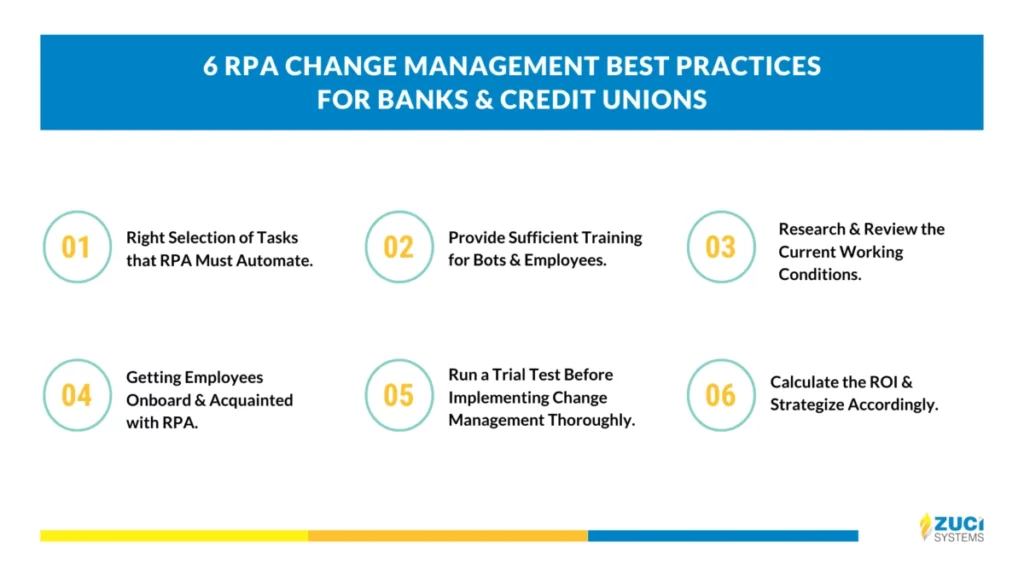
1. Right Selection of Tasks that RPA Must Automate.
There goes a lot into automating any task. You invest a lot of time, resources, and effort in it. While you can automate it, you shouldn’t necessarily automate every process or task.
RPA is recognized to offer a significant return on investment. However, if you automate the incorrect activities, this promise rapidly disappears. Applying RPA to processes that are highly complicated, non-standardized, and have more than 40% exceptions is a common error. These procedures frequently involve human judgment and fluctuate in their labor demands.
You must do research before automating processes to not disrupt the working order all at once and, thus, give rise to a scenario where you’ll have to begin everything from scratch again. After thorough research, you will learn about the potential areas for improvement and existing loopholes in the functioning of the current working system. Then you can select the process RPA can automate for better work efficiency.
To get the most out of your RPA investment, it’s crucial to carefully assess your processes because certain processes create better RPA use cases than others. Then, enlist the help of both your IT team and business analysts to determine your most excellent RPA use cases. We advise you to look for procedures that exhibit some of the characteristics listed below:
- Processes that are manual, prone to error, time-consuming, and time-sensitive
- It does not require human judgment
- High-volume, repetitive, and tedious
- Rule-based
- Constant over time and handles a high volume of transactions
- Has easily accessible test data and low exception rates
- Involved with sensitive data and impacts the bottom line
2. Provide Sufficient Training for Bots and Employees.
You can’t just set RPA bots up and leave them alone. Too frequently, businesses merely provide their bots with a brief training at the start of installation. RPA bots can operate autonomously and without error, but they need some assistance at the beginning and little upkeep throughout their lifetimes.
Businesses frequently neglect to train their staff on correctly utilizing RPA bots. Employees may start doing this work typically performed by a project team as bots make writing new code simpler than before. This addition raises the danger of shadow deployments, which might harm your operations and cybersecurity. A task’s complexity may increase exponentially until it exceeds the complexity of a manual procedure.
3. Research and Review the Current Working Conditions.
Before implementing RPA change management best practices for your bank or credit union, you must conduct complete research and review the working condition and current working system. The research and review must include the working hours taken to perform various tasks, the value return for these tasks, and the associated expenses.
Your RPA investment shouldn’t be a one-time thing. Without adequate long-term planning, you risk missing out on many of RPA’s advantages, and expanding will be next to impossible. Not having strong governance or a team of individuals from throughout your business committed to the success of your RPA investment is another typical RPA error. According to CIO.com, this error is the single biggest driver of value accretion in RPA, making it particularly harmful. It will also be challenging to stay on track and accomplish your objectives without a capable project management team at your side.
Case Study
Las Vegas credit union reclaimed 80% of employee time and effort with digital workforce
4. Getting Employees Onboard and Acquainted with RPA.
Employees have dedicated their time and energy to creating work systems; thus, they have more knowledge about the problems that may arise and their solutions. When you get employees onboard with RPA, you can ask them to share their insights and experiences performing tasks that can be used as input data for RPA. Employees must also be well-acquainted with the working of RPA as it dramatically impacts employee morale and the working environment of your bank or credit union.
To successfully achieve change management, you need the right mix of people, processes, and technology. The people and process aspects of RPA implementation make change management a priority. An RPA endeavor will fail if it is just approached from a technological perspective. When this happens, you can encounter pushback from managers and staff who don’t know how to use the technology or are afraid of it. Because you should be enhancing processes as you automate them, RPA also necessitates process adjustments. Users may oppose your RPA program or even cause it to fail if your change management efforts are ineffective when it comes to people and processes.
5. Run a Trial Test Before Implementing Change Management Thoroughly.
RPA change management is a massive leap in the working order that has repercussions if it’s not conducted correctly. Selecting the right RPA provider is essential. Running a trial test of the RPA working system will give you an idea of its functions and benefits. It will also help you understand if your research and selection of processes to be automated were correct or if you must change them.
10 RPA Use Cases Most Credit Unions Seem to Have Missed
Most data processing operations in a credit union are pretty straightforward. And manual. If your credit union is still scratching its heads about how to utilize robotic process automation (RPA) for savings, this list of 10 RPA Use Cases might help.
6. Calculate the Return on Investment and Strategize Accordingly.
Return on investment is significant when implementing digital change management in an organization as it involves a lot of expenses, employee training for new working systems, and a complete shift of the working environment. Once you successfully implement the RPA change management system, you can evaluate the value return and decide if you want to re-strategize or continue working the same way.
The RPA solution should also interact easily with your current infrastructure and not require large changes or upgrades on your part. Both viability and worth are crucial. Technical viability is crucial. Otherwise, you won’t get the theoretically anticipated business benefit. Working in quick, iterative cycles to yield results quickly is preferable to the conventional waterfall development method. While you check that you are technically on track, these “sprints” can validate the business value.
These can help any bank or credit union to successfully automate tasks and save the time and energy invested in those routine tasks with low value. And thereby shifting their employee’s valuable time, knowledge, and energy to more value-added tasks.
6 Steps to Introduce RPA to Your Employees
This article explains how to introduce RPA to your employees and painlessly get them used to it. The following 6 steps will make the transition easier for everyone involved.
To Conclude
The financial sector is being quickly overtaken and transformed by digital disruptors. Automation and RPA are at the heart of most of its processes and operations. RPA was once seen as a theory, but it now plays a massive and crucial role in strengthening and transforming companies worldwide. According to Gartner, 80% of finance leaders have already implemented or plan to implement RPA in their processes. This not only suggests a strong demand but also shows that RPA has a bright future.
Given all these, it is evident that RPA implementation will be the top priority for banks and credit unions in the coming future. Its success, however, will depend on effective change management. The lack of effective change management is often the reason for the failure of RPA implementation. All these practices will help you successfully implement RPA and ensure seamless processes.
At Zuci Systems, we have worked on use cases ranging from lending & mortgage, risk & compliance, customer service, report automation, employee on-boarding, service desk automation, and more. With a gamut of experience, we have established a highly structured approach to building and deploying Credit Union RPA services and solutions. We work hand in hand with you to define an RPA roadmap, select the right tools, create a time–boxed PoC, perform governance, set up the team, and test the solution before going live.
Read Next:
How is AI driving continuous innovation in finance?

Share On


The Complete Guide for Building Your Healthcare App
8 Common RPA Myths Every Credit Union Should Know
Author’s Profile

Activate Future|