Blog
What is AI-ready data, And Why It Determines the Success of Enterprise AI
25 Jun, 2026
- 7 min read
Share On




Last reviewed : 16th July 2026
Key Takeaways
- In most enterprise AI failures, the data layer breaks before the model does
- Enterprises have data and pipelines, but most lack context engineering and decision-ready data construction, which is what AI agents actually need
- AI-ready data must be retrievable by meaning, enriched with business context, and governed inside live workflows
- Hybrid retrieval that combines semantic search with graph-based retrieval, outperforms vector-only search at enterprise scale
- Fixing the data foundation improves AI output more reliably than swapping the model
The Model Is Rarely the Whole Problem
Enterprise AI conversations often begin with the model. Teams compare foundation models, debate fine-tuning, review benchmarks, and test API performance. Those decisions matter, but in production work they are rarely the main reason an AI system succeeds or fails.
AI pilots usually break when the system cannot find, interpret, trust, or apply the right enterprise data at the right moment. Gartner’s 2025 research made this risk visible. It found that 63% of organizations either do not have the right data management practices for AI or are unsure whether they do. Gartner also forecast that 60% of AI projects unsupported by AI-ready data will be abandoned through 2026.
The MIT NANDA study released later that year reached a similar conclusion after reviewing 300 enterprises. It found that 95% of organizations saw no measurable return from their AI investments. The failure point was not model quality. The systems could not retain context, adapt to workflows, or learn from actual use.
That gap points to a consistent root cause: most enterprises have data, dashboards, and pipelines, but lack the context engineering and decision-ready data construction that AI agents actually need to reason and act reliably.
Before AI, decisions were human-centric. Data lived in systems. Dashboards made it visible. Humans interpreted it, made decisions, and executed actions manually. Context and judgment lived with people.AI agents have reengineered that flow. Data is now ingested from multiple enterprise sources, enriched with business context, relationships, and domain rules, and structured into a decision-ready form at runtime. Agents reason over this structure and generate recommendations or execute actions automatically.
Most enterprises are stuck in the middle of that shift, and this is where most AI programs stall.
Most teams underestimate how much preparation sits between raw enterprise data and something an AI agent can actually reason over.
See how Zuci’s Activate Data approaches it→
What Makes Data AI-Ready
AI-ready data is often mistaken for clean data. Cleaning is necessary, but it is only one part of the foundation. Data becomes decision-ready when it can be reliably retrieved, enriched with business context, structured for AI reasoning, and governed inside a live workflow.
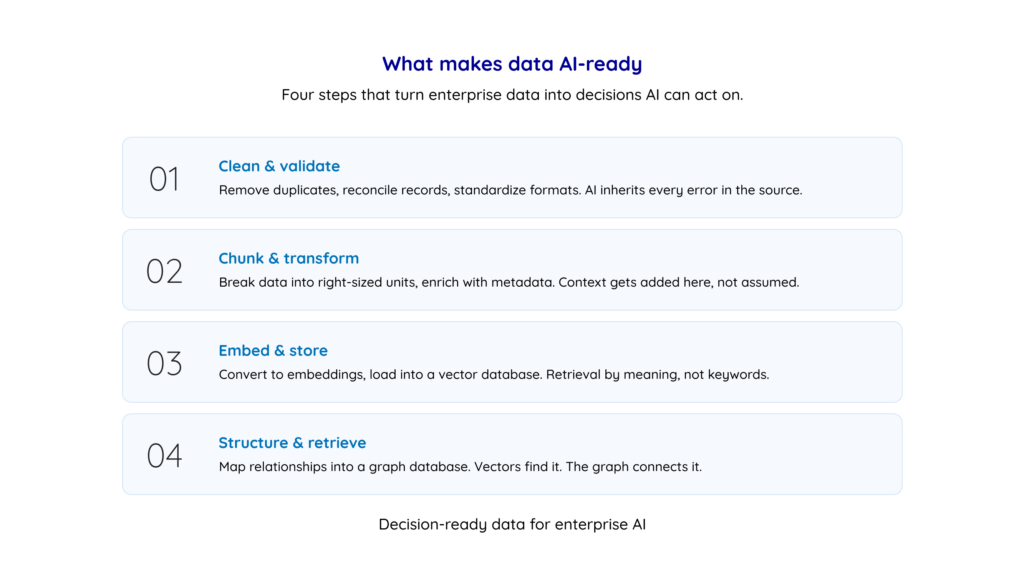
For traditional reporting, data must be accurate, deduplicated, and consistent enough to support analysis. For AI systems, the bar is higher. The data also needs context – metadata that tells the system about source, ownership, permissions, freshness, domain, and relevance. It needs to be discoverable by meaning, not just exact keyword match.
Context engineering is what closes this gap. It is the deliberate work of enriching data with semantic metadata, domain knowledge, business rules, and relationships that allow AI to understand meaning and intent, not just access records. Without it, even well-structured data remains opaque to an agent.
Generative AI adds further preparation demands. Large documents need to be segmented into usable chunks. Those chunks need embeddings so the system can compare meaning across documents and queries. Metadata must travel with each chunk so retrieval does not become detached from business context. Access control, lineage, and update frequency need to be designed into the pipeline from the start.
Without this foundation, even a capable model produces confident answers from incomplete, outdated, or poorly retrieved information leading to hallucination in enterprise workflows.
How to Prepare Enterprise Data for AI
Enterprise data rarely comes from one clean source. It comes from operational databases, APIs, document repositories, CRM systems, collaboration tools, and manual uploads. A production-grade ingestion pipeline needs to bring these sources together reliably and keep them current. A weak pipeline creates stale context, missing records, and inconsistent answers.
The next layer is validation: duplicates resolved, missing values treated, conflicting records reconciled. In regulated industries like banking, insurance, and healthcare, small inconsistencies can produce incorrect recommendations or audit failures.
Transformation depends on the AI use case. For predictive systems, the work centers on feature engineering and training dataset preparation. For retrieval-augmented and agentic systems, it shifts toward document parsing, chunking, embedding generation, metadata extraction, entity recognition, and relationship mapping. Both paths converge on the same requirement: semantic enrichment. Data must be enriched with domain context, business rules, and knowledge models before it can support reliable AI reasoning.
Governance needs to run through the pipeline, not sit outside it. Data lineage, access controls, freshness checks, quality rules, and monitoring all affect whether the AI system can be trusted in production. For agentic workflows where the system retrieves information, generates recommendations, and triggers actions, governance is not optional.
How Hybrid Retrieval Works Better at Enterprise Scale
Retrieval is where many AI systems lose quality. Traditional search relies on exact matches. AI retrieval needs to understand meaning, entity relationships, permissions, and business relevance. A common implementation uses vector search alone, which can work for narrow, consistent document sets. Enterprise environments are less tidy.
Zuci’s approach is hybrid. When a user submits a query, the system runs semantic search and graph-based retrieval in parallel. Semantic search finds content close in meaning to the query. Graph-based retrieval finds content connected through entities and relationships — a customer, a policy, a regulation, a process. Results are combined, scored, and re-ranked before the final context is passed to the model.
This gives the system two complementary signals. Embeddings capture language-level similarity. Graphs capture business-level connection. Structured metadata provides filters and constraints so retrieval stays relevant, compliant, and specific to the user’s context. The goal is not just to give the model better inputs, but to structure those inputs so the model can be trusted to act on them.
That design is especially important in regulated environments. Banking, insurance, healthcare, and other high-stakes industries need AI systems that can explain their inputs, respect access boundaries, and produce outputs that are auditable. The architecture has to do this work. Better prompts alone cannot.
Where Implementations Break
Several failure patterns repeat across enterprise AI programs. Unstructured data is harder to operationalize than it appears in a pilot. PDFs have inconsistent layouts. Tables do not parse cleanly. Scanned files introduce OCR errors. Long documents need chunking strategies that preserve meaning without creating fragments that lose context.
Metadata consistency becomes a scaling issue when multiple teams contribute content. Without common taxonomy and governance, retrieval quality decays as the corpus grows. And context gaps compound everything: when data is not enriched with business context, retrieval produces technically correct results that are practically useless.
What holds up in production:
- Rich, governed metadata that lets the system filter before searching
- Hybrid retrieval combining semantic and graph-based signals
- Structured and unstructured data treated as one workflow rather than two separate systems
- Context engineering done before retrieval tuning, because fixing retrieval on top of context-poor data produces diminishing returns.
What to Focus on While Building AI-Ready Data
Most enterprises that struggle with AI in production are not running out of data. The gap is almost always the foundation, not the model. And the failure patterns are consistent enough that the priorities are clear.
Several failure patterns repeat: unstructured data that degrades outside a pilot, metadata that decays as teams scale, and context gaps that make retrieval return technically correct but practically useless results. The fix is not retrieval tuning — it is building the right foundation before tuning anything.
Here is where that foundation needs to hold:
Start with context engineering, not retrieval. Data enriched with semantic metadata, domain relationships, and business rules is what allows AI to reason correctly. Fixing chunking and ranking on top of context-poor data produces diminishing returns.
Treat structured and unstructured data as one workflow. Enterprise queries do not stay inside one data type. The pipeline should connect these layers, not operate them separately.
Use hybrid retrieval. Semantic search finds language-level similarity. Graph-based retrieval finds business-level connection. Together they return results that are both relevant and contextually grounded.
Build governance in, not on. Lineage, access controls, freshness, and quality rules need to be part of the architecture from the start. Retrofitting them after a pilot usually means rebuilding the retrieval layer.
Design for continuous learning. The most durable AI systems are ones where agent decisions feed back into the data — improving context, updating evidence, and making future reasoning more reliable.
The model is the reasoning engine. The data infrastructure is what makes it trustworthy.
If you are working through any of these challenges, we would be glad to compare notes.
About Zuci Systems
Zuci Systems is an AI transformation partner for enterprises building trusted, production-ready AI systems. We help organizations design and implement AI-ready data foundations, RAG architectures, agentic systems, Quality Engineering for AI, and workflow-integrated automation.
Our approach brings together data engineering, digital engineering, AI orchestration, and governance-ready quality practices so enterprises can move beyond pilots and scale AI with confidence.
Contact: connect@zucisystems.com
Frequently Asked Questions
1. What is AI-ready data?
2. Why do AI projects fail in production?
3. What is hybrid retrieval?
4. Why does graph retrieval matter?
5. What should teams prepare before building AI?

Share On


The Window for Legacy Modernization Is Open. Here's How to Move
What AI tools should developers use in 2026?
Author’s Profile

Senior Data Engineer and AI practitioner, Zuci Systems |