Blog
Agentic AI's Impact on Banking: 3 Key Transformations
20 Mar, 2026
- 13 min read
Share On




Agentic AI in banking is shifting AI from passive prediction to active decision-making. Instead of generating a score and waiting for a human to react, autonomous agents read complex data, interpret context, make judgments, and execute actions with full audit trails.
In financial crime, credit risk, and regulatory compliance, this shift is cutting review loads, shrinking loan turnaround times, and compressing weeks of regulatory monitoring into hours. For banks and financial institutions under pressure from fintech competitors, regulators, and rising risk, agentic AI is starting to look less like a niche technology and more like a new operating layer for the enterprise.
What Is Agentic AI in Banking?
Agentic AI refers to AI architecture composed of autonomous, goal-driven agents capable of perceiving their environment, reasoning about possible actions, and executing decisions by interacting with tools to achieve defined objectives, with minimal human oversight.
In banking and financial services, this represents a move from automation to autonomy. Traditional systems follow preset workflows that trigger when a form is submitted, a rule fires, or a batch job runs. Agentic AI in banking instead creates a network of proactive digital collaborators. Agents do not merely process a transaction. They reason about it, compare it with history, consult policies, act across multiple systems, and explain why they chose a specific course of action.
Three properties make this possible.
- Reasoning lets agents decide what to do next instead of following a rigid path.
- Memory allows them to learn from past actions and outcomes.
- Adaptability enables real-time adjustment as new information, risks, or regulations emerge.
Together, these properties make agentic AI financial services architectures suited to high-stakes, high-variance domains like credit risk, AML, and regulatory compliance.
Which Banking Tasks Are Best Suited for Agentic AI?
A simple way to decide where agentic AI fits is to ask whether a task requires reading, interpreting, judging, and explaining. If the answer is yes, it is a candidate for an agentic AI approach. If a task is purely form-driven, rule-driven, or straight-through processing, traditional automation and conventional machine learning remain sufficient.
Bank statement analysis illustrates this difference. Many lenders still require three to six months of statements for underwriting. These come in varied formats and structures. An effective review demands reading the statements, understanding transaction narratives, spotting patterns, flagging anomalies, forming a judgment, and explaining that judgment to a credit committee or regulator. That is interpretation, not simple data processing.
An agent can ingest statements in any format, understand the borrower’s cash-flow narrative, identify trends and unusual behaviors, and then summarize the findings in clear language. It sequences multiple models, tools, and rules toward a concrete goal such as assessing repayment capacity.
Agentic AI also addresses specific limitations in conventional machine learning systems:
| ML Limitation | Problem in Conventional AI | How Agentic AI Solves It |
| Decision latency | Models act as isolated point solutions and fragment decisions | Agents sequence multiple models and tools in real time toward a single business outcome |
| Low explainability | Predictions arrive without accessible reasoning | Agents produce explicit reasoning traces and natural language explanations |
| Reactive governance | Bias and fairness issues surface only in after-the-fact audits | Governance-in-the-loop runs fairness and compliance checks before actions are executed |
| Static models | Fixed retraining cycles miss emerging fraud and regulatory shifts | Feedback loops detect degradation and trigger recalibration dynamically |
| Limited context | Risk models operate in silos and miss cross-domain signals | Shared memory and cross-system reasoning integrate signals into a holistic risk picture |
Are you thinking of building your first enterprise AI agent?
Use this structured worksheet to define agent goals, constraints, tools, escalation paths, and governance checkpoints before you build.
By design, agentic AI in banking is not just more capable. It is more governable and transparent, which is critical for regulated institutions.
Would Your AI Agent Withstand Audit and Scale?
Explore the 7 design principles that ensure AI agents remain predictable, auditable, and aligned with regulatory expectations in high-stakes environments.
5 Benefits of Agentic AI for Banking and Financial Services
Agentic AI financial services architectures are emerging in response to clear business imperatives. The benefits are most evident in five areas:
- Speed to compete with fintech: Fintech challengers set expectations for instant decisions and personalized experiences. Agentic AI enables dynamic, goal-driven orchestration in near real time, compressing customer journeys without eroding controls.
- Operational coordination across silos: Credit approvals, risk monitoring, payment reconciliation, and collections often span multiple systems and teams. Agents coordinate fragmented tasks, pass clean context between steps, and keep execution consistent from end to end.
- Proactive customer service: With memory and situational awareness, agents anticipate needs. They can detect fraud before it happens, surface relevant financial recommendations at the right moment, and handle exceptions without pushing customers into manual back-office queues.
- Built-in regulatory compliance: Regulations such as the EU AI Act and United States model risk guidelines demand transparency, traceability, and robust governance. Agentic AI logs reasoning, creates auditable decision paths, and embeds real-time compliance checks inside workflows rather than bolting them on later.
- Risk resilience in changing conditions: Fraud patterns, credit behaviors, and markets evolve constantly. Agents detect drift, learn from feedback, and recalibrate autonomously, which protects both customers and balance sheets over time.
Across these benefits, four impact patterns consistently deliver the highest value: multi-step orchestration across fragmented systems, cross-domain reasoning that connects internal and external data, autonomous exception management in high-volume processes, and governance-embedded operations where auditability is non-negotiable.
Want to assess if your use case is a good multi-agent candidate?
Not every workflow needs a team of agents, but some genuinely do. Use our 5-criteria checklist covering complexity, coordination, memory, human oversight, and governance to get a clear answer before you go down the multi-agent path.
High‑Impact Uses of Agentic AI in Banking
Agentic AI is already showing strong potential in three banking domains where work is complex, judgment‑heavy, and highly regulated. The table below summarizes how banks are applying agentic AI across these areas and the impact they are seeing.
| Domain | Use Cases | Typical Impact Range |
| Financial crime (AML and KYC) | Intelligent alert triage, deep investigation support, SAR drafting, sanctions screening, perpetual KYC | Up to 40% reduction in review load, 30–50% faster case resolution, 25–45% fewer false positives, 50%+ less periodic KYC effort |
| Credit risk | SME loan origination and underwriting, portfolio monitoring, pre-close mortgage review | 40–60% reduction in underwriting cycle time, up to 70% faster loan processing, 40–60% less manual document review |
| Regulatory compliance | Continuous regulatory monitoring, gap and impact analysis, control updates, reporting automation | 50–70% reduction in tracking and reporting effort, 50–60% faster remediation, response to new obligations in hours |
Agentic AI Use Cases in Banking and Financial Services
Within banking risk and operations, three clusters are especially well suited to agentic AI: financial crime, credit risk, and regulatory compliance. Each combines complex data, evolving rules, and high oversight requirements.
What Structures Multi-Agent Intelligence in Regulated Environments?
Successful agentic systems rely on a clear separation between perception, reasoning, action, and governance.
PRIMAL Core defines how these layers work together inside enterprise constraints.
1. Financial Crime: AML and KYC
Rule-based AML and KYC systems generate large volumes of alerts and false positives. Analysts must manually gather customer data, transaction histories, and past case outcomes before deciding whether to close or escalate each alert. This leads to backlogs, inconsistent decisions, and rising operating costs.
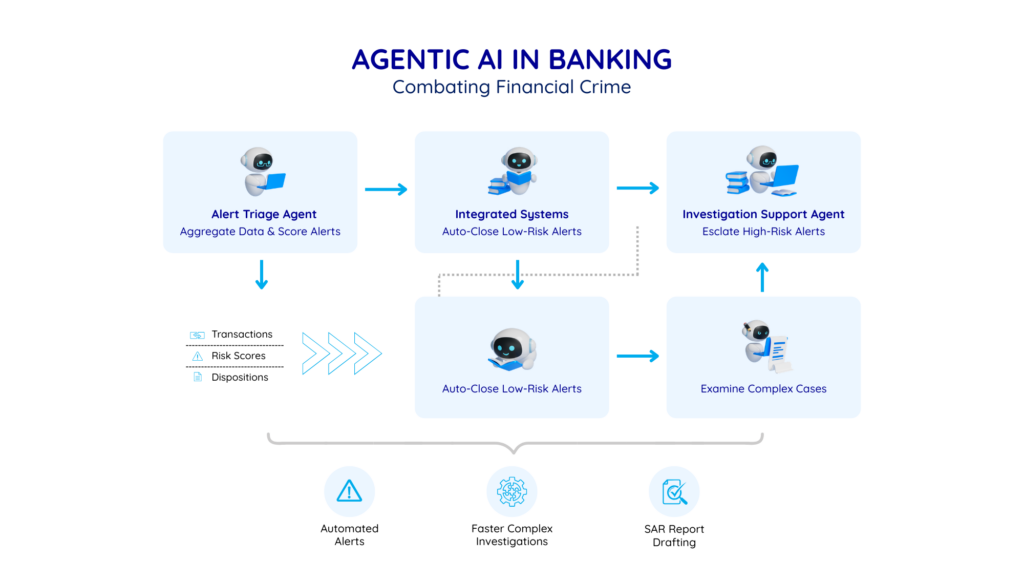
How agentic AI in banking handles AML and KYC
- Alert triage agents ingest transaction data, customer risk scores, and previous dispositions through APIs, then run planner–executor loops to evaluate alert patterns and calculate risk scores.
- For low-risk alerts, agents auto-close cases and record a clear rationale. For high-risk alerts, agents assemble a full context pack that includes customer background, behavior patterns, related entities, and relevant historical cases before escalating to analysts.
- Investigation support agents help analysts probe complex cases by summarizing long narratives, highlighting suspicious linkages, and suggesting the next best actions.
- SAR narrative drafting agents convert structured case data into first-pass narratives that analysts refine, rather than drafting from scratch.
- In KYC, context-aware sanctions screening agents look beyond simple name matches to evaluate broader customer context. Perpetual KYC agents maintain continuously updated profiles instead of relying only on periodic reviews.
Business Outcomes
- Up to 40 percent reduction in analyst review load in transaction monitoring.
- Approximately 30 to 50 percent faster case resolution for complex investigations.
- Up to 60 percent reduction in SAR drafting time.
- Around 25 to 40 percent reduction in false positives from better threshold calibration.
- Approximately 35 to 45 percent fewer false positives in sanctions screening and more than 50 percent reduction in periodic KYC effort.
Because every step is logged with reasoning, banks gain a more defensible narrative for why an alert was closed, escalated, or reported.
2. Credit Risk: Loan Processing and Underwriting
SME and mortgage loan processes are document-heavy and fragmented. Applicants submit returns, bank statements, KYC forms, and tax filings in inconsistent formats. Manual validation across multiple systems slows decisions, drives rework, and introduces inconsistent policy interpretation.
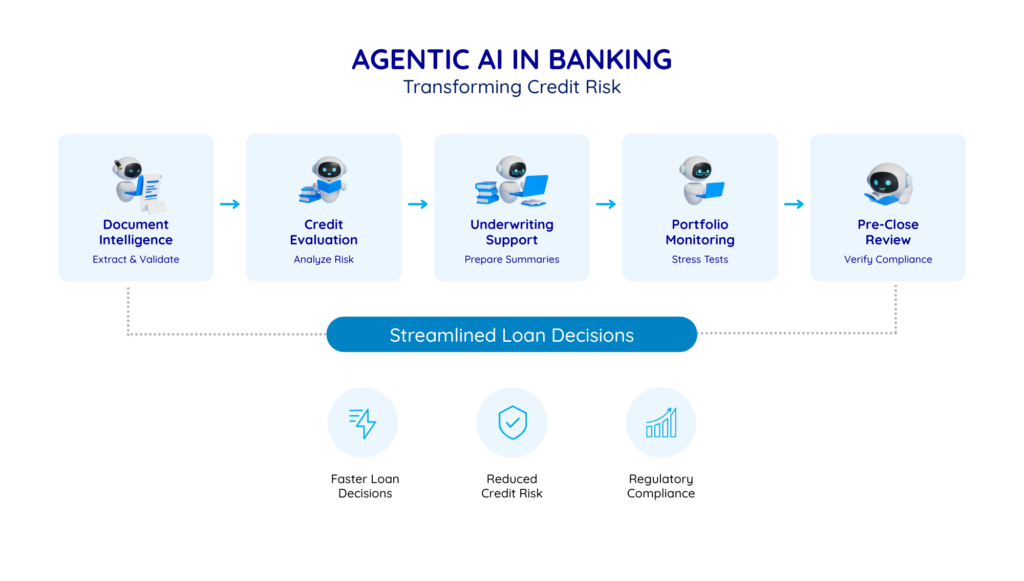
How agentic AI banking workflows transform credit risk
- A document intelligence agent reads any document format, extracts required data, validates completeness, and flags mismatches across sources.
- A credit evaluation agent analyzes cash flows and repayment patterns, benchmarks applicants against similar borrowers, and surfaces anomalies and edge cases.
- An underwriting support agent assembles pre-underwritten case files that summarize key metrics, highlight risk factors, and recommend next actions for underwriters.
- Portfolio monitoring and stress-testing agents gather data from internal systems, apply stress scenarios, and generate structured outputs that align with regulatory expectations.
- Pre-close mortgage review agents check documentation and policy adherence before closing, reducing post-close remediation and customer friction.
Business Outcomes
- Roughly 40 to 60 percent reduction in underwriting cycle time for SME loans.
- Up to 70 percent reduction in overall loan processing time when document review and validation are automated.
- Around 40 to 60 percent reduction in manual document review effort.
- Fewer rework cycles due to cleaner data handoffs and better policy interpretation.
- More consistent underwriting decisions supported by clear audit trails.
This is where agentic AI in banking moves beyond optical character recognition or static scorecards and becomes an orchestrator of the full loan journey. Building that orchestration inside a regulated environment is as much an engineering problem as a modeling one.
What Are the Core Components of a Multi-Agent AI System?
Document intelligence, underwriting support, and regulatory monitoring rarely operate as isolated agents. They depend on coordinated roles across perception, reasoning, action, and governance layers.
This breakdown explains how enterprise multi-agent systems are structured.
3. Regulatory Compliance: Monitoring and Reporting
Regulatory change management still relies heavily on manual monitoring of regulator websites, circulars, and guidance documents. Obligation mapping is often managed through spreadsheets and email threads. This introduces delays, duplication of effort, and inconsistent implementation of new rules across business units.

How agentic AI financial services platforms strengthen compliance
- Perception agents continuously scan regulatory sources such as websites, portals, PDFs, and circulars for new or amended regulations.
- Reasoning agents extract obligations, tag them by jurisdiction, effective date, and business impact, and map them to policies, processes, and controls.
- Action agents assign owners, set deadlines, and trigger alerts inside the institution’s compliance or risk platform.
- Governance agents log every update, mapping decision, and follow-up action with explanations that compliance leaders can audit, validate, or override.
Business Outcomes
- Approximately 60 to 70 percent reduction in compliance tracking effort.
- Roughly 60 percent reduction in the time needed for regulatory gap and impact analysis.
- Around 50 to 60 percent faster control remediation cycles.
- Roughly 50 to 70 percent reduction in compliance reporting effort.
Most importantly, compliance teams can act on new obligations within hours instead of weeks, strengthening regulatory posture and reducing last-minute firefighting.
How We Used Agentic AI to Modernize Loan Funding at a Credit Union
A credit union relied on a paper-heavy loan funding process. Loan packets included handwritten forms, identity documents, and compliance disclosures. Staff had to review each packet manually, rekey data into multiple systems, and chase missing information across departments, which slowed funding and created inconsistency.
How agentic AI in banking restructured the process
- An ingestion agent powered by Azure Document Intelligence classified documents and extracted key fields from diverse formats.
- Orchestration through APIs integrated agents with the credit union’s existing enterprise systems, so data flowed automatically into core platforms.
- Planner–executor loops performed autonomous document validation by checking completeness, consistency, and compliance with policy.
- A human-in-the-loop mechanism sent only low-confidence extractions and genuine edge cases to inspectors for review, turning humans into supervisors rather than data-entry operators.
This is a concrete example of agentic AI in banking that shows how institutions can modernize operations without replacing their entire technology stack.
Want to discuss your Agentic AI Roadmap?
Evaluating AML modernization, underwriting automation, or regulatory monitoring? In a focused 30-minute session, review your workflow, architecture considerations, and production-readiness gaps with our AI specialists.
Managing Risk When Deploying Agentic AI
Deploying agentic AI in financial services introduces new risks, but careful design can control them.
Security and access risks are managed through least-privilege access, sandboxing, real-time anomaly detection, and audited APIs with emergency stops. Goal misalignment is reduced through explicit constraints, guardrails, and planner–executor checkpoints that keep agents within defined boundaries. Governance, ethics, and compliance risks are addressed with fairness testing, full audit trails, and alignment with regulations such as the EU AI Act, OCC model risk guidance, and GDPR.
Cost, ROI, and scalability concerns are handled by targeting well-defined pilots with clear metrics, using modular architectures, and tracking total cost of ownership. Workforce resistance is reduced by positioning agents as augmentation, involving end-users early, demonstrating quick wins, and investing in upskilling.
When these practices are embedded from the start, agentic AI increases control and resilience rather than weakening them.
Agentic AI in banking is already cutting AML alert volumes, shrinking loan processing cycles, and making regulatory change management more responsive.
The institutions that will lead are those that treat agentic AI as a full-lifecycle transformation, from data and infrastructure to models, agents, and governance. For regulated enterprises, the next step is to pinpoint high-friction, high-oversight workflows in financial crime, credit risk, and compliance, design agentic patterns that embed governance by design, and scale with partners who understand both AI engineering and regulatory-grade quality.
Building Agentic AI for Regulated Banking
Turning agentic AI into a real enterprise capability requires the right foundations across data, platforms, governance, and AI engineering. See how Zuci helps financial institutions design and scale intelligent, compliant banking systems.
Explore our BFSI Solutions →
Frequently Asked Questions
1. What is agentic AI in banking and how is it different from traditional automation?
Agentic AI in banking uses autonomous, goal-driven agents that can perceive their environment, reason about possible actions, and execute decisions across tools and systems with minimal human oversight. Traditional automation typically follows fixed rules and workflows, while agentic AI adds interpretation, judgment, and explanation, which makes it suitable for complex processes in risk, compliance, and operations.
2. Where does agentic AI in financial services deliver the fastest return on investment?
3. How does agentic AI improve AML and KYC effectiveness in banks?
4. What role does agentic AI play in credit risk and loan underwriting?
5. How can banks manage regulatory and ethical risks when adopting agentic AI in financial services?
Next Steps
Read Next: PRIMAL Core Framework
Learn how we design intelligence that operates reliably within these structural boundaries.
Read: PRIMAL Core – A Framework for Multi-Agent Intelligence →
Book an AI Agent Design Review
Discuss your specific agentic AI use cases with our AI experts and get feedback on design, structure, and production readiness.
About Zuci Systems
Zuci Systems is an AI-first digital transformation partner specializing in enterprise-grade AI agent design and multi-agent orchestration. We help Fortune 500 companies in banking, insurance, and healthcare design and deploy AI systems that are predictable, explainable, and production-ready.
Our approach combines structural discipline (7 design principles), intelligence design (PRIMAL Core framework), and enterprise controls (Trust Layer) to create agents that work reliably in regulated, high-stakes environments.
Author's Profile

Head, Gen Al Center of Excellence, Zuci Systems

Srinivasan heads Zuci’s Generative AI Center of Excellence, leading initiatives that unite AI, engineering, and enterprise transformation.
With over 20 years of experience in technology strategy and digital platforms, he helps organizations design scalable AI systems that balance creativity and control.
Share On


Trends in QE 2026: How AI Is Redefining Quality Engineering
RPA vs APA: How to Choose the Right Automation for Your Enterprise
Author’s Profile

Head, Gen Al Center of Excellence, Zuci Systems|