Blog
Trends in QE 2026: How AI Is Redefining Quality Engineering
20 Mar, 2026
- 13 min read
Share On




Key Takeaways
- Quality engineering is undergoing a rapid recalibration as QE in AI matures
- Only 15% of organizations have been able to achieve AI at production levels, with other companies still grappling with experimental phases
- QE trends highlight a shift towards the “Quality, not quantity” mantra when it comes to applied AI
- Key trends include agentic QE, continuous quality loops, system modernization, synthetic data, reliable TDM, and evolution of human roles in the QE niche
- Organizations must now leverage QE as a strategy rather than testing to rise up the AI ladder
As AI-powered software delivery gains cadence in the industry, enterprises must simultaneously evolve the processes that go into validating it. Quality engineering in AI moves from a supporting activity to a core discipline for digital resilience.
The 17th edition of the World Quality Report 2025-26 underscores this shift. As code generation and automation accelerate, organizations must also demand validation with equal fervor. This report highlights a big gap: while 15% of the organizations have successfully scaled their AI, 43% remain in the experimental phase.
It directly highlights the modern challenges in the existing QE practices: how to move AI from pilots to production. Let’s take a look at some of the most important quality engineering trends for 2026.
The State of Quality Engineering In AI
Interestingly, the landscape of quality engineering in AI seems bifurcated so far. On the one hand, you clearly see the surge in the adoption of generative AI and related implementations for tactical tasks. On the other hand, there is a cautious “Let’s wait and see” sentiment approach when it comes to autonomous agents.
Up until now, enterprises focused on “Testing as a Service” to describe AI and its adoption. However, the Everest Group Enterprise QE Services PEAK Matrix 2025 highlights a crucial market trend rising in 2026: enterprises are now considering engineering-led assurance as a high-priority for AI adoption.
This shift also shows up in the 17th World Quality Report 2026, recounting how “Quality for AI” and “AI for Quality” are now being budgeted as distinct, high priority workstreams.
The industry is evidently moving towards a “Quality, not Quantity” mantra. Instead of focusing on volume of automated test cases, leaders are emphasizing outcome-linked indicators such as release predictability, production stability, and business value alignment.
Key QE Trends Shaping the Industry
AI is removing old bottlenecks and accelerating workflows by leveraging well-defined QE strategies that serve as the final guardrail to ensure high-quality results. Here are the top QE trends that are set to transform QE, AI, and output quality in 2026:
1. AI Reshaping the QE Methodology
According to the World Quality Report, while 95% of organizations utilize GenAI for test data, only 10% have been able to embed this technology into their development lifecycles. The gap is usually knowing where GenAI actually earns its place — the use cases for generative AI in software testing are the practical starting point. GenAI still remains limited to project-based tasks with a limited scope rather than being leveraged to its full potential as a strategic partner.
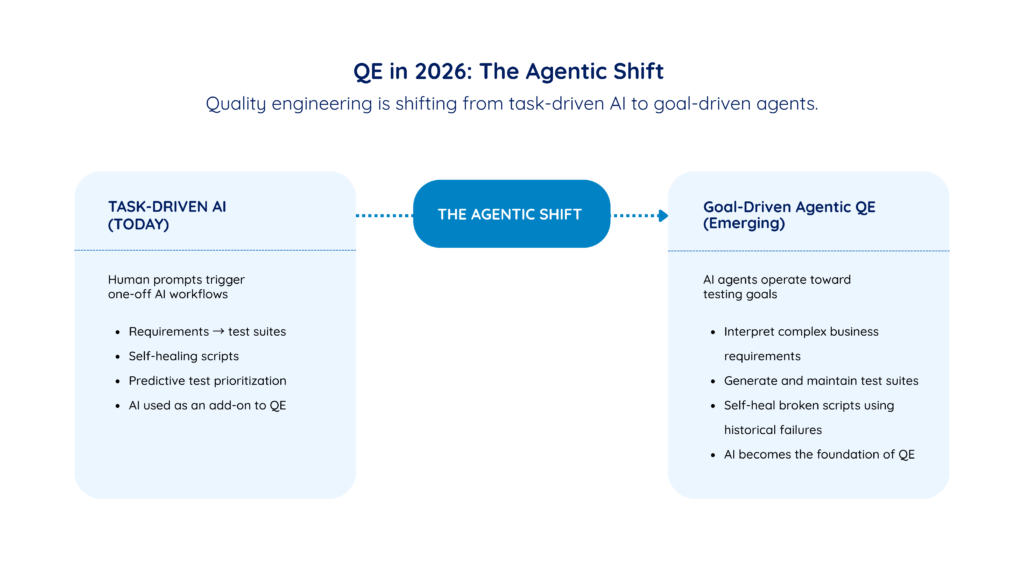
In 2026, that changes. AI is no longer an add-on to existing QE processes; it becomes the foundation of how quality is designed, executed, and improved.
The agentic shift
Enterprises are moving from task-driven AI (a human triggers a one-off AI workflow with a prompt) to goal-driven, agentic AI. Intelligent AI agents can now:
- Interpret complex business requirements.
- Generate and maintain comprehensive test suites.
- Self-heal broken scripts by learning from historical failures.
This shift significantly reduces manual test maintenance effort and accelerates test cycles.
Predictive prioritization
One of the key components that drives this trend is the use of systems to predict high-impact regressions. In simpler words, agentic AI systems are able to prioritize “what gets tested” by thoroughly analyzing historical code changes and defect patterns.
This ensures that resources are allocated to the areas of highest risk, making the entire QE process efficient. For QE engineers, there is a shift in roles from writing scripts to governing, curating, and optimizing these autonomous workflows.
What does this mean for the QE industry?
The trend highlights that the industry is beginning to consider using AI as a “Design architect” for shaping inputs like requirements and test design. AI may soon be able to go beyond the question “how to report” and understand “what to test”.
What should enterprises be doing?
Enterprises stand at the cusp of change now; this is the right time to bridge the pilot-to-production gap by empowering strategy with execution and converting theory into action:
- Shift from “AI for efficiency” to “AI for quality outcomes.” While 52% of organizations value efficiency, only 30% focus on error/defect detection and quality transformation metrics, such as optimized coverage and product quality outcomes
- Treat QE as a strategic function, not an operational overhead. As AI-powered software scales, quality must be designed as a first-class capability, not a late-stage checklist item.
Enterprises that want to benefit from AI-driven QE must treat requirements, test cases, runs and production incidents, as a governed asset. The stronger this foundation, the more effectively AI agents can design tests, self-heal suites and prioritize coverage where it truly reduces risk.
2. Unified Shift-Left + Shift-Right Quality (Continuous Quality)
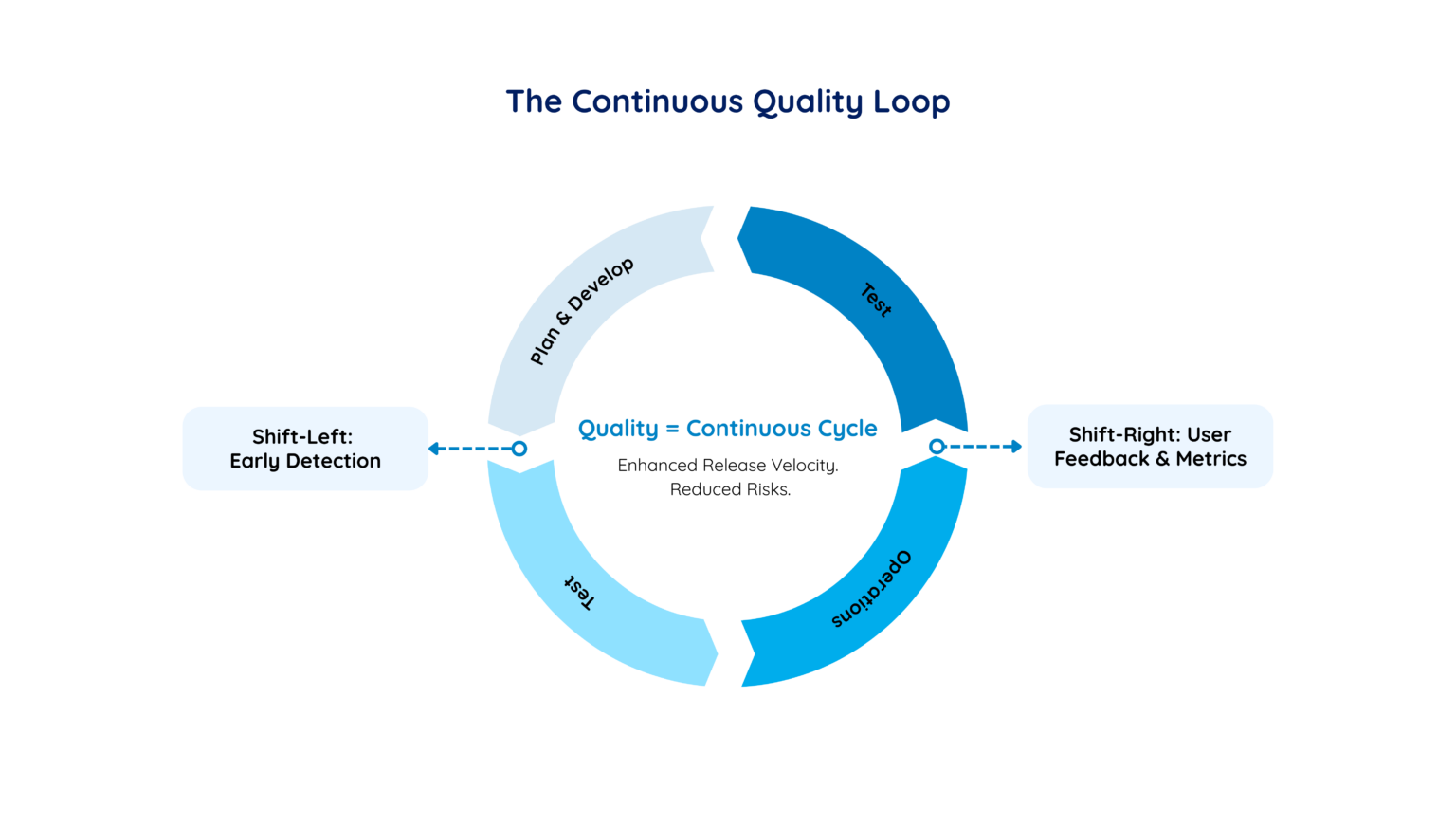
The second major trend consists of rapidly blurring boundaries between development, testing, and operations. “Quality” has become a continuous, cyclical practice instead of being a milestone in the software cycle.
Continuous feedback loops
- Shift-left: The process continues to focus on early detection of defects during the design and development phases
- Shift-right: The process leverages user feedback and metrics to validate performance in production
What does this mean for the QE industry?
Working in tandem, shift-left and shift-right inform the testing strategies of the next release, creating a continuous quality loop. It helps enhance the release velocity and mitigates the risk of production failures.
What should enterprises be doing?
Continuous quality requires QE leaders to operate in a “two-speed” model:
- Build AI-aware quality knowledge: Quality loops are only as strong as the knowledge they draw on. Enterprises should invest in secure knowledge management that allows AI and QE platforms to leverage internal context including, requirements, defect histories, production incidents, and architectural constraints to shape test design and prioritization.
- “Empower” rather than “replace”: The World Quality Report highlights that 52% of the leaders believe QE should leverage GenAI to increase its speed. The real opportunity, however, is to free experienced QE specialists from repetitive checks so they can focus on risk assessment, exploratory testing, and quality strategy, rather than headcount reduction alone.
3. QE for AI: Redefining Quality for AI-Powered Ecosystem
Traditional, determinism-oriented testing methods are proving inadequate to truly gauge the output quality of AI systems. Assessing probabilistic systems calls for a different discipline — QE for AI. Until recently, QE focused on deterministic systems where the inputs were fixed, and outputs were guaranteed. However, AI’s probabilistic nature introduces variability that determinism cannot properly judge.
New trends suggest a redefinition of quality, from verifying binary correctness to making less “predictable” systems more trustworthy.
What does this mean for the QE industry?
This shift emphasizes that testing is no longer the final gatekeeper for AI quality. Instead, QE now functions as a continuous scaffolding integrated into the entirety of AI lifecycle. Success is now measured through probabilistic intervals instead of pass/fail results, and it requires new metrics such as factuality rates, bias indices, and determinism percentages.
What should enterprises be doing?
Strategy fragmentation is an issue of structure, not testing.
- Expand definitions of “quality”: Enterprises need to move beyond model correctness and measure parameters like reproducibility, factuality, bias, drift, and explainability
What does “AI quality” actually mean in measurable terms?
Explore how the Five Dimensions of AI Quality framework helps enterprises evaluate trust, reproducibility, and production reliability across AI systems.
The 5 Dimensions of AI Quality: A Guide to Scaling AI from Pilot to Production →
- Adopt new frameworks: Align validation strategies with specific system behaviors using novel frameworks like the Determinism Spectrum.
AI does not behave like traditional software. So how do you test it?
Understand how the Determinism Spectrum reframes validation for probabilistic systems.
Read: The Determinism Spectrum: Why AI Can’t Be Tested Like Just Another Software →
- Formalize evaluation: Emphasize structured rubrics and human-in-the-loop evaluations rather than subjective judgments
- Continuous assurance: Enterprises need to replace regression cycles with continuous telemetry and drift detection in the production pipelines
Quick Check: How reliable is your AI output?
Take our 10-minute AI Output Quality Assessment and get an instant personalized report showing:
- Your overall AI Quality Score with maturity status
- Dimension-level breakdown across 7 key areas
- Practical, tailored recommendations for each dimension
- A clear roadmap to scale responsibly
4. Quality as a Strategic Driver of Growth
As quality engineering undergoes an organizational transformation, “quality engineering” changes from something enterprises use to find bugs to something that ensures business resilience, protects revenue, and maintains customer trust.
What does this mean for the QE industry?
Traditional QE metrics like test coverage and defect counts are no longer enough. Leaders now look at outcomes such as predictability of releases, production stability, user adoption rates, and the reliability of AI‑driven experiences.
Quality is now embedded within cross-functional squads through service providers that maximize business value using effective AI implementation and platformization.
What should enterprises be doing?
- Align metrics with business goals: Leverage benchmarks such as uptime, revenue protection, and customer experience to measure quality, and establish standardized definitions for each parameter
- Cross-functional collaboration: Prioritize collaboration between analysts, developers, and testers. 61% of organizations say that this is the top enabler of AI quality and speed
- Utilize production insights: Move beyond pre-production testing by applying production data analysis insights to optimize testing and updating regression packs
The whole process of incorporating quality at the heart of AI model testing defines the modern QE for AI.
From defect detection to delivery confidence
See how Zuci helped a healthcare platform scale quality with intelligent testing and release confidence.
Probabilistic AI breaks in ways traditional testing was never built to catch.
Most teams apply deterministic methods to probabilistic models — and miss the failures that matter most. Here are three mistakes to fix before your next production release.
5. Evolving QE Roles & Skills (Skills Evolution)
With the evolution of QE for AI, the role of QA engineer is expanding. As AI takes over repetitive script generation and execution, the traditional “QA Engineer” now changes to “AI Orchestrator” or “Strategic Business Alignment Partner”.
This shift in roles can be attributed to the move from deterministic testing to probabilistic evaluation of AI systems. Since the “why” and “how” of an AI model’s reasoning matter just as much as the output, the required human skillset is also shifting from manual bug detection to AI/ML model evaluation, API observability, and business risk management.
What does this mean for the QE industry?
Referring to the Everest Group PEAK Matrix, the “Major contenders” in the QE system are those trailblazers that successfully and timely upskill their talent in AI/ML, API observability, and business risk management. Currently, only 53% of testers possess AI and ML skills, hinting that the demand for skilled testers is higher than supply.
What should enterprises be doing?
Enterprises should move ahead of the “AI hype” and replace random automation with validated outcomes, a skilled workforce, and a map for future growth and leverage.
- Workforce upskilling: The true mark of success for enterprises is to have a workforce that knows how to work with machines and govern the process. To put that into perspective, 55% of organizations have already upskilled their testers with AI/ML training. Enterprises should consider upskilling programs for the workforce that focus on AI and automations that they are planning to mobilize
- Balanced tooling strategy: Enterprises should aim to intelligently blend open-source and commercial toolsets, prioritizing governance and long-term sustainability over tool hype
The future QE professional is not replaced by AI; they are the human layer that ensures AI-powered systems behave safely, reliably, and in line with business objectives.
Recommendations for the Future
Organizations aiming to “thrive, not just survive” in this emerging QE in AI ecosystem must look beyond tools and think about governance and resilience:
- Prioritize resilience over visibility: Teams must explore chaos engineering and controlled failure experiments to validate system stability under stress, because monitoring alone isn’t adequate anymore. Chaos engineering follows a disciplined, proactive approach to testing software resilience through intentionally introducing faults (such as server failures, network latency, or high traffic) into production or pre-production systems. By compromising testing components in a controlled way, QE specialists can identify vulnerabilities, validate monitoring, and improve system reliability before failures cause real, costly outages
- Centralize data ownership: Federated, ad-hoc data creation is becoming a thing of the past. Enterprises must move towards enterprise-wide TDM to ensure compliance and accuracy with their AI implementations
- Modernize frameworks for speed: AI-driven development is an advanced practice requiring modern frameworks and architecture. Legacy tools can rarely cater to such an environment; it is inevitable to replace legacy systems with modernized technology. The sequence for doing that without losing traceability is covered in our guide to modernizing enterprise test automation.
- Align metrics with business value: Success metrics for AI need to change fromthe number of tasks automated to business adoption, customer satisfaction, and metrics that define tangible gains
Frequently Asked Questions About QE in AI
1. What is the biggest trend in quality engineering in AI?
2. Why is synthetic data important for QE in AI?
3. What are the main challenges for scaling AI for QE?
4. Is AI replacing Quality Engineers?
Next Steps
One of the key trends in quality engineering in AI is the evolution of test data and continuous QA loops. It is important to know how to establish AI quality for its probabilistic nature by shifting from verifying correctness to quantifying confidence.
Read Next: QE for AI: Determinism-Based Quality Assurance for AI Systems
Determining AI quality goes beyond testing: it relies on understanding the principles that govern AI behavior and assess the system holistically. Learn how you can evaluate your AI systems for quality outputs with Zuci’s Five Dimensions of AI quality that empower you to scale your AI from pilot to production.
Read Next: AI Quality Checklist: A Five Dimensions Approach to AI Accuracy
If you are ready to begin with AI, book a consultation with Zuci Systems to harness the true power of AI for your enterprise’s specific needs.
Book a consultation: Zuci Systems helps enterprises realize the full potential of their AI
If your organization is navigating the shift to AI-driven software delivery, Zuci Systems can help.
About Zuci Systems
Zuci Systems is an AI-first digital transformation partner specializing in enterprise-grade AI agent design and multi-agent orchestration. We help Fortune 500 companies in banking, insurance, and healthcare design and deploy AI systems that are predictable, explainable, and production-ready.
Our approach combines structural discipline (7 design principles), intelligence design (PRIMAL Core framework), and enterprise controls (Trust Layer) to create agents that work reliably in regulated, high-stakes environments.
Contact: connect@zucisystems.com | www.zucisystems.com


Share On


The 7 Principles of Enterprise-Grade AI Agent Design
Agentic AI's Impact on Banking: 3 Key Transformations
Author’s Profile

Head, Quality Engineering, Zuci Systems|