Blog
RPA vs APA: How to Choose the Right Automation for Your Enterprise
20 Mar, 2026
- 10 min read
Share On




Key Takeaways
- RPA and APA are not rivals; they are distinct tools designed for different specific tasks
- RPA is ideal for high-volume, deterministic processes characterized by stability, unchanging environments, and rule-based logic. It delivers fast and reliable results
- APA is built for document-heavy, exception-prone, and context-dependent workflows that involve judgment, unstructured inputs, or frequent changes. It is a more durable investment for complex scenarios
- As AI agents become more accessible and enterprise-grade, the balance is slowly shifting toward agentic automation
- The emergence of agentic AI has raised the bar for automation capabilities
- The primary question is not “To adopt agentic AI or not”, but rather identifying which processes to prioritize and how to design for production-ready results from the outset
For many enterprises, RPA started as a clear win. Bots handling reconciliation overnight, structured data moving without manual effort, SLAs getting met consistently. Then, somewhere along the way, the cracks begin to appear. A UI update breaks two bots. A policy change creates a backlog. IT starts spending more time patching scripts than automating new work.
This is not a sign that RPA failed. It is a sign that the processes outgrew what RPA was designed to do. That is the point where Agentic Process Automation becomes relevant, not as a replacement for what is working, but as the answer for everything RPA was not built to handle.
RPA and APA are not rival approaches. They are different tools built to solve different kinds of problems. Where RPA executes deterministic workflows with clearly predefined steps, APA navigates ambiguity and learns from new data. According to the World Quality Report (2025), while 89% of organizations are pushing for the adoption of GenAI, only 15% have been able to achieve enterprise-wide implementation. That gap shows how difficult it is to move from simple task automation to agentic, enterprise grade AI that actually works in production.
We’ve seen this in practice with a leading U.S credit union.
In their first phase, RPA was a clear win. A modular bot framework automated reconciliations, regulatory reporting, and routine fraud checks across Finance and Operations. Manual effort dropped by ~80%, accuracy climbed to 98%, and reconciliation cycles shortened by 2–3 days.
For a well-defined, rules-heavy environment, RPA delivered exactly what it promised: clean, predictable value.
The problems started when the work stopped being so predictable.
| Principle | Description |
|---|---|
| Ownership | One agent per specific responsibility. |
| Actions | Explicit registry of permitted actions, APIs and data. |
| Triggers | Defined conditions for activation. |
| Guardrails | Non-negotiable constraints and business rules. |
| Human Control | Designed protocols for human-in-the-loop escalation. |
| Memory/Interaction | Structured output schemas and data retention policies. |
| Performance | Success metrics and intervention thresholds. |
When RPA is the Right Tool
RPA is still the natural first choice for stable, rule based processes. It is most effective when inputs are structured, rules rarely change, and exceptions are rare, for example, straight-through reconciliations, report generation, and deterministic data movement between systems.
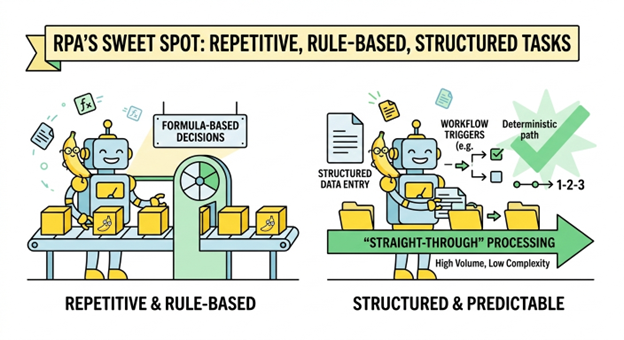
RPA is reliable because the path it follows is predictable. If a process is deterministic, traditional RPA is often sufficient (like testing).
The Hidden Cost: The Maintenance Burden That Doesn’t Show Up in Pilots
RPA works best when processes are clearly defined. Conversely, every process change like a new field, a UI update, or a policy revision, triggers RPA maintenance. Each change must be updated for every bot involved in that process.
At scale, that maintenance effort compounds., IT and operations end up spending more time fixing bots than improving the process itself. For stable, high-volume processes, the math holds. But for any frequent changes, the maintenance burden erodes ROI faster than organizations can anticipate.
Not sure how much of your RPA maintenance burden is process complexity versus poor automation fit?
The AI Agent Design Worksheet helps you map your current workflows against the right automation approach — before you commit to a fix.
Where RPA Breaks Down and APA Steps in
In lending and other document-heavy operations, these limits are not theoretical; they surface every day. A credit union processing thousands of loan applications, income proofs, and disclosures each month quickly runs into friction when most of that information arrives as PDFs, scanned images, or free-form emails. Manual reviewers spend hours reconciling details, exception queues keep growing, and every policy update or new document template amplifies operational strain, even when RPA is already in place.
Traditional automation often struggles when it encounters unstructured inputs, such as emails or PDFs. There is a lack of context-aware reasoning required to handle evolving rules. When automation is required to make a judgment, a standard bot will either fail or trigger an exception. These failures create maintenance bottlenecks for your IT teams. High exception rates often indicate that a process might be too complex for the RPA bot alone.
Why This Matters Now: Enterprises Are Hitting the Wall
APA matters now because your last wave of RPA is hitting its limits. Many organizations that scaled RPA 3–5 years ago now face brittle workflows, rising maintenance costs, and a backlog of automation requests that scripts can’t handle. As processes become more digitized and exception-heavy, RPA alone is no longer enough.
The question now isn’t whether or not to move toward agentic automation, it’s how to do it without abandoning what already works
What Agentic Process Automation Actually Does Differently
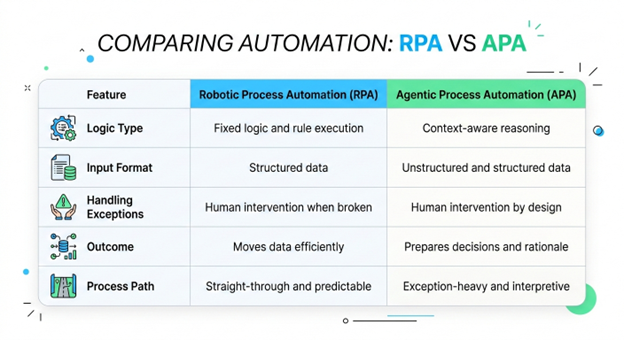
APA isn’t a “smarter RPA”. APA is fundamentally built on reasoning, unlike RPA that is built on scripting. Here is how this difference translates into practice:
RPA works by following a fixed script. At every stage in the process where there is a bot, there is a set of rules the bot has to follow for progression. On the other hand, APA agents assess the situation, select appropriate tools for action, and construct the workflow dynamically with a proper context and a clear goal.
RPA is associated with “Execution”; APA is associated with “Decision-making”. An AI agent processing an insurance claim doesn’t merely route it: it reads the document, evaluates it against policy rules, flags exceptions, and determines the next steps on its own.
The Autonomy Spectrum: From Scripted to Self-Managing
Think of autonomy as a spectrum. At one end, fully scripted RPA handles narrow, deterministic tasks. As you mature, you introduce AI-assisted decisions between data and human judgment, and eventually progress toward agents that can pursue higher-level business goals with minimal supervision.
The Decision Framework: 5 Questions
Before you compare feature checklists, use these five questions to interrogate a specific process. You are not judging RPA or APA in theory. You are checking what this process really needs in production.
01. How often does this process change?
RPA is honest about change. Every new field, screen, or rule needs a bot update. If the process and its UI have been stable for 12 to 18 months, RPA is usually safe. If your policies and screens move every quarter, the maintenance tax will show up fast.
- Mostly stable: lean toward RPA.
- Frequently changing: consider APA or a hybrid.
02. What is the real exception rate?
On slides, most workflows look straight through. In production, edge cases appear from messy PDFs, odd templates, and partial data. RPA pushes these to humans. APA can read them, interpret them, and decide the next step.
- Low exceptions (for example under 10 percent): RPA is fine.
- High or unpredictable exceptions: you are in APA territory.
03. Can you realistically define all the rules?
If you can list clear rules for every path and outcome, a rules engine or RPA bot can execute them. If you need dozens of conditional branches, or you rely on “someone senior will look at it and decide,” you are already depending on judgment, not rules.
- Clear, finite rules: RPA can own it.
- Lots of “it depends” and human review: APA is a better fit.
04. How painful is it when the process needs to adapt?
Look at the last time this workflow had to change. Did it take days or weeks to update scripts, re-test, and redeploy? The longer your adaptation cycle, the more business value you leave on the table during that window. APA can absorb more change without a full rebuild.
- Adaptation is rare and low impact: RPA remains viable.
- Adaptation is frequent and delays are costly: consider APA or agent assisted steps.
05. Does this process need to learn over time?
RPA executes. It does not learn, improve, or self correct. If your team is already reviewing outcomes, tuning thresholds, and updating playbooks, there is an opportunity to encode that learning into the system itself.
- Stable performance is enough: RPA is sufficient.
- You want the workflow to get smarter with experience: APA is the right architecture.
Implementation Reality: What Deployment Actually Looks Like
Deployment looks different for RPA and APA:
RPA usually has a faster start but carries a maintenance tax. Deploying RPA involves mapping a “happy path” for the bots to follow. It requires thorough documentation of every click and keystroke. This makes it faster to deploy for well-defined processes with lower initial investment. However, each bot requires continuous upkeep, and in complex enterprise environments, that maintenance burden compounds.
APA takes longer to design and deploy because you are defining agent goals, context, and guardrails upfront. The upfront investment in architecture, governance, and integration is real. However, once in production, APA adapts rather than breaking, eventually reducing the maintenance cycles that quietly drain RPA programs.
Designing agentic AI systems properly involves following 6 core building blocks: PRIMAL.
- Perceive: Understanding the process
- Reason and Remember: interpreting context with continuity
- Intend: Forming and committing to decisions
- Manifest: Acting within specified guardrails
- Advance: Learning without losing stability
- Liaise: Coordinating across agents and humans
Read PRIMAL Core: A Framework for Building Multi-Agent AI Systems to understand how you can start building your agentic AI.
The design decisions you make before deployment determine whether APA delivers or disappoints. If you’re scoping your first agentic implementation, a 30-minute session with our team can help you sequence it right.
The Hybrid Approach: When to Use Both
In practice, most mature architectures run stable, high-volume sub-processes on RPA and use agentic AI for decision-heavy, document-intensive, exception-prone steps. The crucial design task is to define clear handoff points like what RPA owns, what agents own, and when humans step in.
Migration Strategy: From RPA to Agent-Enhanced Automation
You should start with RPA workflows that encounter the highest amount of friction. For example, workflows that require constant maintenance or human escalation. These workflows are your highest priority candidates for layering in agents or replacing brittle steps with APA.
Migration rarely means ripping out existing RPA. Instead, you layer AI agents onto the specific steps where bots are fragile, high-maintenance, or overly dependent on human escalations.
To achieve a well-orchestrated system of multiple AI agents, it is important to go through the 6 critical building blocks of a multi-agent system. Begin by reading “What is a Multi-Agentic Sytem? A Clear Breakdown of the 6 Core Building Blocks”.
Hybrid architectures only work when the handoff points are well-defined. If you’re deciding what RPA keeps, what agents take over, and where humans stay in the loop — bring your workflow map and let’s pressure-test it together.
Next Steps
Making Your Choice: An Assessment Guide
Before selecting between RPA vs APA, perform a quick assessment of your target process. Rate the process across five decision dimensions: stability, exception rate, rule definability, adaptation cost, and learning requirement. Then gauge whether the score favors straight-through automation (RPA), or decision-making (APA), or a little bit of both (hybrid).
Run this quick assessment using our RPA vs APA checklist and get a clear recommendation in under 15 minutes.
If your assessment points towards agentic AI automation (or even a hybrid approach), the architecture decisions you make upfront determine whether you get another failed pilot or a production-ready system.
Still uncertain what your assessment really means in practice?
Book a 30-minute call with our automation team. We’ll help you translate your workflows into the right approach — RPA, agentic, or hybrid — based on what will actually move the needle for your business.
About the author
Srinivasan Sundharam
Head, Gen Al Center of Excellence, Zuci Systems
Srinivasan heads Zuci’s Generative AI Center of Excellence, leading initiatives that unite AI, engineering, and enterprise transformation.
With over 20 years of experience in technology strategy and digital platforms, he helps organizations design scalable AI systems that balance creativity and control.
About Zuci Systems
Zuci Systems is an AI-first digital transformation partner specializing in quality engineering for AI systems. Named a Major Contender by Everest Group in the PEAK Matrix Assessment for Enterprise QE Services 2025 and Specialist QE Services, we’ve validated AI implementations for Fortune 500 financial institutions and healthcare providers.
Our QE practice establishes reproducibility, factuality, and bias detection frameworks that enable enterprise-scale AI deployment in regulated industries.
Explore more at Zuci Systems
Frequently Asked Question
1. What’s the difference between RPA and APA?
2. When should I use RPA instead of APA?
3. When is APA a better fit than RPA?
4. Do I need to replace my existing RPA with APA?
5. How do I decide where to start with APA?
Keep reading
Our whitepaper breaks down why scaling AI often means rising cost and shrinking control – and what execution architecture actually looks like when you fix that.
Get the whitepaper →
Author's Profile

Head, Gen Al Center of Excellence, Zuci Systems

Srinivasan heads Zuci’s Generative AI Center of Excellence, leading initiatives that unite AI, engineering, and enterprise transformation.
With over 20 years of experience in technology strategy and digital platforms, he helps organizations design scalable AI systems that balance creativity and control.
Share On


Agentic AI's Impact on Banking: 3 Key Transformations
Legacy Modernization in the AI Era - What IBM's $30B Week Taught Me
Author’s Profile

Head, Gen Al Center of Excellence, Zuci Systems|