Blog
The Evolution of the SDLC: From AI-Assisted Coding to AI-Native Engineering
17 Nov, 2026
- 9 min read
Share On



At 9:00 a.m. on a Tuesday, a developer prompts an AI assistant to build a new feature, and by 9:40 a.m., the code is done. By Friday, though, the feature that took just 40 minutes to write still hasn’t shipped. It’s waiting for an architect to confirm what it touches, for a reviewer to check it against rules nobody wrote down, and for testing, which only starts after review.
That’s why the question engineering leaders ask us most is some version of this: “We already have AI coding tools. Why isn’t that enough?”
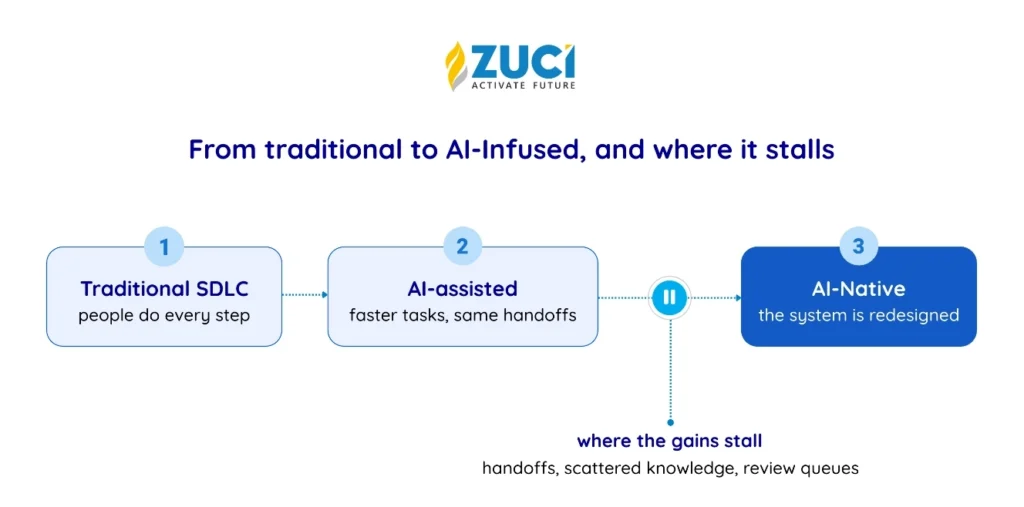
It’s a fair question. AI has made the first draft of code almost instant, but software isn’t delivered by writing code alone. In a software development lifecycle (SDLC) built around human handoffs, even as coding gets faster, requirements, reviews, and testing still move at human speed.
So the advantage isn’t simply in having the best model. It’s in redesigning the engineering operating model around what humans and AI can each do well. In AI-native engineering, AI can contribute to analysis, creation, execution, and validation at machine speed, while people remain accountable for intent, consequential judgment, and outcomes. The challenge is to connect those contributions into a reliable engineering system.
| Three things to take from this The problem: AI coding tools accelerate part of execution, while intent and alignment, context reconstruction, and assurance still constrain end-to-end delivery. The shift: An AI-native SDLC redesigns the workflow itself, not just the tools inside it. The proof: On a lending platform we built for a large US lender, Zuci Systems’ AI-Native Engineering delivered a 70%+ reduction in overall requirements-to-implementation effort. |
The four frictions of human-centric software delivery
In 20-plus years, I’ve watched Agile shorten cycles, DevOps close the gap with operations, and cloud change how we consume infrastructure. None of it changed the premise underneath: only humans could understand intent, build the solution, and check it.
So the SDLC became a relay race.
Analysts pass requirements to architects, architects pass designs to developers, and developers pass code to reviewers and testers. At every handoff, someone re-explains what the business wants, rebuilds the context, and checks the work again. That coordination is where much of the cost hides, and it shows up as four frictions:
| Friction | What it looks like |
|---|---|
| Intent and alignment | Business intent is reinterpreted, and diluted, at every handoff |
| Context reconstruction | Knowledge is scattered, so each contributor rebuilds it first |
| Assurance | Reviews, tests, and approvals re-verify the same understanding, mostly at the end |
| Execution | Every artifact takes human effort, so more delivery means more people |
In enterprise programs, they tend to show up the same way: knowledge spread across a few subject matter experts and years of old code, and a handful of architects every critical decision waits on.
Here’s the catch: AI coding tools primarily ease part of execution friction, not all four forms of friction. On focused, well-bounded work, the gains are real. But once work spans teams and systems, intent and alignment, context reconstruction, and assurance can still slow the overall flow. Faster coding doesn’t necessarily mean faster delivery. Coding was never the only bottleneck.
We’re not the only ones seeing this. McKinsey notes that AI-assisted coding “has often delivered productivity improvements of 20 to 50 percent across development tasks.” Its verdict: “Transitioning to AI-native development requires far more than adopting AI-coding tools.”
At the Chief AI Officer Exchange in Chicago in May 2026, we analyzed 138 challenge statements from 46 enterprise AI leaders, from banking and insurance to healthcare. Two concerns kept coming up: how to scale AI beyond isolated wins, and how to keep it governed as it spreads. One leader described the software version of that problem exactly: AI-generated code that doesn’t consistently meet internal engineering standards, so engineers keep correcting it.
Won’t better models fix this?
It’s the obvious objection. Better models can reduce some errors, but model improvements alone don’t decide what work should be done, what context is trustworthy, which dependencies matter, or when human judgment is required. AI outputs can be plausible without being correct, and probabilistic behavior calls for additional evaluation and controls alongside conventional software testing. As Vasudevan Swaminathan, CEO of Zuci Systems, puts it: “AI tools are becoming commodities. Engineering systems are not.”
How we moved from AI-assisted development toward AI-native engineering
When we started applying AI to complex engineering work, our first move was better inputs for each activity: bounded work, explicit intent and constraints, and the knowledge each task needed. It worked. It also raised a bigger question: if we were changing engineering work for AI anyway, why stop at optimizing individual activities?
That question marks the shift from AI-assisted development toward AI-native engineering. AI-assisted development typically inserts AI into workflows originally organized around people. AI-native engineering asks how the workflow itself should change when humans and AI can perform engineering work together. It seeks to remove unnecessary sequential handoffs and context reconstruction, introduce concurrency where dependencies allow, and preserve the controls required by engineering logic, risk, and assurance. The design question changes from “Where can we insert AI?” to “Which parts of the workflow should we redesign?”
Agents are part of this shift, which is why you’ll also hear it called an agentic SDLC, but agent participation alone doesn’t redesign an engineering system. AI-native engineering brings together the knowledge, context, governed execution, continuous validation, and system-level control needed to make the redesigned workflow dependable.
Five foundational capabilities support this operating model:
- Knowledge Foundation: connected business, product, system, and engineering understanding, including decisions and validation evidence, retained and kept current
- Context Engineering: the minimum sufficient, relevant, and trustworthy context for each task
- Governed Execution: bounded human-AI work, appropriate autonomy, permissions, escalation, and evidence
- Continuous Validation: independent, risk-appropriate checks close to where uncertainty enters, including concurrent implementation and validation
- Engineering Control Plane: observe, govern, control, and optimize engineering workflows, quality, AI behavior, risk, human-AI effectiveness, and cost
Traditional delivery often organizes work around specialist handoffs. AI-assisted development can accelerate individual steps without changing that flow. AI-native engineering creates room for a different design: shared intent and specifications can support implementation and independently derived validation in parallel; bounded tasks receive the context they need; and human judgment is introduced where risk, ambiguity, and consequence warrant it. The objective isn’t to parallelize everything. It is to remove dependencies caused mainly by scarce human capacity while preserving dependencies required for sound engineering.
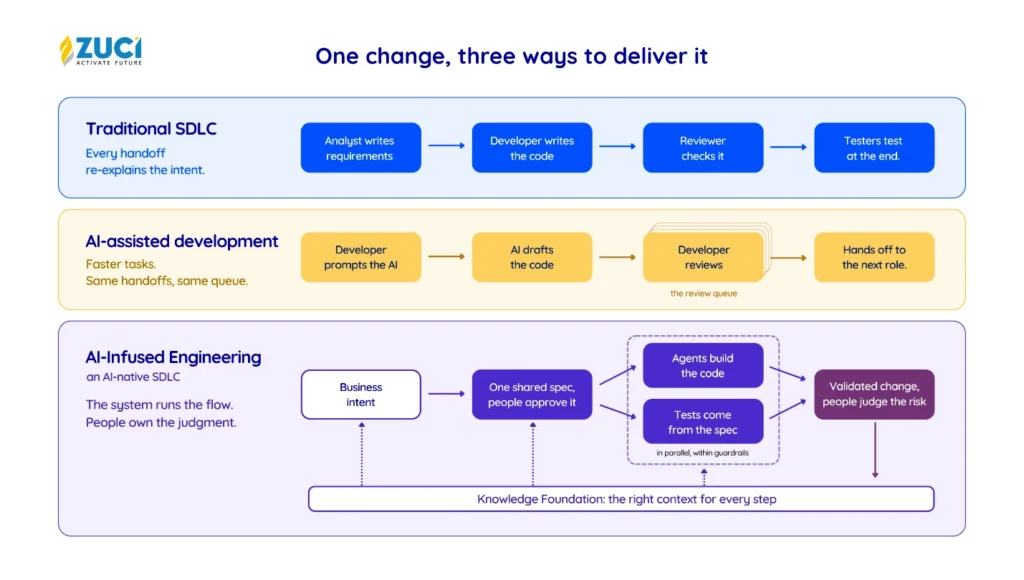
One principle we hold firm on is independence of assurance. When implementation and tests are derived from the same mistaken assumption, they can agree while the software remains wrong. Independence does not require a blanket rule that one AI system can never produce both code and tests. It requires validation grounded independently in expected behavior, specifications, acceptance criteria, and constraints, with separation of context, execution, or review appropriate to the risk. As AI takes on more work, credible assurance matters more, not less.
What changes at each stage of AI-Native Engineering
| Stage | AI-Native Engineering | What engineers do | Outcome |
|---|---|---|---|
| Plan | Intent is captured once, in a shared specification with acceptance criteria. Critical gaps are closed before work starts. | Understand the business intent | Reduces rework from misread requirements |
| Design | AI maps what a change touches across systems, data, and tests, then splits the work into Modular Business Units (MBUs). | Design the change and its trade-offs | Reduces dependence on a few senior experts |
| Build | Humans and AI agents execute bounded MBUs concurrently where dependencies permit, with engineered context and risk-based guardrails. | Direct the work and handle exceptions | Shortens lead time for changes |
| Test | Tests and expected behaviors are independently derived from intent and specifications, and can run as implementation becomes executable. | Validate the result against the intent | Lowers the change failure rate |
| Release | People approve the changes that carry real risk, and every change ships with its evidence. | Govern the risk and approve what matters | Increases release frequency |
| Maintain | Decisions, dependencies, defects, fixes, and validation evidence are retained as reusable engineering knowledge to inform the next change. | Improve the system | Reduces repeated discovery and improves future change effectiveness |
AI may generate the implementation, but engineers still own the intent, the trade-offs, and the outcome. Judgment becomes more valuable, not less.
AI-native engineering aims to improve the delivery outcomes leaders already watch: lead time, release frequency, change failure, and recovery. These are system-level measures, not guaranteed results of adopting AI. In the lending example below, the reported improvement concerns overall requirements-to-implementation effort, with additional observations about delivery throughput and the distribution of review effort.
Add AI coding tools to a traditional SDLC without governance, though, and those same numbers can move the wrong way. AI works so fast that one mistake can spread through a lot of code before anyone reviews it. Catch it only at the end, and you get more failed changes and slower fixes. That’s why AI-native engineering checks standards, security, and quality at every step, not just before release.
Implementing AI-Native Engineering for a large US lender
For a large US lender, we built a new lending platform from the ground up. That created an opportunity to design engineering workflows around AI from the outset rather than simply add coding assistants to an existing sequence. Using Zuci Systems’ AI-Native Engineering approach and IgniteZ platform, the program reported a 70%+ reduction in overall requirements-to-implementation effort against its measured baseline. This is an end-to-end engineering effort measure, not a claim that code generation alone became 70% faster.
Within a week, the team delivered three features, approximately nine stories across a React front end and Node.js back end. For the stories measured, effort was approximately half the team’s estimate for an AI-coding-assistant-only approach. In the observed effort breakdown, specification and code generation accounted for about 12%, while review accounted for about 88%. These figures describe the measured scope and should not be interpreted as universal benchmarks.
“The code was the quick part,” says Ajitha Prakash, Delivery Manager, Digital Engineering, who managed delivery on the program. “Most of our hours went into checking the work against what the business needed, and that’s where our engineers added the most value.”
The effort breakdown illustrates a larger point: as creation accelerates, checking that work against intent, constraints, and expected behavior becomes increasingly important. Independent, continuous validation offers a path to reducing that assurance burden without sacrificing confidence. The longer-term opportunity is cumulative intelligence: decisions, discovered dependencies, validation evidence, defects, and corrections can become reusable knowledge, so subsequent work starts better informed rather than reconstructing the same understanding.
Where should engineering leaders start now?
If you’re deciding where to begin, resist the urge to buy another tool or wait for a better model. For small, isolated applications, AI coding tools alone may be enough. Where work spans systems and teams, find where work waits longest. Redesign unnecessary handoffs, break work into bounded business-aligned units, connect the knowledge it depends on, and bring independent validation into execution before widening AI autonomy. Retain dependencies that protect correctness, security, and accountability.
Then measure the system, not the activity, because speed alone isn’t value. Track how quickly business intent becomes a validated change, with what human effort and AI cost. Capture the decisions, failures, and evidence that can improve the next change. At scale, an Engineering Control Plane makes this observable and governable: it monitors execution, quality, AI behavior, policy adherence, human intervention, and economics, and uses that evidence to improve context, workflows, controls, and validation over time. This is how engineering can become a continuously learning system rather than a series of faster but disconnected tasks.
And if you think the next model release will close the gap on its own, I’d like to hear that case. Let’s compare notes. The full model, including how we govern it, is in our whitepaper on AI-Native Engineering.
The future of software engineering is not about replacing humans with AI. It is about redesigning engineering for a world in which intelligence is no longer exclusively human.
Does AI-Native Engineering replace tools like Claude Code, Cursor, or GitHub Copilot?
No. AI-native engineering can work alongside coding assistants and agents. In Zuci Systems’ implementation, IgniteZ orchestrates supported tools and models, supplying bounded work and relevant context, governing execution, collecting validation evidence, and involving people where judgment is required. Existing engineering systems of record remain authoritative.
Is an AI-native SDLC the same as vibe coding?
Isn’t an AI-native SDLC just waterfall with more documents?
Will AI replace software engineers?
Author's Profile

Head, Gen AI Center of Excellence, Zuci Systems

Srinivasan heads Zuci’s Generative AI Center of Excellence, leading initiatives that unite AI, engineering, and enterprise transformation.
With over 20 years of experience in technology strategy and digital platforms, he helps organizations design scalable AI systems that balance creativity and control.
Share On


Why your AI bill keeps growing while token prices fall: A CIO’s guide
Author’s Profile

Head, Gen AI Center of Excellence, Zuci Systems|