Blog
Determinism by Design: Closing AI’s Trust Gap
22 Jun, 2026
- 8 min read
Share On




Key Takeaways
- 42% of enterprise AI projects failed in 2025, and nearly two-thirds never move beyond pilot. The barrier is rarely AI capability; more often, it’s enterprise confidence.
- The blocker isn’t model performance, it’s trust. Probabilistic AI doesn’t naturally fit into deterministic, accountability-driven enterprise environments.
- Hallucinations may become less frequent as AI models improve, but enterprises cannot depend on model advances alone. Trust must be built into the systems that validate, govern, and control how AI outputs are used.
- Determinism by Design is Zuci’s design principle for surrounding probabilistic AI with deterministic controls. AI outputs become inputs to a governed process where validation, business rules, and escalation occur before execution.
- The approach delivers measurable business value. In one engagement, governed AI contributed to 98% accuracy in price quotations, 30% improvement in conversions and a 50% reduction in human review.
The Next Challenge in Enterprise AI
Over the past two years, the focus has been on capability. The next challenge is confidence. This article opens our Determinism by Design series, which examines how enterprises can introduce predictability, governance, and trust into AI-driven systems.
Organizations have run AI pilots, explored high-value use cases, and demonstrated measurable gains in productivity, automation, and decision-making. On paper, the results look promising.
Yet many of these same organizations struggle when it’s time to scale.
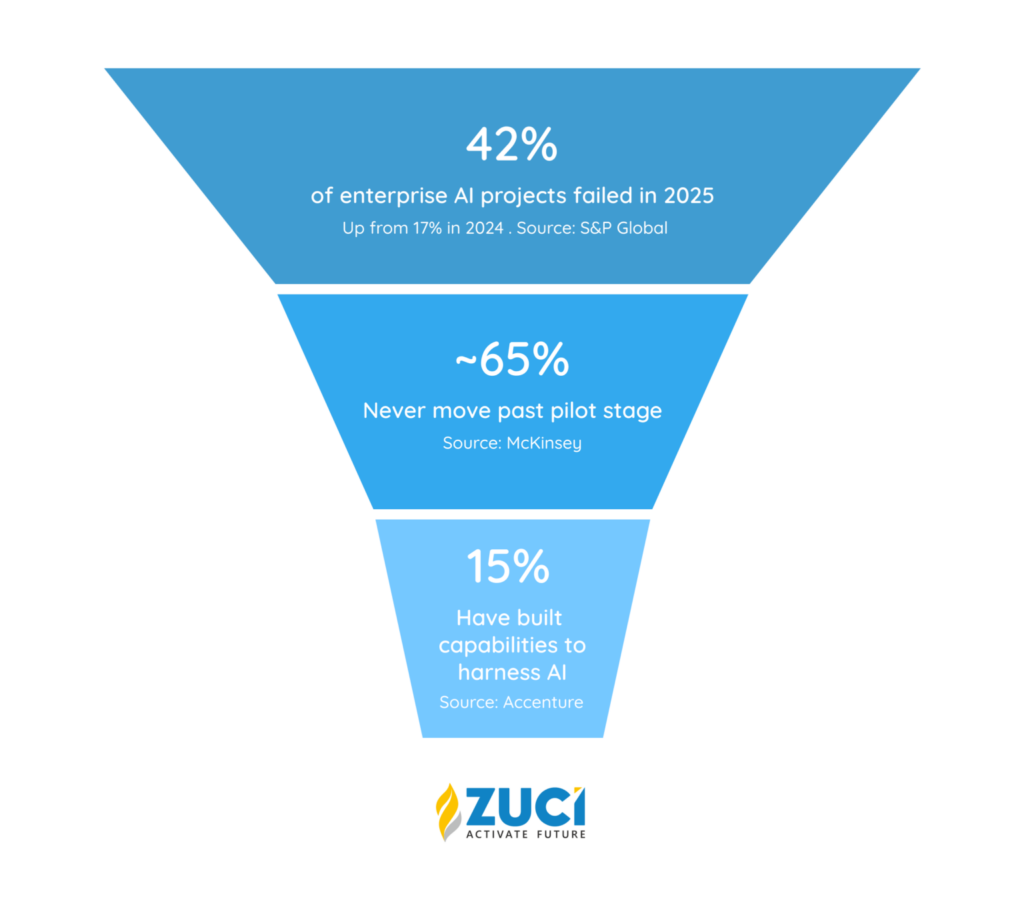
The numbers bear this out. 42% of enterprise AI projects failed in 2025, up from 17% the year before, according to S&P Global. McKinsey reports that nearly two-thirds never move past pilot, and Accenture puts the share of companies that have built the capabilities to harness AI at just 15%.
So why do so many AI initiatives slow down once they leave the pilot environment? This is usually because once AI moves from experimentation to production, the conversation changes. The question is no longer “Can AI do this?” It’s more about “Can we trust the AI system enough to let it influence real decisions?” For many organizations, that is where the uncertainty begins.
Why Enterprises Hesitate to Rely on AI Systems
Most enterprise systems are built around predictability. Processes follow defined rules. Decisions are expected to be consistent. Outcomes need to be explainable. If something goes wrong, organizations need to understand why and be able to trace the decision back to its source.
AI doesn’t naturally operate this way. Modern AI systems generate outputs based on probability. They are designed to reason, infer, and make connections. That flexibility is what makes them useful, but it also introduces variability.
In a customer support scenario, that variability may be acceptable. But in a claims process, compliance workflow or financial decision, it becomes much harder to tolerate.
This creates a challenge that many organizations underestimate. They are introducing systems designed to reason probabilistically into environments designed to operate deterministically. The resulting tension isn’t just technical, but operational. Enterprise processes depend on consistency, accountability, and control, while AI systems optimize for inference, flexibility, and probability. That mismatch creates the trust gap.
This trust gap isn’t theoretical. It is already affecting enterprise AI adoption. Independent research consistently shows that organizations struggle not because AI lacks capability, but because they lack confidence in deploying it at scale.
| What the data shows | Figure | Source |
| Organizations that have experienced at least one negative consequence from AI use | 51% | McKinsey |
| AI search tools’ incorrect citation rate across 1,600 tested queries | 60%+ | Columbia Journalism Review |
| Organizations Gartner expects will fail to realize AI’s value by 2027 due to weak governance | 60% | Gartner |
Taken together, these findings point to the same conclusion: improving AI models alone will not solve the enterprise adoption challenge.
Is your AI impressive in controlled conditions but unproven where it counts?
Bridge the gap between model performance and operational trust with validation that verifies outputs before they influence decisions.
The Missing Piece Isn’t the Model, but the System Itself
When organizations encounter this challenge, their first instinct is usually to focus on the model itself. They refine prompts, experiment with different models, fine-tune performance, and introduce checks to improve the quality of outputs.
While these efforts can deliver better results, they don’t address the underlying issue. The challenge isn’t simply what the model produces, but what happens once that output enters a real business process.
Even as AI models continue to improve, enterprises cannot assume that incorrect or uncertain outputs will disappear. Real-world environments are inherently dynamic: prompts vary, enterprise data evolves, users behave unpredictably, and business contexts continuously change.
OpenAI’s own 2025 research, Why Language Models Hallucinate, reinforces this reality by showing that hallucinations arise from the way today’s models are trained and evaluated. While this behaviour can be reduced over time, it cannot be assumed away in enterprise deployments today. The question, therefore, is not whether an AI system will occasionally produce an imperfect output.
The real questions are: Can the organization validate the output before acting on it? Can it ensure business rules and compliance requirements have been met? Can it identify potential risks before a decision is executed? And if an auditor, regulator or customer asks questions later, can it explain how that decision was reached?
These are not model questions. They are system questions. Answering those questions requires a different way of thinking about AI.
Shifting the Point of View to System-Centric Thinking
Instead of treating AI as the decision-maker, treat it as one component within a larger system.The AI layer provides reasoning, recommendations, and insights. The surrounding system provides control.
It validates outputs, applies business rules, manages risk, enforces compliance requirements and determines when human intervention is needed. This approach changes the role of AI.
Rather than acting directly, AI operates within a framework designed to ensure that only validated and acceptable outcomes move forward. The focus shifts from making AI perfect to making AI governable. This is the thinking behind Determinism by Design.
Determinism by Design
Determinism by Design starts with a simple premise: AI will always contain an element of uncertainty. Rather than trying to eliminate that uncertainty, organizations should design systems that anticipate, validate, and manage it.
Under this approach, AI-generated outputs are treated as inputs into a governed process rather than final decisions.
- AI outputs are validated before they influence business decisions.
- Business rules and organizational policies are enforced before execution.
- Human oversight is introduced whenever confidence falls below acceptable thresholds.
- Every decision remains traceable, explainable, and auditable.
In other words, determinism is introduced through the system, not the model.
This shifts the engineering objective. Instead of asking how to make AI perfectly reliable, organizations ask how to build systems that remain reliable even when AI is occasionally uncertain. Trust is no longer a property of the model alone—it becomes a property of the entire system.
Trust emerges from the interaction between AI reasoning and the systems that validate, constrain, and govern how that reasoning is applied. Determinism by Design is about engineering that interaction deliberately.
Can you trace, explain, and repeat every decision your AI makes today?
If not, the controls have to live in the system around the model. We can look at where they’re missing in yours.
What Shifts When Trust Is Built In
Once this governance layer is in place, enterprise AI becomes easier to scale. Decisions become more predictable because outputs are validated before they influence business processes.
Risk is reduced because controls exist before execution rather than after the fact.
Compliance becomes easier because organizations can explain how decisions were made and demonstrate that required safeguards were followed.
The result isn’t just better governance. It is greater operational confidence. Teams can adopt AI across more workflows because they trust that every recommendation passes through consistent validation before it becomes action.
We’ve seen this approach work in practice. In one engagement, a professional services organization used GenAI to process incoming client requests received through emails and supporting documents. The AI system extracted requirements, identified missing information, estimated price using similar historical engagements, and generated a draft quote.
Because every recommendation passed through structured validation—including confidence thresholds, business rules, historical cross-checks, and human review where required—the organization was able to accelerate proposal preparation while maintaining consistency and control over quotations.
That shift delivered 98% accurate price estimations, a 30% improvement in bid conversion and over a 50% reduction in human reviews, all of these achieved because AI insights passed through structured validation rather than going straight into execution.
The Takeaway – What This Means for Enterprises
As AI becomes more capable, the question for enterprises is no longer whether the technology works. The question is whether it can be trusted in environments where decisions matter.
The enterprises that succeed will not necessarily be the ones with the smartest AI.
They’ll be the ones that build the systems, controls and governance needed to use AI confidently at scale.
Because the biggest challenge in enterprise AI is no longer capability. It’s confidence.
About this series
This article is the first in Zuci’s Determinism by Design series, which explores how enterprises can close the gap between probabilistic AI and the deterministic demands of enterprise systems.
The next article, Determinism by Design in Practice: What Governed AI Looks Like Across the Enterprise, explores how these principles are applied across 3 use cases: financial decisioning, engineering workflows, and customer-facing processes.
Earlier in your AI journey?
Explore our five-part series on moving from AI strategy to production scale. The series follows five decisions that need to be made in sequence: identifying the right problem to solve, filtering ideas to what is actually feasible, prioritizing what to fund first, building the first working system, and scaling it with governance that can sustain enterprise-wide adoption.
About Zuci Systems
Zuci Systems is an AI-first digital transformation partner specializing in quality engineering for AI systems. Named a Major Contender by Everest Group in the PEAK Matrix Assessment for Enterprise QE Services 2025 and Specialist QE Services, we’ve validated AI implementations for Fortune 500 financial institutions and healthcare providers.
Our QE practice establishes reproducibility, factuality, and bias detection frameworks that enable enterprise-scale AI deployment in regulated industries.
Explore more at Zuci Systems
Frequently Asked Questions
1. Why do enterprise AI rollouts stall after a successful pilot?
Pilots run in controlled conditions where governance requirements are minimal. Production environments demand traceability, repeatability, and auditability. These are properties AI does not provide by default. The gap between what the model produces and what the enterprise needs to act on it safely is structural, and it shows up at scale.
2. What is the difference between AI compliance and AI governance?
3. Why doesn’t improving the AI model solve the problem?
4. Is Determinism by Design relevant outside regulated industries?
5. Where does this sit relative to what we have already built?
Keep reading
Our whitepaper breaks down why scaling AI often means rising cost and shrinking control – and what execution architecture actually looks like when you fix that.
Get the whitepaper →
Author's Profile

Head, Gen Al Center of Excellence, Zuci Systems

Srinivasan heads Zuci’s Generative AI Center of Excellence, leading initiatives that unite AI, engineering, and enterprise transformation.
With over 20 years of experience in technology strategy and digital platforms, he helps organizations design scalable AI systems that balance creativity and control.
Share On


Determinism by Design in Practice: What Governed AI Looks Like Across the Enterprise
The Window for Legacy Modernization Is Open. Here's How to Move
Author’s Profile

Head, Gen Al Center of Excellence, Zuci Systems|