Blog
Why Enterprise AI Needs a Context Graph: The Missing Knowledge Substrate
22 May, 2026
- 9 min read
Share On




Six months into a deployment, an agent that had cleared every test in development started behaving inconsistently in production. The same inputs, on different days, were producing answers a senior practitioner would never have signed off on. The team followed the standard protocols, like rewriting the prompts, tightening the guardrails, and swapping the models. But none of them helped, because the gap was upstream of all of them.
How reliable is your AI system?
Get your personalized AI Quality Report in 10 minutes. See your scores across 7 dimensions, identify your biggest risks, and get a tailored roadmap—all emailed instantly.
What we keep finding in cases like this is that experienced operators bring a kind of institutional memory to every decision they make, and almost none of that memory has ever been captured in a system the agent can reach. A recent piece in the California Management Review puts it cleanly: the real differentiator in the age of agentic AI is not the data or even the models, but the tacit knowledge embedded in the judgment of experienced employees. That is the gap a pilot exposes when it moves from controlled testing to live workflow. The agent is reasoning without access to the context that makes enterprise decisions defensible.
This is the knowledge substrate problem. The architectural answer to it is the context graph, and most stalled AI pilots are missing it. MIT’s NANDA initiative recently put the enterprise generative AI pilot failure rate at 95%, with $30 to $40 billion already spent against very little measurable return. Most of the boardroom explanations for that number focus on model limitations or insufficient guardrails. We think the actual cause sits one architectural layer underneath.
Not sure where your AI program should actually begin?
Most pilot failures trace back to decisions made before the first line of code. Start with a clear strategic foundation.
Read: Enterprise AI Strategy — Where Should You Start Your AI Journey?
The argument is straightforward. Build the context graph as architecture now, and AI can scale through your enterprise the way every other production system does. Treat it as something to bolt on later, and your pilots will keep stalling at the same handoff, which is roughly what 95% of pilots are already doing.
The Substrate Most Enterprise AI Programs Have Not Built
The substrate is institutional memory. When a senior underwriter at a commercial bank reviews an unusual loan file, they are not running policy logic alone. They are reading the file against exceptions their credit committee approved last quarter, the regulator’s flag from the most recent audit, and the unwritten judgment their team has built over years of edge cases.
None of that lives in a system. It lives in their head, and in the heads of the three people they would informally consult before signing off on something complicated.
Enterprise architecture has never tried to capture this layer. Every system that mattered, the ERP, the data warehouse, the document repository, was being read by people who already had the institutional context. The system held the record. The underwriter brought the meaning.
Agents change one thing about that arrangement. They can read the record, but they bring nothing to it. The same loan file that an experienced underwriter resolves in two minutes becomes, for the agent, a set of fields without context. Every consequential ambiguity in that file, the kind a human resolves through accumulated judgment, is the kind an agent gets wrong in production.
This is why oftentimes the standard post-mortem on a stalled AI pilot misses the cause. More documents in the vector index, a tighter prompt, a different model: none of that addresses the actual problem because all of it is downstream of the missing input. The fix has to be upstream, in the substrate the agent is reasoning over.
Is your AI pilot missing the intelligence layer it needs to reach production?
Context loss, decision contradiction, cascading errors – if your agents are already exhibiting any of these, it’s worth a conversation.
Book a 30-minute call with our AI team. We’ll understand your multi-agent use case and explore whether PRIMAL holds the answer.
What a Context Graph Actually Is
A context graph is a structured representation of how an organization actually makes decisions. It holds the entities you deal with, the policies that apply to them, the exceptions granted against those policies, the people who granted them, and the outcomes that followed. It sits as a queryable layer that agents read at reasoning time, governed by humans before any agent ever touches it.
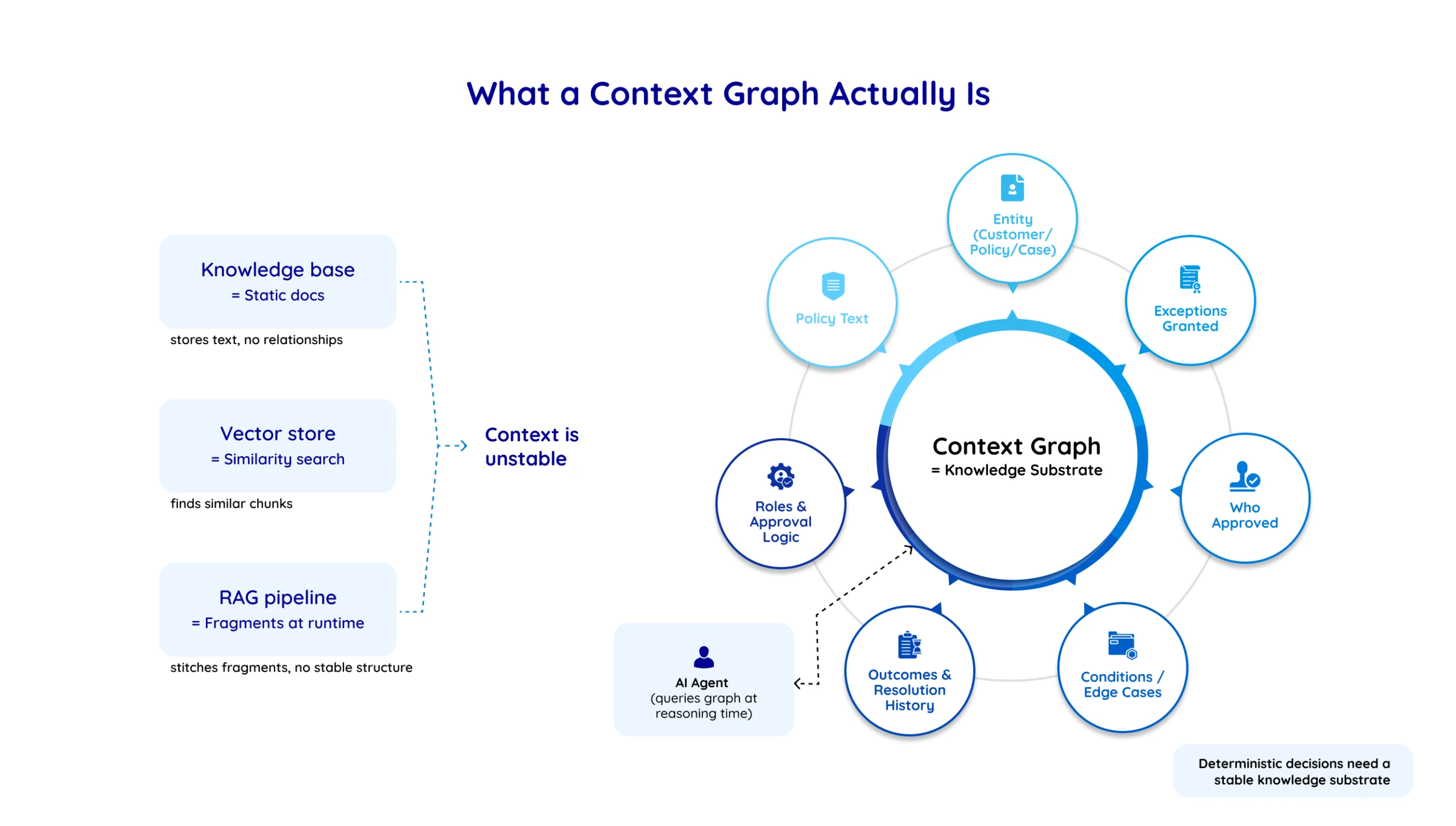
The most common confusion is with RAG. RAG fetches relevant passages at query time and stitches them into a prompt. If the retrieval shifts, the answer shifts, and there is nothing in the architecture binding any two queries to the same logic. A context graph is the layer that holds when retrieval doesn’t.
What gets structured in the graph is not just entities and policies but the relationships between them. A specific policy connects to the seven exceptions granted against it last year, the senior leader who approved each one, the conditions that justified each exception, and what eventually happened to those accounts. That is the connective tissue an experienced operator carries in their head, and what every agent so far has been missing.
A cosmetics company described in the California Management Review built one for regulatory compliance and went from a few hundred evaluations a month to over 40,000, with full accuracy on the validated rules. We see the same pattern in our financial services and insurance work. The AI systems that survive the move into production are the ones whose context graph encodes the resolution history and exception precedent underneath the policy text. Without that layer, the agent is reading the policy the way a brand-new hire would: technically correct, operationally lost.
Is your AI agent ready for production — or just ready for the next demo?
The gap between a controlled pilot and a live deployment is almost always architectural. Here’s what production-ready actually looks like.
Read: From Pilot to Enterprise Scale: Making AI Systems Production-Ready →
How This Connects to Determinism by Design
Deterministic enterprise decisions need deterministic inputs. Without that, every governance and audit control sitting downstream is operating on something it cannot reconstruct.
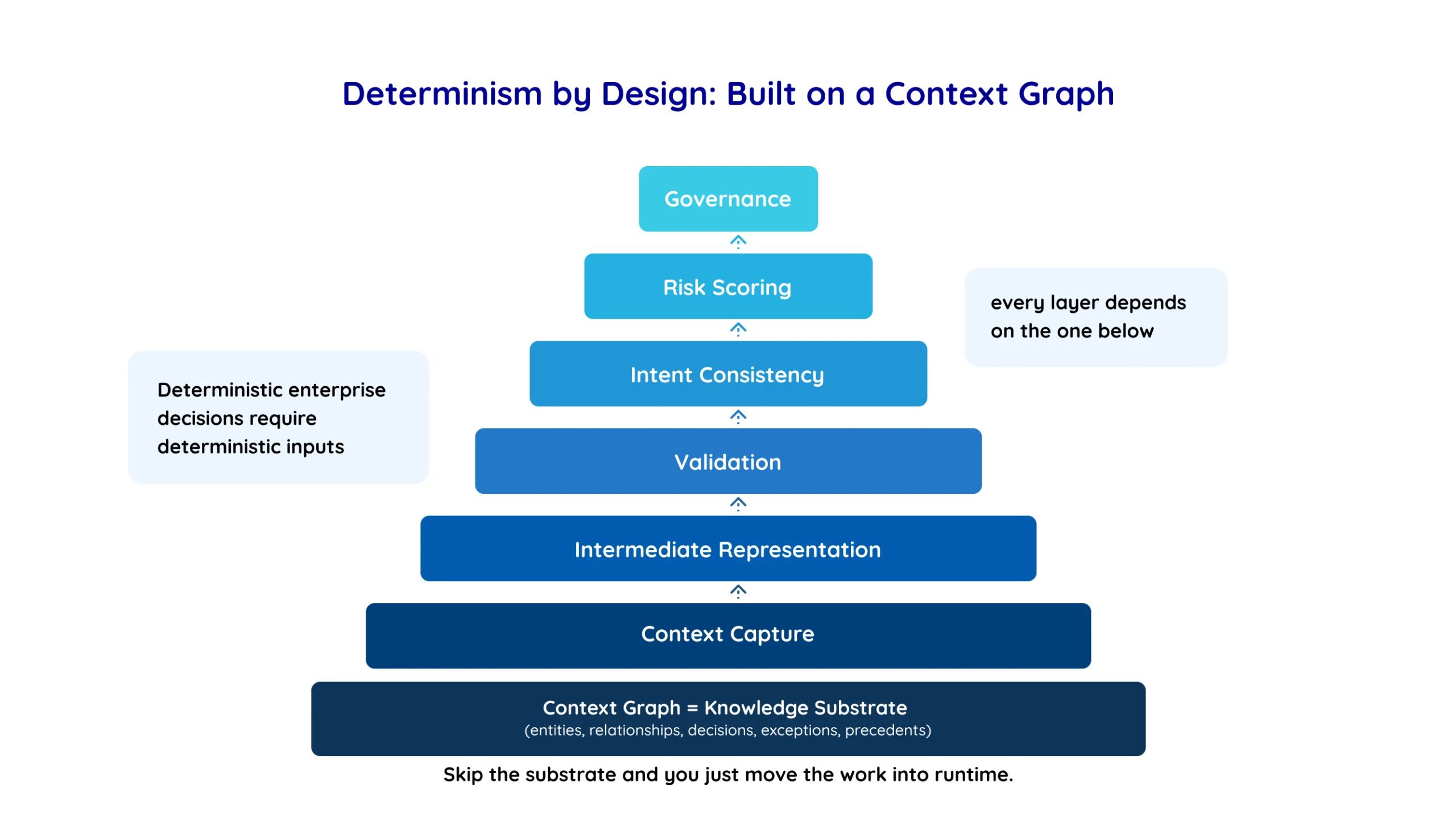
This is why we built Determinism by Design around a staged control stack: context capture, intermediate representation, validation, intent consistency, risk scoring, and governance. The order matters here, and each stage takes the output of the one before it and adds a control. The first stage is context capture, and what context capture operates on is the substrate.
If the substrate is missing, context capture devolves into runtime scraping. The agent pulls fragments wherever it can, and the validation engine has nothing stable to evaluate against, and what should have been an audit trail turns into a forensics exercise the next time a regulator asks for one. We have walked into AI programs that had clean models and reasonable governance frameworks on paper, and the audit trail still could not be reconstructed, because the context the model reasoned over was different every time.
When the substrate exists, the stack actually behaves the way it was designed to. The same query against the same graph produces the same reasoning path, which gives the validation a known target and governance something specific to govern. An audit trail becomes a property of the architecture, not a forensic job under a deadline.
This is why we treat the context graph as the first architectural commitment in any AI program with serious production ambition. Every later control layer inherits whatever it sits on, and the cost of skipping the substrate doesn’t disappear. It just shows up later, in production, under deadline, with a regulator watching.
The Next System of Record
Data warehouses became obvious in retrospect. For most of the 1990s, the case for a separate analytical layer was a hard internal sell, because running reports off transactional databases was good enough for one more quarter. The enterprises that built the warehouse anyway compounded a structural advantage for two decades.
The context graph is the same kind of decision, and Gartner is now calling it that. Their 2026 data and analytics predictions place universal semantic layers alongside data platforms and cybersecurity as critical infrastructure, which signals that the substrate has stopped being a research-side conversation and started being a budget conversation.
Most enterprises will end up with a context graph one way or another. The question is whether you design one or whether your fifth agent project quietly recreates a worse version of what your second one already built. We have walked into engagements where four separate teams had each stood up their own context layer for their own agent; none aware of the others, and none reusable. Consolidating that costs more than building it once.
The question worth taking to your next architecture review is narrower than the framing usually offered: who is going to own the context graph, what it covers in its first version, and which agent program will be the one to prove it works.
Ready to move from architecture decisions to your first working build?
A structured path from idea to MVP helps you define ownership, scope, and proof of value before you commit resources.
Read: Enterprise AI Development — A Structured Path from Idea to MVP →
If your AI program keeps stalling at the same point on the way to production, the substrate is the first place to look. We help enterprise teams build the context graphs their AI systems will need anyway, before regulators or production failures force the conversation.
About Zuci Systems
Zuci Systems is an AI-first digital transformation partner specializing in quality engineering for AI systems. Named a Major Contender by Everest Group in the PEAK Matrix Assessment for Enterprise QE Services 2025 and Specialist QE Services, we’ve validated AI implementations for Fortune 500 financial institutions and healthcare providers.
Our QE practice establishes reproducibility, factuality, and bias detection frameworks that enable enterprise-scale AI deployment in regulated industries.
Explore more at Zuci Systems
Author's Profile

Head, Gen Al Center of Excellence, Zuci Systems

Srinivasan heads Zuci’s Generative AI Center of Excellence, leading initiatives that unite AI, engineering, and enterprise transformation.
With over 20 years of experience in technology strategy and digital platforms, he helps organizations design scalable AI systems that balance creativity and control.
Share On


Scaling AI from Pilot to Enterprise: The 7-Layer Control System You Can't Defer
Determinism by Design in Practice: What Governed AI Looks Like Across the Enterprise
Author’s Profile

Head, Gen Al Center of Excellence, Zuci Systems|