Blog
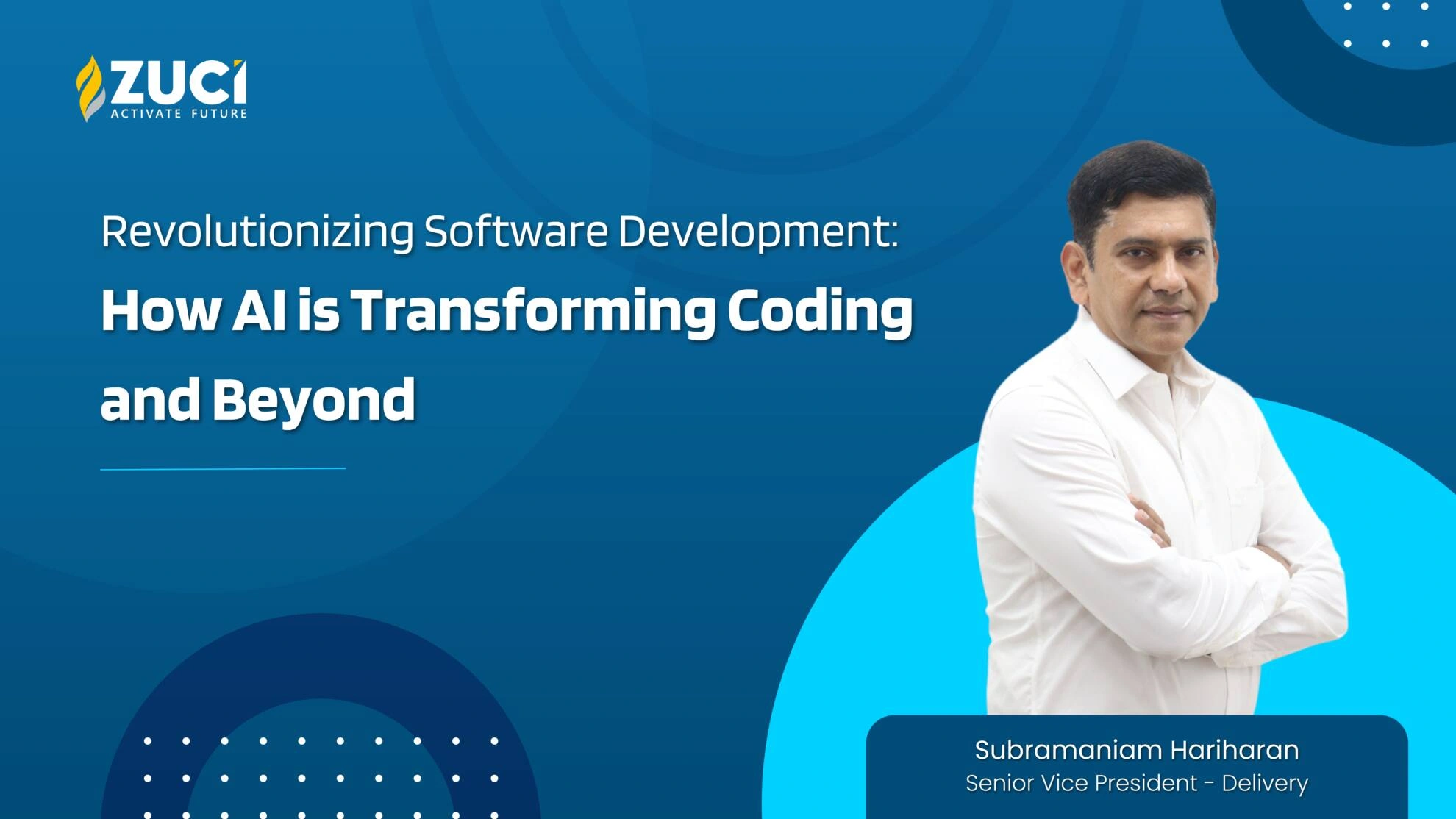
How AI is Transforming Coding and Beyond
30 Oct, 2025
- 8 min read
Share On



For what seems like forever, the Software Development Life Cycle (SDLC) remained one of the bulwarks of IT, keeping projects on track, ensuring quality, and enabling timely deliveries. Then, along came Generative AI and nothing has been the same ever since. Initially, it was a novelty, used primarily to generate conversational language answers to user questions. However, as GenAI evolved, it began assisting with more complex, semi-automated tasks, improving efficiency by decreasing human effort in creative and decision-making processes. Soon it was generating code blocks and assisting with design and decision-making. Today AI has infused every stage of the SDLC from ideation to implementation, and everything in between.
The Changing Role of Software Engineers
AI has freed up engineers from performing routine tasks, enabling them to perform higher level activities such as planning, design, decision making, creative thinking, and innovation. So, while AI tools generate code, engineers shift to the role of designers, reviewers and guides who enable overall project goals.
Engineers now collaborate closely with AI platforms and systems, while continuing to leverage human skills to fine-tune AI-generated code so that it meets business objectives. This collaboration between human developers and AI systems enables the creation of richer applications built on data analytics and facilitates greater software innovation and system optimization.
While highly skilled engineers harness AI to create advanced solutions, lower skilled developers can leverage low-code and no-code platforms to generate code faster and with higher quality than was possible earlier.
AI in Software Development
With its Natural Language Processing (NLP) capabilities, AI can hold meaningful conversations with engineers, understand requirements, generate code, make suggestions, even add comments, and create documentation.
Let’s take a look at how AI is transforming the entire SDLC.
Code Generation
Code synthesis enables developers to provide inputs in natural language and generate code snippets, blocks, or entire functions. AI tools not only generate code faster but also make fewer errors, provide suggestions for improvements, and predict and autocomplete code in real time, making coding much faster.
Error Detection
AI algorithms can detect bugs, vulnerabilities, and inefficiencies in code, and then fix errors, provide patches, and optimize performance. They can autocorrect code issues in real time to refine programs. They go a step further to predict future bugs based on an analysis of observed patterns.
Quality Engineering
AI tools can generate test cases based on user stories, optimize them, and increase test coverage. Typically, AI considers far more test cases, covers more code branches, and finds more edge cases than manually possible. It also prioritizes critical tests to optimize time and resources and can perform predictive analytics to discover which parts of a system are most likely to fail, based on previous data. By automating testing and enabling seamless code integration, AI tools can facilitate Continuous Integration and Continuous Deployment (CI/CD) pipelines.
Code Review
AI reviews code to detect deviations from coding standards, performs refactoring, suggests improvements, and optimizes it to improve efficiency. AI-powered platforms can also analyze pull requests and ensure consistency of code quality.
Personalized Tools
By analyzing developers’ coding style and past work, AI can create a smart and adaptive Integrated Development Environment (IDE) that is customized to suit the developers’ preferences, make context-specific suggestions, and even predict possible errors in advance.
Security
Cybersecurity can be enhanced with AI-driven tools that identify vulnerabilities and provide fixes and mitigation strategies before they are exploited. AI can perform automated security audits to detect threats such as Structured Query Language (SQL) injection and Cross-site Scripting (XSS) risks.
Optimization
AI can analyze parameters such as memory usage and algorithm complexity to optimize code and improve its performance and simplify maintenance. It can also monitor performance and predict issues that may arise after implementation.
DevOps
AI can enhance DevOps by automating infrastructure management, provisioning servers, managing cloud resources, performing intelligent monitoring of CI/CD pipelines, load balancing, and scaling. It detects issues in real time and improves the efficiency and speed of deployments.
Software Design
Based on best practices, AI tools can recommend the optimal software architectures and scalable frameworks for greater performance. Neural networks can be used to analyze vast data sets and craft the most efficient architecture designs for complex systems. Using historical data and trends, AI can help developers make informed decisions such as feature requirements and release cycles.
Maintenance
AI can perform heavy-duty software maintenance tasks such as checking for outdated system components and deploying required updates. It can also detect anomalies and unusual system behavior to predict failures and perform preventive maintenance.
Transforming the SDLC
As a result of the numerous and radical changes that AI brings to every aspect of software development, there is a need for a paradigm shift away from the traditional view of the SDLC:
- Requirements : Due to its ability to process natural language, AI systems transform the conventional step of gathering requirements into a conversation with the AI to convey business goals and user expectations as inputs, followed by an analysis of the AI output to ensure it meets the desired outcomes.
- Design: By recommending possible designs and architectures, AI can create network diagrams, flow charts, specifications sheets, and even User Interfaces (UI). The role of engineers and developers is now to review the AI-generated artifacts and refine them to ensure consistency and compliance with project constraints.
- Development: As Generative AI can assist coders and also producing code, the developers can focus on higher-order thinking, code review, security checks, and software innovation.
- Testing: Automated test generation and execution implies that quality engineers now need to focus on overall approaches, quality improvement, and software innovation, rather than fixing bugs.
- Implementation: With CI/CD pipeline optimization and faster builds, developers need to focus on strategic decisions such as the choice of the technology environment—on-prem, cloud, or hybrid, for instance—and manage the implementation across systems, ensure security and governance, and facilitate seamless transitions.
- Documentation: With its strong natural language capabilities, AI system can automatically generate documents, whether it’s a how-to or user manual, and keep them updated with code changes, freeing developers to review the documentation and ensure accuracy and relevance.
- Maintenance: AI can monitor system performance, detect errors, suggest improvements, and predict potential issues. Developers need to quickly act upon such inputs to ensure that downtime is minimized.
- Improvement: Based on system performance and user behavior, AI can recommend code refinement and improvement. Developers can analyze such AI outputs to identify critical requirements and prioritize important changes.
The Pros and Cons of AI in Software Development
AI has had a transformative effect on software development in several ways including enhancing the productivity and quality of applications and solutions:
- By freeing up engineers from routine tasks, AI helps them to focus on problem-solving and overall design. Instead of detecting bugs and generating test cases, quality engineers can focus instead on thinking about new features and customer needs.
- Due to its superior ability to generate test cases and even autonomously run tests, AI enables a much higher level of software quality than was possible with manual efforts, which often focused mainly on “happy paths” whereas AI ensures much higher test coverage.
- The emergence of low-code and no-code platforms has increased the number of “programmers” who lack the technical expertise or knowledge but can go ahead and develop software applications anyway.
- AI predictions about timelines and resource allocation, based on historical trends, can greatly help project managers function more efficiently and plan more accurately.
- End-users of AI-generated applications will have greater choice due to the higher degree of personalization and customized features built around specific user preferences, leading to greater customer satisfaction.
On the other hand, AI has downsides as well that organizations need to proactively navigate around:
- AI is notorious for potential biases that can creep in if the model training was based on non-diverse or insufficiently representative sample data sets. AI can amplify these biases and countering them is essential, especially in critical decision-making roles.
- Another potential downside of AI is the negative impact it can have on human jobs, more so in low-skilled profiles. Here organizations need to ensure their employees are trained in collaborating with AI systems to enable them to move into overseer and reviewer roles.
- AI systems are also not always transparent and secure, and it is possible to encounter serious vulnerabilities and/or opacities that can have serious consequences. To mitigate such risks, all AI-generated outputs need to be vetted, and human reviews should be an essential part of code reviews.
Summary
The incorporation of AI across every stage of the Software Development Life Cycle has ushered in a new era for developers and coding practices in general. AI has transformed each step of the SDLC and drastically changed the roles and responsibilities of engineers at all levels.
While the displacement of jobs is a major concern, AI also promised to unleash a new breed of developers, essentially creating many new opportunities for technology enthusiasts with little or no programming expertise, to create innovative applications using low- and no-code platforms and tools.
Developers across levels will need to shift to an overseer, guide, and reviewer role, collaborating with AI systems to imagine, develop, test, implement, and improve a whole new array of software applications.
Ethical concerns too need to be addressed, and organizations will need to focus on ensuring thorough debiasing of AI models to ensure fairness, transparency, and compliance.
The overall impact of AI on the SDLC can be expected to be largely positive, with faster development, less tedium, higher quality, and greater customer satisfaction. The transformational impact of AI is being felt—and will continue to do so—across the SDLC, leading to better coding practices, more streamlined workflows, and greater innovation.
With 200+ successful AI projects, Zuci Systems has developed an innovative Activate Digital offering that empowers the workforce with powerful digital tools, boosting their capabilities and productivity. Activate Digital helps streamline development processes by automating repetitive tasks and optimizing design workflows, resulting in faster time-to-market and improved innovation. It aims to help organizations seamlessly transform their customers’ journeys and unleash a new era of efficiency and satisfaction.

Share On


What are the Success Metrics to Go After When Opting for App Modernization?
How to Kickstart Test Automation from Scratch?
Author’s Profile

Activate Future|