Blog
The Window for Legacy Modernization Is Open. Here's How to Move
22 Jun, 2026
- 8 min read
Share On



Key Takeaways
- The risk of not modernizing is now larger than the risk of moving. Legacy platforms cannot host the AI capabilities redefining competitive advantage in financial services.
- The framework rests on three things working together: a Knowledge Substrate that captures every business rule and dependency, Context Engineering that gives AI real business intent to act on, and Determinism by Design that keeps every AI-assisted decision inside human-validated guardrails.
- Once decoded and rebuilt, a platform can host what the old one never could — automated decisioning, real-time risk scoring, and document intelligence built directly into the workflow, not bolted on after.
- A Canadian mortgage lender modernized a 500,000-line, 20-year-old platform in 12 months, with 80% of low-risk loan applications now moving through automated underwriting.
- The decisive variable is not the AI, but the expertise directing it. AI determines how fast the work moves. Architects and domain experts determine whether what gets rebuilt is actually correct.
Most CIOs responsible for a legacy core platform know exactly what they are sitting on. A system built fifteen to twenty years ago. Engineers who have moved on. Two decades of business logic embedded in compiled code that no one on the current team can fully read. Documentation that either does not exist or no longer matches what the system actually does.
The case for modernization is not in question. But what has kept it off the agenda is the fear that the risks – disruption to live operations, timeline overruns, lost institutional knowledge, spiraling costs—outweigh the pain and risk of living with the system.
Meanwhile, the cost of standing still has changed shape. Competitors are not just modernizing – they are embedding AI directly into underwriting, servicing, and customer experience, on platforms built to absorb that kind of change. A core system nobody can safely touch cannot absorb anything new. Every quarter spent protecting the status quo is a quarter spent losing ground on the one capability now deciding who wins the next decade.
That belief was reasonable for a long time, but it may not be relevant any longer.
What Has Changed
The hard part of legacy modernization has always been the same: extracting decades of business logic from systems no one can read, without losing it in translation. That problem sat at the root of every risk that made boards hesitate.
AI has changed the equation — but only in the hands of architects and domain experts who understand how the business and the system actually work. Directed correctly, AI now reads legacy systems at a depth manual reverse engineering never reached, and rebuilds against that understanding at a speed manual development never could. Conditional rules, runtime dependencies, undocumented integrations — the things that used to take six to twelve months of forensic work to surface — now take weeks.
That compression changes everything downstream. Once the business logic is legible, scope can be priced from evidence rather than contingency. Migration can be staged against known behavior. Cutover risk becomes manageable because each new service is tested against the old system before any traffic moves.
The risks have not disappeared but have been bounded. That is the shift.
What convinced the market that legacy modernization is becoming more achievable?
Even Wall Street is paying attention. IBM’s $30B week made the case that AI-led modernization isn’t a future bet; it’s already showing up on balance sheets.
What Modernization Actually Looks Like Now
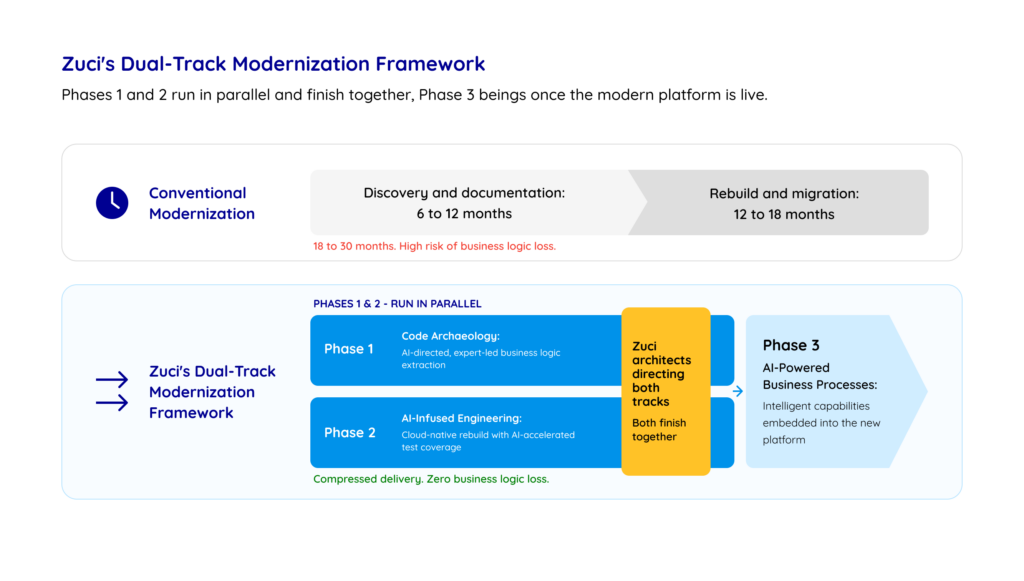
Here’s what that shift looks like in practice. Two tracks run in parallel — legacy decoding and a cloud-native rebuild — and that overlap is what compresses a multi-year timeline into months. A third phase, embedding AI into the business itself, begins once the new platform can support it. This is Zuci’s dual-track modernization framework in motion.
All three phases run on one engineering foundation — which is what keeps the pace safe rather than reckless. Three things hold it together: a knowledge substrate, a living record of every business rule and dependency, so nothing gets lost in translation as the rebuild proceeds; context engineering, business and system context expressed in a form AI can act on, so it works from real intent rather than guesses; and Determinism by Design, guardrails and human validation at every critical decision, so AI operates inside set boundaries, never on its own.
Phase 1: Code Archaeology
Your compiled code is the only complete record of how the platform actually behaves — the architects who built it are long gone, and AI is what makes that record readable again, surfacing every conditional path, runtime dependency, and integration behavior that was never written down.
But surfacing a rule and knowing why it exists are different things. It might be there because regulation requires it, because a customer commitment depends on it, or because someone patched a problem under pressure a decade ago and it quietly became permanent. Telling those apart is what decides whether the rebuild preserves the business or quietly breaks it — which is why domain experts direct the AI, not the other way around.
What comes out isn’t documentation but the working foundation for the rebuild: specifications, dependency maps, migration boundaries, regression coverage, a sequenced roadmap.
For a Canadian mortgage lender. this meant decoding 500,000 lines of undocumented code across 88 tightly coupled components — with no original architects left to ask — and producing full business logic specifications before a single migration decision was made.
Phase 2: AI-Orchestrated Modernization
This is where the platform gets built — and where most programs stall, because using AI as a faster typewriter isn’t the same as rebuilding the delivery process around it. The difference shows up in outcomes: test coverage that grows with the build instead of trailing it, logic gaps caught in review instead of staging, more workstreams running in parallel without the error accumulation that usually comes from moving fast.
Sustaining that usually means modernizing the test automation stack alongside the application, not after it.
The standard held throughout is behavioral fidelity. Every new service has to produce the same business outcome as the old one — unless you’ve explicitly decided otherwise.
Phase 3: AI-Powered Business Processes
This is where the investment pays back. Whatever AI capabilities you’ve been deferring — automated decisioning, document intelligence, intelligent routing, real-time risk scoring — the new platform can finally host them safely, because the knowledge and governance built in Phases 1 and 2 are already there. The old platform couldn’t. Not because the ambition was wrong, but because there was nowhere safe to put it.
In the Canadian mortgage lender project, the AI-powered modernized platform now routes approximately 80% of low-risk applications through automated underwriting. Document intelligence handles income verification, employment checks, and property data extraction. Complex cases go to underwriters with full context already assembled. Exception handling sits inside the same governance fabric as the rest of the platform. Underwriters spend their time on the cases where judgment actually matters. The volume of work that once absorbed the team runs through governed automated flows, with the audit trail and decision evidence regulators expect fully intact.
What Modernization Programs Change for the Business
Three shifts hold consistently across modernization programs done this way.
- Operating leverage on transaction volume. High-volume processing moves into automated, governed workflows. The business gains capacity without adding headcount proportionally, and the people who remain in these functions shift toward work that actually requires judgment. This changes hiring profiles over the next few years.
- Launch velocity on new products. New mortgage products, claims variants, and onboarding journeys plug into domain APIs the platform already exposes, with regression coverage in place from day one. Launch cycles drop from quarters to weeks. More importantly, product teams at independent software vendors stop making roadmap decisions based on integration effort and start making them based on what customers actually want.
- AI inside the operating model and not just beside it. AI stops being a separate initiative with its own budget and roadmap. It sits inside day-to-day operations, governed by the same engineering discipline that built the platform. The organization builds the operational muscle to run AI as a permanent part of how the business works – with the monitoring, audit evidence, and quality controls that regulators and boards can accept.
The last shift is the one boards have been waiting to authorize as the legacy platform is no longer the blocker.
Expertise Is Always the Real Differentiator
The most important factor in any modernization program isn’t the tool, but the human directing it. AI can read legacy code, generate tests, and rebuild services faster than any manual team. What it cannot do is tell a regulatory requirement from a decade-old workaround, or decide which behaviors the business needs to carry forward. That judgment belongs to architects who understand the legacy system, domain experts who validate what AI recovers from it, and business owners who decide what survives the rebuild and what doesn’t.
That’s exactly what the Knowledge Substrate, Context Engineering, and Determinism by Design exist to protect. These are the mechanisms that keep human judgment embedded in Zuci’s dual-track framework at every step AI touches. Speed without that discipline is just risk moving faster. Speed with it is what compressed a 20-year-old, undocumented platform into a 12-month rebuild.
The result isn’t just a modernized system. It’s a platform the business can trust for the next decade, and one built to carry whatever AI capability comes next, which the old system never could.
Have cost, timelines, or business disruption kept your modernization plans on hold?
AI is changing what’s possible. Our team would be happy to share insights from real-world modernization initiatives.
About Zuci Systems
Zuci Systems is an AI-first digital transformation partner specializing in quality engineering for AI systems. Named a Major Contender by Everest Group in the PEAK Matrix Assessment for Enterprise QE Services 2025 and Specialist QE Services, we’ve validated AI implementations for Fortune 500 financial institutions and healthcare providers.
Our QE practice establishes reproducibility, factuality, and bias detection frameworks that enable enterprise-scale AI deployment in regulated industries.
Explore more at Zuci Systems
Frequently Asked Questions
1. How does AI help modernize legacy systems?
AI accelerates the recovery of business logic from compiled code that no current engineer can fully read by hand. Directed by domain experts and architects, it surfaces the conditional rules and runtime coupling buried in legacy binaries and helps generate the regression coverage the rebuild team needs to protect business behavior.
The discovery cycle compresses from six to twelve months of forensic work to weeks. Architectural decisions and risk judgment stay with the engineering team.
2. What is code archaeology in legacy modernization?
3. How long does AI-led legacy modernization take?
4. Can legacy modernization be done without business disruption?
5. What happens to existing data during legacy modernization?
Author's Profile

Executive Vice President, Digital Engineering

Jagadeesh heads Zuci’s Digital Engineering, Data, and AI CoE practices, leading large-scale digital and AI-driven transformation initiatives across the Retail, Hi-Tech, BFSI, and Mobility sectors. With nearly three decades of experience in product engineering and solution delivery, he helps organizations navigate complex transformation programs while balancing scale, speed, and precision.
Share On


Determinism by Design: Closing AI’s Trust Gap
What is AI-ready data, And Why It Determines the Success of Enterprise AI
Author’s Profile

Executive Vice President, Digital Engineering |