Blog
The Determinism Spectrum: Why AI Can’t Be Tested Like Just Another Software
06 Feb, 2026
- 17 min Read
Share On




Key Takeaways
- AI systems have unique testing requirements. Traditional testing methods yield inaccurate results that hinder scaling
- The Determinism Spectrum highlights an AI system’s deterministic and probabilistic positions, helping you classify it into one or more of the Four Zones – 1, 2, 3, and 4, for more reliable and accurate testing
- Each of these zones has its own tolerance, variance, and quality parameters that correspond to system purpose, not output
- To classify your AI system into Determinism Spectrum zones, you can ask specific questions that highlight what the AI system is built for, and how you can measure the quality of output
- Every AI system can belong to one or multiple Determinism Spectrum zones depending on its purpose and intent
- After system classification, you can proceed to identify zone-specific quality dimensions and metrics, and select corresponding methodologies to monitor the output quality
Talk to our AI Quality experts
Not sure where to begin? Book a 30-Minute AI Quality Engineering Consultation with us and review your AI system architecture and use cases with our AI Quality experts and identify your highest-risk quality gaps
One of the biggest challenges QE teams face with AI is assuming that all AI systems should be tested the same way.
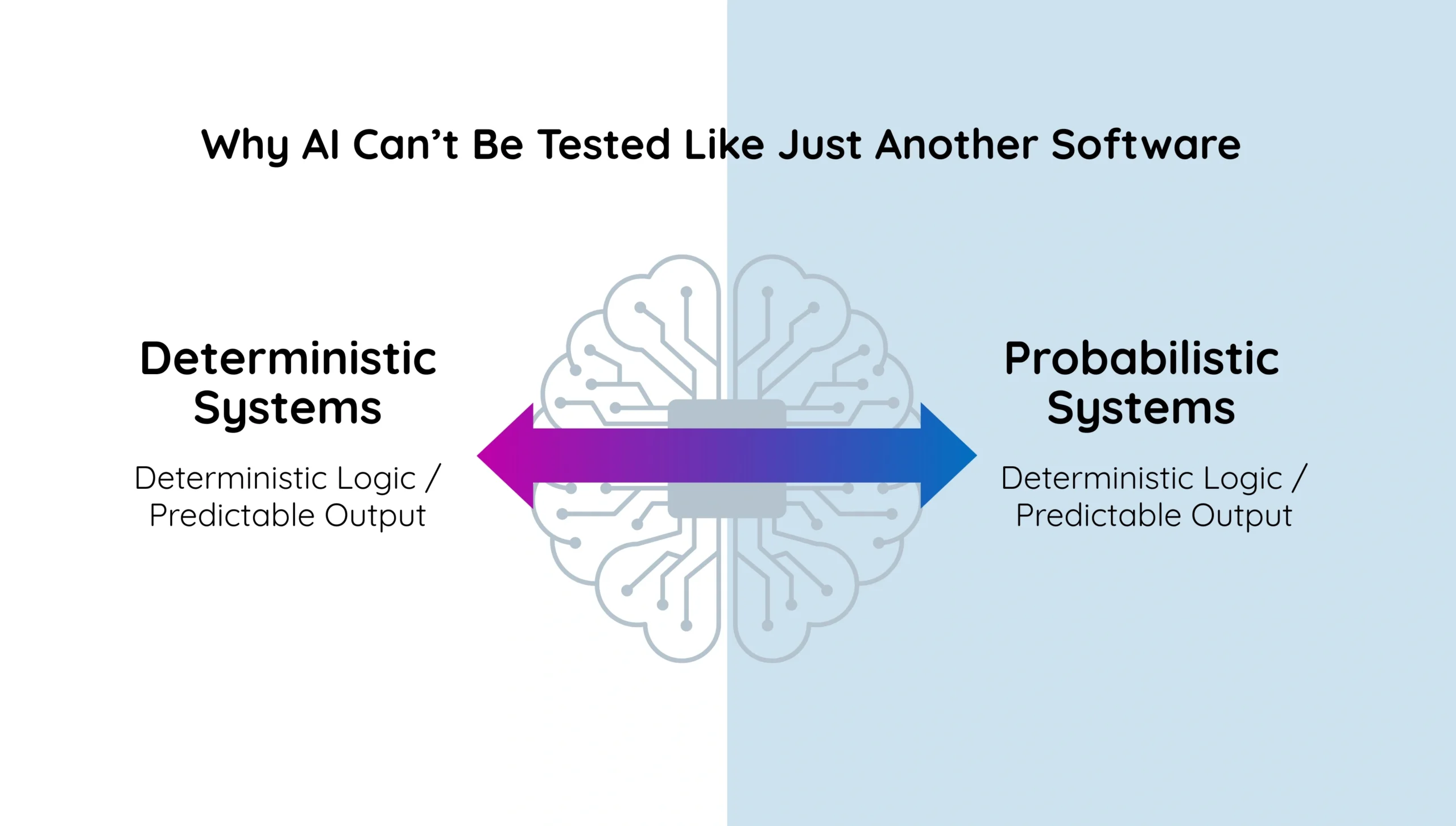
Consider a Fortune 500 bank deploying AI across three very different use cases: credit scoring, loan approval summaries, and personalized marketing emails. The QE team applies a familiar testing playbook across all three: measuring accuracy, consistency, and repeatability.
The results are puzzling. The credit scoring model performs flawlessly, while the loan summarization system appears inconsistent and raises red flags. The marketing AI fails outright, producing different outputs every time.
Nothing is technically “broken.” The issue lies in the AI testing approach.
These systems are designed to behave very differently:
- Credit scoring is inherently deterministic. Given the same inputs, the output does not change
- Loan summarization is contextual. Similar inputs can reasonably produce varied but acceptable outputs
- Marketing content generation is intentionally creative, where uniqueness is the goal, not consistency
All three systems, by design, are required to generate outputs that correspond to their purposes. However, testing all three through the same lens makes expected behavior look like a defect.
This is the core challenge of enterprise AI quality engineering today: not all AI systems are equally predictable, and quality cannot be defined the same way for each of them.
Why Traditional QA Fails for Most AI Systems
Traditional software testing is built on a simple assumption: determinism. The same input produces the same output every time. This predictability has enabled quality engineering practices to mature the way they have.
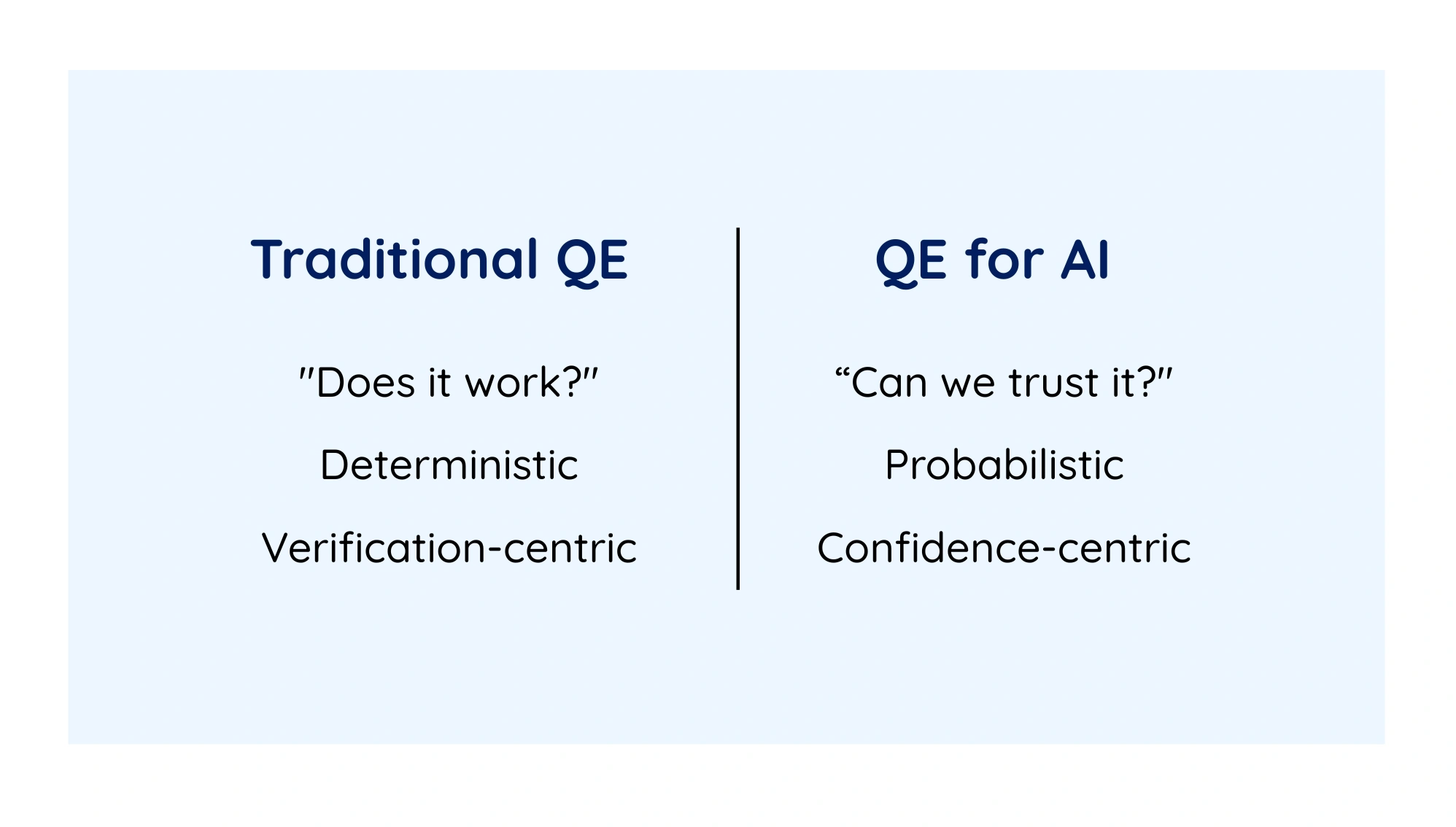
As AI moves from isolated experiments into real enterprise workflows, determinism no longer holds. AI systems interpret context, generate variable outputs, and often rely on external models and services outside the enterprise’s direct control. Once AI becomes part of an application, the system becomes less predictable by design—and that’s not a flaw, it’s a feature.
In traditional software, the relationship is straightforward:
Input A → Output X.
With AI systems, the relationship looks very different:
Input A → Output X, Y, or Z—depending on context and design.
This creates a fundamental QE challenge: how can AI quality testing for systems be adaptive, probabilistic, and occasionally creative?
Where traditional testing breaks down
When QE teams apply traditional testing practices to AI systems, predictable problems emerge:
- Consistency is enforced on systems designed to be creative
- Reproducibility is expected from systems meant to adapt to context
- Variance is flagged as a defect when it is intentional behavior
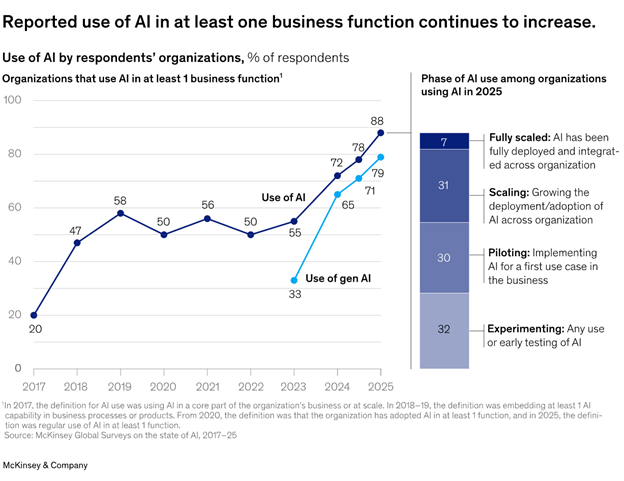
The result is frustration on both sides: AI teams feel constrained, QE teams feel uncertain, and initiatives stall. According to McKinsey (2025), 88% companies report adopting AI for at least one business function, while only 39% can trace any financial benefit of it. To emphasize the QE gap, only 7% organizations have been able to scale AI up to enterprise levels:
Introducing the Determinism Spectrum for Testing AI Systems
This is where the Determinism Spectrum comes in.
At Zuci Systems, we developed the Determinism Spectrum to help teams classify AI systems based on how predictable they are by design. Before you can test an AI system effectively, you need to understand how much determinism it is meant to exhibit.
That understanding shapes everything that follows: what behavior to expect, how to define “good,” which quality dimensions matter most, and which AI software quality testing techniques are actually relevant.
By classifying systems along the Determinism Spectrum, teams can move away from one-size-fits-all testing and adopt zone-appropriate quality strategies and metrics that correspond to intended behavior of a system.
At a high level:
- Zone 1 systems behave like traditional software and should be tested for accuracy and repeatability
- Zone 2 systems require validation for contextual reasoning
- Zone 3 systems are evaluated for output quality and usefulness to humans
- Zone 4 systems demand AI software testing for alignment, creativity, and bias
These zones realign the testing approach once you rethink what parameters determine the “quality” of your AI systems.
Download The Determinism Spectrum Framework: Classify your AI system in under 10 minutes and match your testing strategy to your AI system.
Understanding AI Quality Dimensions
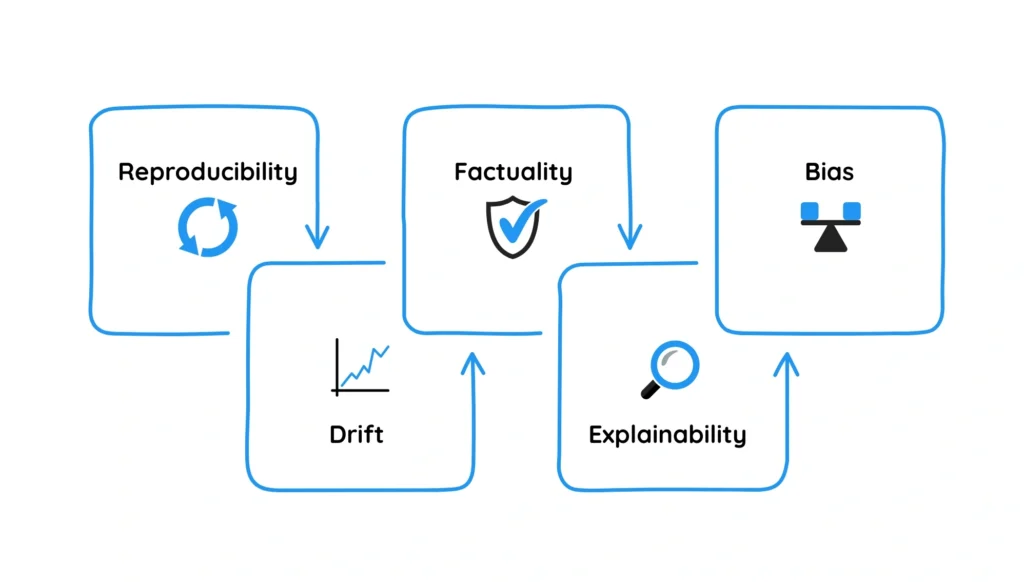
AI systems don’t fit into that model. They are probabilistic, context-aware, and continuously evolving. As a result, quality must be assessed across multiple dimensions rather than a single pass/fail outcome.
At Zuci, we evaluate AI quality across five core dimensions:
- Reproducibility: Consistency within an acceptable range of variation
- Factuality: Accuracy and hallucination prevention
- Bias: Fairness across demographic and behavioral segments
- Drift: Stability of performance over time
- Explainability: Transparency and auditability of decisions
Not every AI system needs to optimize all five dimensions equally. What matters is understanding which dimensions matter most, based on where the system sits on the Determinism Spectrum.
For a detailed exploration of each dimension, see our guide: The 5 Dimensions of AI Quality: A Guide to Scaling AI from Pilot to Production
The Four Zones of the Determinism Spectrum
Not all AI systems are meant to behave the same way, and that’s exactly why they shouldn’t be tested the same way either.
The Determinism Spectrum groups AI systems into four zones based on designed predictability. As you move from Zone 1 to Zone 4, predictability decreases, output variability increases, and human judgment becomes progressively more central to quality assessment:
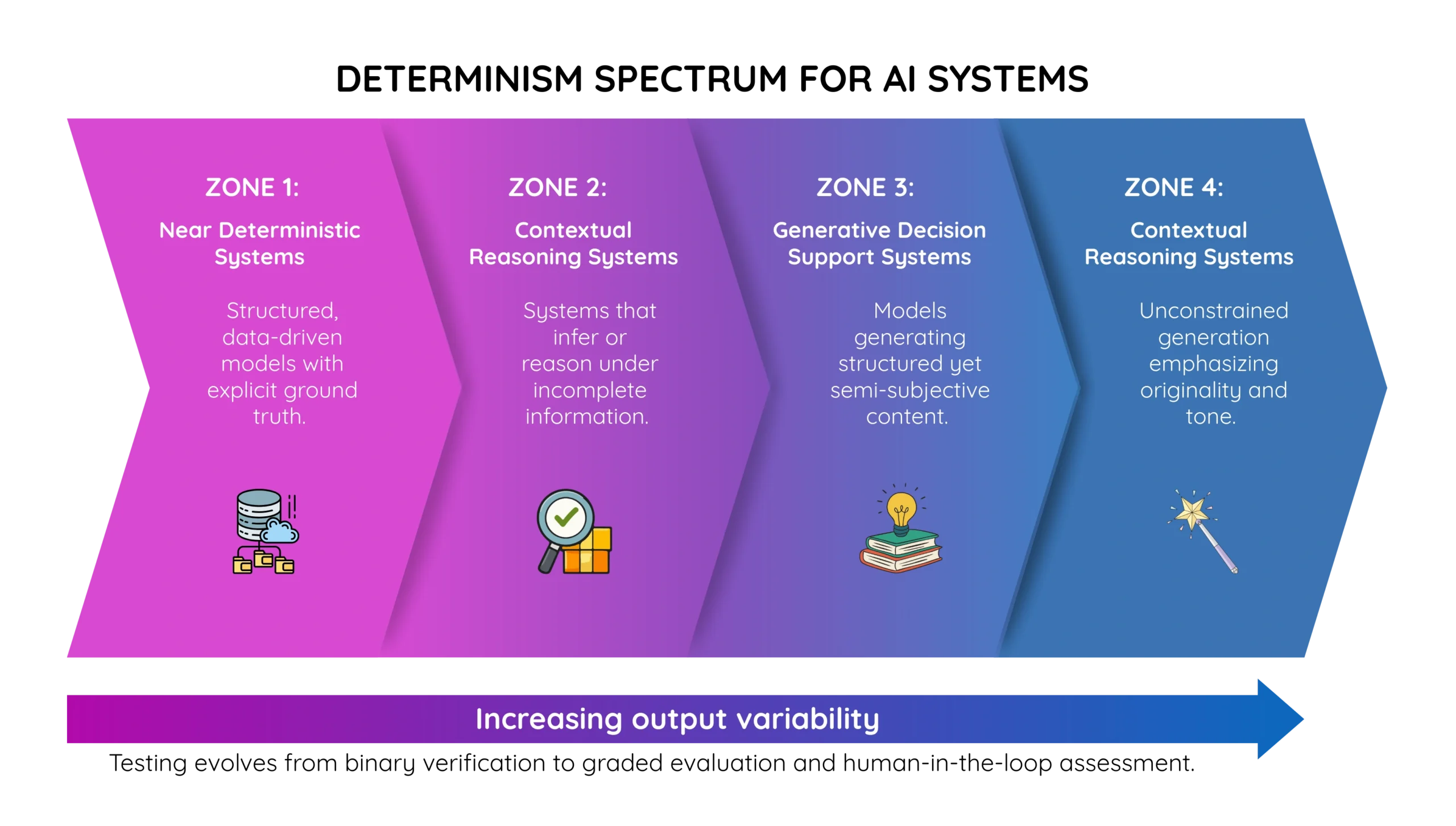
At a high level:
- Zone 1 systems behave almost like traditional software
- Zone 2 systems reason based on context
- Zone 3 systems generate recommendations that humans act on
- Zone 4 systems create original, open-ended outputs
Understanding which zone a system belongs to is the foundation for choosing the right quality strategy.
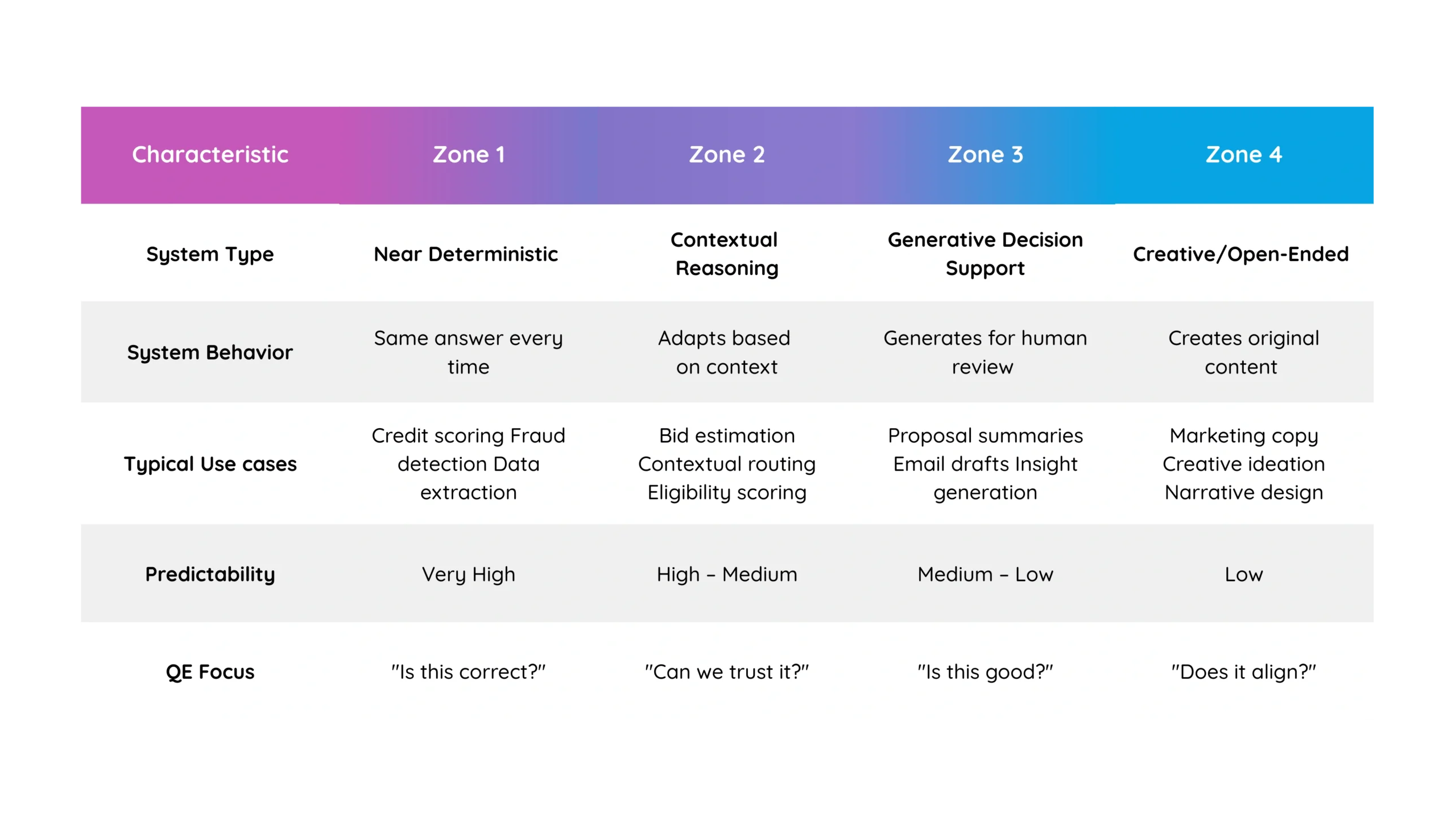
As systems move from Zone 1 to Zone 4:
- Predictability decreases
- Output variability increases
- Human judgment becomes more central to quality assessment
Zone 1: Near deterministic systems
Understanding: AI that gives the same answer every time
Zone 1 systems are the closest to traditional software. They process structured inputs and produce consistent, measurable outputs. Given the same input, the expectation is simple: the output should not change.
Typical examples include:
- Credit risk scoring
- Churn prediction
- Invoice or document data extraction
- Fraud detection scoring
QE focus: Is this output correct?
AI system testing here looks familiar. Traditional verification methods work well because tolerance is low and predictability high. The same input should produce the same output, usually with less than 2% acceptable variance.
Quality priorities
- Reproducibility and factual accuracy are non-negotiable
- Bias matters at a segment level
- Drift and explainability need monitoring, especially in regulated contexts
Common testing approaches
- Regression testing with fixed datasets
- Accuracy, precision, and recall metrics
- Threshold-based pass/fail criteria
- Automated unit and integration tests
Download The Determinism Spectrum Framework: Classify your AI system in under 10 minutes and match your testing strategy to your AI system.
Zone 2: Contextual reasoning systems
Understanding: AI that adapts its response based on context
Zone 2 systems introduce nuances. They interpret relationships, conditions, and the surrounding context before producing an output. While responses may vary slightly, the underlying reasoning should remain stable and explainable.
Examples include:
- Bid or proposal cost estimation
- Intelligent customer routing
- Eligibility scoring across multiple criteria
- Context-aware document classification
QE focus: Can we trust this output?
Here, expecting identical outputs is unrealistic. Instead, it is more suitable to check whether responses fall within acceptable ranges, and that the reasoning behind them is sound.
Quality priorities
- Factuality and explainability are critical
- Reproducibility remains important, but variance is acceptable
- Bias and drift need closer attention as context patterns evolve
Common testing approaches
- Variance analysis across similar inputs
- Counterfactual testing (change one factor, observe impact)
- Confidence score validation
- Contextual and edge-case testing
Download The Determinism Spectrum Framework: Classify your AI system in under 10 minutes and match your testing strategy to your AI system.
Zone 3: Generative decision support systems
Understanding: AI recommends, humans decide
Zone 3 systems don’t make final decisions. They generate summaries, insights, or recommendations that humans review and act upon. Variability is expected, and often useful.
Examples include:
- RFP or proposal summaries
- Draft customer outreach emails
- Executive insight generation
- Code review suggestions
QE focus: Is this a good answer?
Correctness alone is no longer sufficient. Quality is judged by usefulness, clarity, fairness, and whether the output helps you make better decisions. Structured evaluation becomes essential because “good” is a subjective metric.
Quality priorities
- Factuality, bias, drift, and explainability become central
- Reproducibility is low priority; variance is normal
- Transparency matters because humans rely on these outputs
Common testing approaches
- Human-in-the-loop evaluations using scoring rubrics
- Output quality scoring (relevance, completeness, accuracy)
- Hallucination detection and fact-checking pipelines
- Comparative analysis across multiple runs
Download The Determinism Spectrum Framework: Classify your AI system in under 10 minutes and match your testing strategy to your AI system.
Zone 4: Creative and open-ended systems
Understanding: AI where originality is the goal
Zone 4 systems are designed for novelty. Consistency is neither expected nor desirable. Instead, quality is about alignment with brand, values, ethics, and intent.
Examples include:
- Marketing copy generation
- Creative ideation and brainstorming
- Storytelling and narrative creation
- Design concept generation
QE focus: Does this align with our intent and values?
Here, human judgment is indispensable. Quality engineering provides structure; not to constrain creativity, but to ensure outputs remain trustworthy, ethical, and aligned.
Quality priorities
- Bias, drift, and explainability are critical
- Reproducibility is not applicable
- Factuality matters only when factual claims are made
Common testing approaches
- Brand and tone alignment scoring
- Bias and stereotype detection
- Human preference testing (A/B comparisons)
- Ethical review frameworks
- Style and consistency checks
Want the visual Determinism Spectrum framework? Download our 2-page guide: The Determinism Spectrum: Quick Classification Guide. It includes the zone comparison table, classification questions, and quality dimension priorities you can reference while testing.
Download The Determinism Spectrum Framework: Classify your AI system in under 10 minutes and match your testing strategy to your AI system.
How Quality Dimensions Shift Across the Determinism Spectrum
Once you know where your AI system sits on the Determinism Spectrum, the next question becomes clear: what does “quality” actually mean for this system?
The answer changes by zone.
Not every quality dimension matters equally across all AI systems. Priorities in a near-deterministic scoring model are very different from priorities in a creative content generator. The Determinism Spectrum helps you clearly establish the weightage of these quality parameters individually for each AI system.
Quality priorities by zone
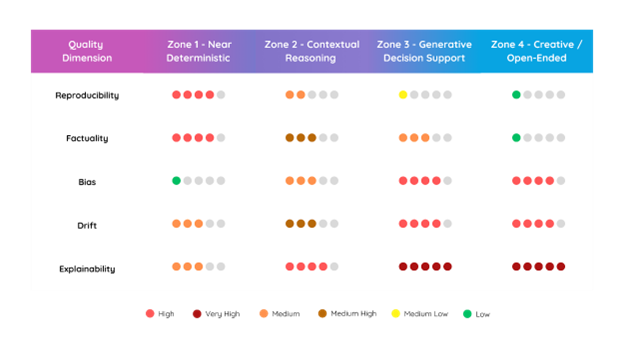
Factuality becomes critical in Zone 4 only when explicit factual claims are made.
As you move from Zone 1 → Zone 4:
- Reproducibility becomes less relevant (variance is critical for creativity)
- Bias becomes more critical (generative outputs can reinforce harmful patterns)
- Explainability becomes essential (humans need to understand AI’s reasoning)
- Drift matters more (subjective quality standards change over time)
Where Does Your AI System fit?
It is a common misconception that AI models define quality behavior. In practice, quality is determined by the use case.
The same underlying model can sit in different zones depending on how it’s applied in the business.
Take GPT-4 as an example:
- Zone 1: Structured data extraction from documents
- Zone 2: Customer inquiry routing based on intent and context
- Zone 3: Executive summary generation for decision support
- Zone 4: Marketing tagline or creative copy generation
Same model, very different expectations; completely different QE strategies.
Talk to our AI Quality experts
Not sure where to begin? Book a 30-Minute AI Quality Engineering Consultation with us and review your AI system architecture and use cases with our AI Quality experts and identify your highest-risk quality gaps
A quick zone-classification guide
It is easy to assess output quality of an AI system by classifying it into the correct zones. Ask these questions to discover where your AI systems land on the Determinism Spectrum:
Zone 1: Near deterministic
- Does the same input always produce the same output?
- Is there a clear, objectively correct answer?
- Can accuracy be measured quantitatively?
Zone 2: contextual reasoning
- Does the system interpret context to respond appropriately?
- Should similar inputs produce similar—but not identical—outputs?
- Does reasoning adapt based on nuanced information?
Zone 3: generative decision support
- Does the system generate content that humans review or refine?
- Can outputs vary in phrasing while remaining accurate?
- Is usefulness to humans a key success metric?
Zone 4: creative/open-ended
- Is originality more important than consistency?
- Is success based on human preference rather than objective correctness?
- Are outputs evaluated on creativity, tone, or brand alignment?
The takeaway is simple: not all quality dimensions matter equally across zones. Where Zone 1 demands strict reproducibility, Zone 4 needs rigorous checks for bias, alignment, and explainability. It modifies your quality parameters to account for model purpose. For example, AI hallucination testing can be a point of focus for Zone 1 systems where factual accuracy is critical.
Download: Classify Your AI System in 5 Minutes with the Determinism Spectrum framework with:
- Zone classification worksheet (4 simple questions)
- Quality dimension priority matrix (which dimensions to test first)
- Testing approach recommendations (methodologies by zone)
Building Your QE Strategy Using the Spectrum
Once you’ve classified your system, the Determinism Spectrum becomes operational, not theoretical. Follow the steps below:
1. Classify the system: Start by determining the intended behavior and business use case for the model
2. Prioritize quality dimensions: Focus on the dimensions that matter most for your zone instead of testing everything under the same umbrella
3. Select zone-appropriate methodologies:
- Zone 1: Regression testing, accuracy metrics, automated unit tests
- Zone 2: Variance analysis, counterfactual testing, confidence scoring
- Zone 3: Human-in-the-loop evaluation, output quality rubrics, hallucination detection
- Zone 4: Brand alignment scoring, bias detection, human preference testing
4. Define success metrics:
- Zone 1: Accuracy thresholds (>95%), pass/fail rates
- Zone 2: Acceptable variance ranges (<10%), reasoning consistency
- Zone 3: Output quality scores, relevance ratings
- Zone 4: Brand alignment, bias flags, creative effectiveness
5. Monitor continuously: Higher-zone systems need stronger drift detection and ongoing human evaluation to stay aligned with business intent
Next Steps: How to Apply This Framework
Ready to implement this framework? Get started with these downloadable kits:
Classify your AI system in under 10 minutes
Our Determinism Spectrum framework has everything you need to classify your AI systems and match AI testing strategies.
What’s inside:
- 4-zone comparison table with examples and variance thresholds
- Classification worksheet (4 questions to determine your zone)
- Quality dimension priority matrix (where to invest testing effort)
- Testing approach recommendations (methodologies by zone)
Download: Classify Your AI System in under 10 Minutes and match Your Testing Strategy to Your AI System with the Determinism Spectrum Framework
How reliable is your AI system?
Get your personalized AI Quality Report in 10 minutes. See your scores across 7 dimensions, identify your biggest risks, and get a tailored roadmap—all emailed instantly.
Explore the 5 dimensions of AI quality in depth
The Determinism Spectrum tells you which quality dimensions to prioritize. To learn how to test for reproducibility, factuality, bias, drift, and explainability:
Talk to our QE experts
Not sure where to begin? Book a 30-Minute AI Quality Engineering Consultation with and review your AI system architecture and use cases with our AI Quality experts and identify your highest-risk quality gaps:
- Discuss proven approaches from similar implementations
- Outline a phased QE roadmap tailored to your system
Have questions about AI quality engineering? Email us at connect@zucisystems.com
Related resources
Join Srinivasan Sundharam (Head of GenAI CoE, Zuci Systems), Sujatha Sugumaran (Head of QE Practice, Zuci Systems), and Ankit Nath (Everest Group) as they unpack:
- Why 88% of AI pilots fail to reach production—and what the 12% do differently
- QE maturity stack for AI systems
- Determinism by Design approach to testing AI systems
- Real-world case studies: Banks, healthcare providers, and fintech companies that scaled AI using systematic QE
Webinar: Redefining QE for AI: Testing probabilistic systems deterministically, in collaboration with the Everest Group
Need Help Implementing?
At Zuci, we’ve applied the Determinism Spectrum across banking, healthcare, and fintech to help teams move from AI pilots to production with confidence.
Our QE for AI services spans:
- AI output quality assurance
- Traditional ML model testing and validation
- AI assurance strategy
- AI business value assurance
Explore our QE for AI services
Frequently asked questions: the Determinism Spectrum
Can the same AI model fall into different zones?
Yes; the same AI model (like GPT-4 or Claude) can operate in different zones depending on how it’s used:
- Zone 1: Using GPT-4 to extract structured data from invoices (deterministic)
- Zone 2: Using GPT-4 to route customer inquiries to the right department (contextual)
- Zone 3: Using GPT-4 to generate executive summaries for review (generative decision support)
- Zone 4: Using GPT-4 to write marketing copy (creative)
What if my AI system falls between two zones?
Do I need to test all five quality dimensions for every AI system?
How do variance thresholds work in practice?
What’s the difference between the Determinism Spectrum and the 5 Dimensions of AI Quality?
How often should I re-classify my AI systems?
Can I use traditional QA tools for any zone?
What if my organization is testing AI the wrong way right now?
Is the Determinism Spectrum relevant for traditional ML models or just GenAI?
About the Author
Srinivasan Sundharam
Head, Gen Al Center of Excellence, Zuci Systems
Srinivasan heads Zuci’s Generative Al Center of Excellence, leading Srinivasan heads Zuci’s Generative Al Center of Excellence, leading initiatives that unite Al, engineering, and enterprise transformation. With over 20 years of experience in technology strategy and digital platforms, he helps organizations design scalable Al systems that balance creativity with control.
About Zuci Systems
Zuci Systems is an AI-first digital transformation partner specializing in quality engineering for AI systems.
Named a Major Contender by Everest Group in the PEAK Matrix Assessment for Enterprise QE Services 2025 and Specialist QE Services, we’ve validated AI implementations for Fortune 500 financial institutions and healthcare providers.
Our QE practice establishes reproducibility, factuality, and bias detection frameworks that enable enterprise-scale AI deployment in regulated industries.
Share On

The 5 Dimensions of AI Quality: A Guide to Scaling AI from Pilot to Production
The Three Most Common AI Testing Mistakes (And How to Fix Them Before Production)
Author’s Profile

Head, Gen Al Center of Excellence, Zuci Systems|