Blog
Building Intelligent Automation: The Role of AI Agents in Modern Software Development
25 Feb, 2025
- 3 min read
Share On


Software development is constantly shifting, and we now find ourselves at a thrilling crossroads: the convergence of traditional automation and artificial intelligence. What happens when we elevate our automation frameworks from simple script-driven processes to intelligent, self-adapting systems? The emergence of AI agents in development workflows isn’t just another technological trend—it’s a fundamental shift in how we approach software development and maintenance.
The Evolution of Development Automation
Traditional automation has served us well like scripts, CI/CD pipelines, and automated testing frameworks have become the backbone of modern development practices. But what if our automation could think, learn, and adapt? This is where AI agents become important, transforming our static automation into dynamic, context-aware systems. As businesses seek more sophisticated automation solutions, these agents are growing in popularity: In 2024, the global AI agents market size was valued at approximately USD 5.40 billion and is projected to expand at a CAGR of 45.8% between 2025 and 2030.
Understanding AI Agents in Development
AI agents represent a paradigm shift in development automation. Unlike conventional automation tools that follow predetermined paths, these intelligent entities can:
- Analyze code patterns and suggest optimizations in real-time
- Automatically detect and respond to system anomalies
- Learn from developer behaviors to anticipate needs
- Orchestrate complex workflows with minimal human intervention
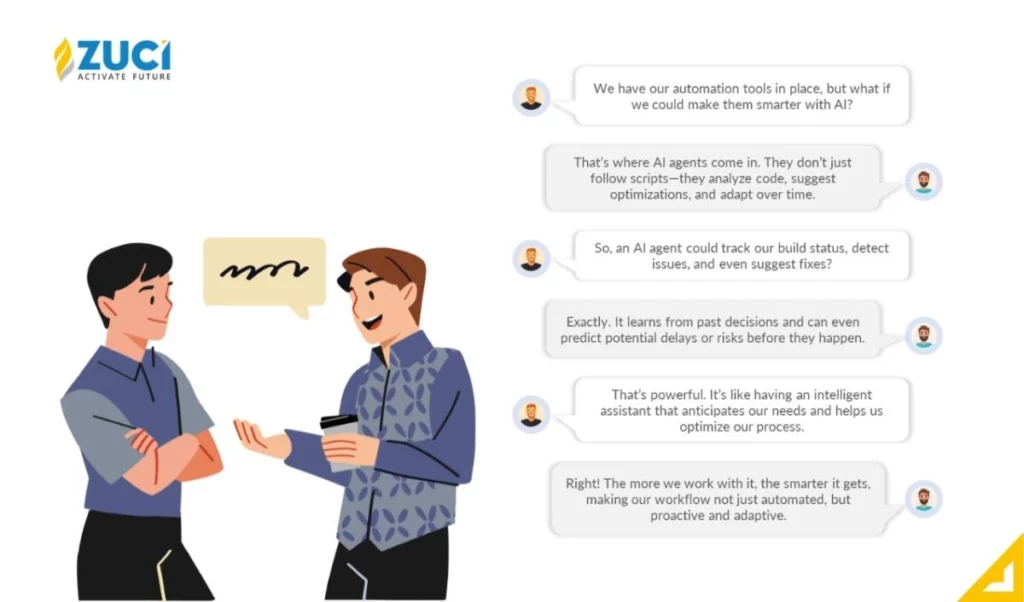
A Practical Example: AI Agents at Work
Let’s bring this to life with a quick scenario:
The Building Blocks of Intelligent Automation
The journey from manual processes to intelligent automation isn’t a single leap—it’s a thoughtful progression. With the right software engineering services in place, businesses can seamlessly integrate AI agents into their automation frameworks, ensuring efficiency and adaptability. Consider the layers of this evolution:
- Foundation: Traditional Automation
Begin with solid automation fundamentals. Your CI/CD pipelines, testing frameworks, and deployment scripts form the bedrock upon which intelligence can be built. These systems provide the structured data that AI agents need to learn and improve.
- Integration: Adding Intelligence
What transforms a simple automated process into an intelligent one? The key lies in implementing AI agents that can:
- Monitor system metrics and development patterns
- Make decisions based on historical data and current context
- Adapt workflows in response to changing conditions
- Collaborate with human developers through natural language interfaces
- Evolution: Learning and Adaptation
The true power of AI agents emerges in their ability to evolve. Each interaction, each decision, and each outcome become part of their learning model. But how do we ensure this evolution aligns with our development goals?
Practical Implementation Steps
To implement AI agents effectively in your development workflow:
- Start by identifying repetitive tasks that require context-aware decision making
- Implement monitoring systems that can feed rich data to your AI agents
- Deploy initial agents with limited scope but clear learning objectives
- Gradually expand agent responsibilities as they demonstrate reliability
The Future of Development Automation
As we look ahead, the question isn’t whether AI agents will become integral to development workflows, but how profoundly they’ll transform our approach to software development. Are we moving toward a future where AI agents become peer developers rather than just tools?
Consider the implications: development environments where AI agents proactively identify potential issues, suggest architectural improvements, and even handle routine maintenance tasks autonomously. This isn’t science fiction; it’s the natural evolution of our development practices.
Summing Up
The future of development automation lies not in replacing human developers but in amplifying their capabilities through intelligent collaboration with AI agents. As these systems become more sophisticated, we’re not just automating tasks, we’re reimagining the very nature of software development itself.
Connect with our experts to learn more about building intelligent automation solutions!

Share On


Cloud Cost Optimization: Top Practices to Make the Best Out of Your Cloud Investment
AI-powered SDLC: Automating Coding, Testing, and Deployment to Stay Competitive
Author’s Profile

Activate Future|