Blog
From Validated AI Use Case to Working MVP in 9–12 Weeks: The Execution Model
22 May, 2026
- 13 min read
Share On




Last reviewed : 22nd July 2026
Key Takeaways
- Design decisions made during the MVP phase determine whether the system can be governed and scaled in production.
- Deciding which components of a system are deterministic and which are probabilistic is the design decision that determines whether the system can be audited and controlled in production.
- Governance, observability, and human-in-the-loop controls built into the MVP carry forward into production.
- A working MVP in 9 to 12 weeks is a consequence of reusable engineering and standardized design. The speed comes from eliminating ground-up development.
A prioritized use case solves the selection problem. It does not solve the execution problem, and the two require different disciplines.
What we see consistently across engagements is that teams who applied real rigor to use case selection arrive at the build phase without an equivalent model for execution. The MVP gets scoped informally, built as a prototype, and governance gets deferred to a later stage. By the time that stage arrives, the system has to be redesigned before it can survive real users, which means the time saved at the front gets spent twice at the back.
The execution model covered in this article is built around one principle: the MVP is the foundation of the production system. Governance, observability, and the deterministic boundaries that make a system auditable in production are architectural decisions that belong at the design stage. Deferring them moves the cost forward and compounds it.
This is the fourth article in a five-part series on the enterprise AI journey. Earlier articles cover the strategic front: identifying the right problem, filtering viable use cases, and sequencing what to fund first. This article covers the three-stage execution model for moving a prioritized use case to a working MVP in 9 to 12 weeks, built to scale from day one.
6 Principles That Drive Delivery
Moving from idea to MVP is not just an execution problem. It requires a disciplined approach that balances speed, engineering rigor, and long-term scalability. Our methodology is anchored on six principles that ensure AI initiatives deliver value quickly without creating rework or technical debt later.
- Speed with Purpose
The first proof point of any AI initiative should be visible within 9 to 12 weeks. This is not about building a feature-complete system, but about validating whether the use case can deliver measurable business impact. Speed is critical to maintain stakeholder momentum and enable early decision-making. - Build Once, Reuse Forward
Unlike traditional prototypes, our MVPs are not throwaway experiments. Every component built during the MVP phase is designed to be reused and extended as the solution evolves into a pilot and eventually into a full-scale implementation. This ensures continuity and avoids rebuilding from scratch. - Determinism by Design
Not all problems should be solved using AI. We explicitly distinguish between deterministic components, such as rules, workflows, and validations, and probabilistic components, such as interpretation, reasoning, and generation. This ensures that AI is applied where it adds value, while critical business logic remains controlled, predictable, and auditable. - Value-First Validation
The objective of the MVP is not technical experimentation but business validation. Every build activity is tied back to a clear value hypothesis, whether it is reducing manual effort, improving accuracy, or accelerating cycle time. - Enterprise Readiness from Day One
Even at the MVP stage, we incorporate foundational elements such as governance, explainability, and human-in-the-loop controls. This ensures that the transition from MVP to pilot does not require re-architecture and can scale seamlessly. - Accelerated Engineering through Tooling and Reuse
Speed is achieved not by cutting corners, but by leveraging modern development tools such as Claude, GitHub Copilot, Cursor, Replit, and BOLT for rapid SDLC compression. These are complemented by Zuci’s own accelerators, enabling teams to move faster without compromising engineering quality.
The 3-Stage Execution Model
Translating a prioritized use case into a working solution requires a structured approach that balances speed, validation, and scalability. Our execution model is designed to move rapidly from concept to value, while ensuring that what is built can evolve seamlessly into a full-scale implementation.
The journey from idea to MVP is executed across three distinct but connected stages.
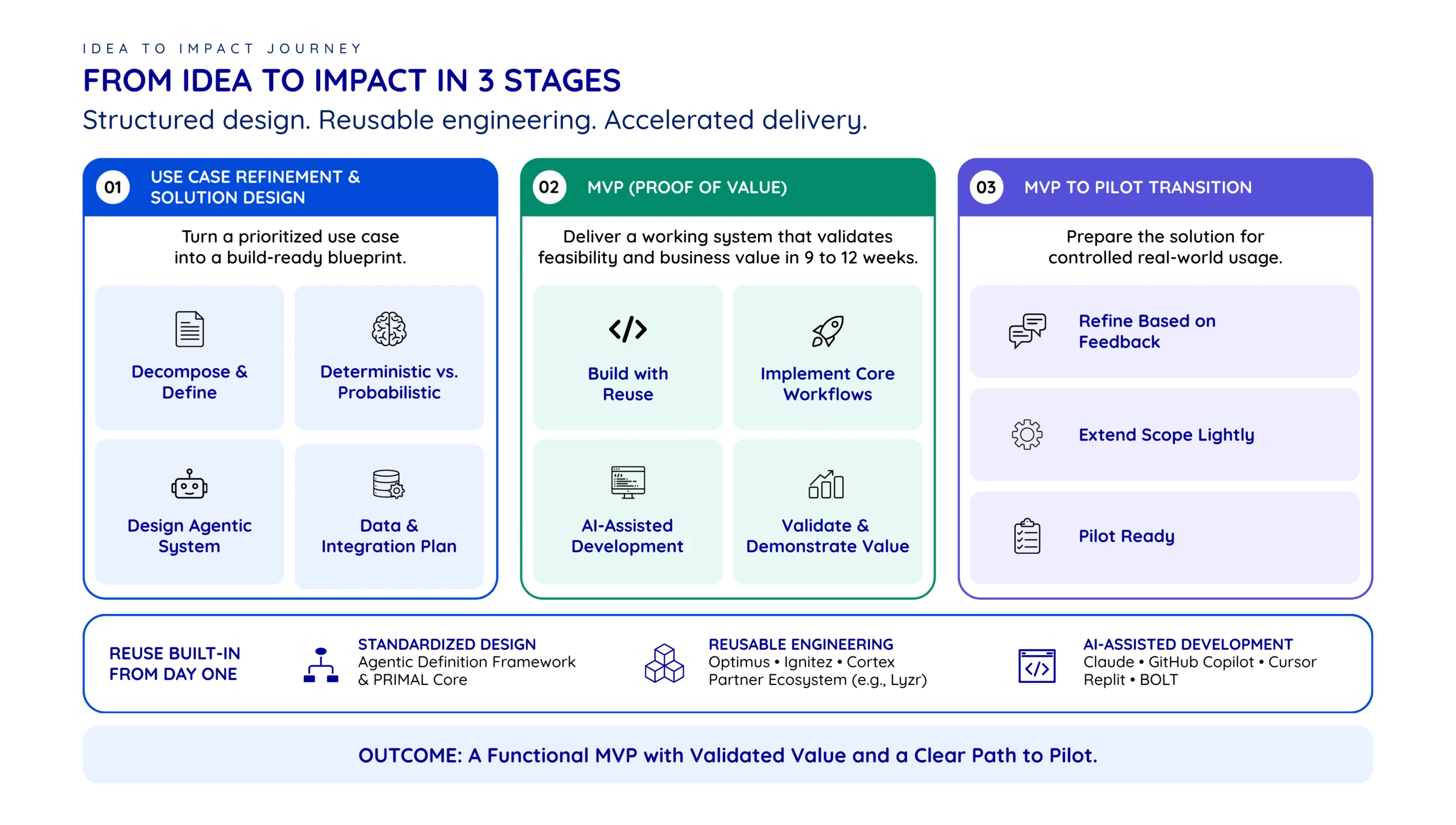
Stage 1: Use Case Refinement and Solution Design
This stage focuses on converting a prioritized idea into a build-ready blueprint. While the use case has already been identified and prioritized, it typically exists at a high level and requires further refinement before execution.
At this stage, you work with business and technology stakeholders to decompose the problem into its core components, identify underlying constraints, and define the desired outcomes in measurable terms. A key aspect of this phase is the explicit classification of the solution into deterministic and probabilistic components, ensuring that AI is applied only where it adds value, while critical workflows remain governed by predictable logic.
In parallel, you define the agentic architecture and interaction model, including agent roles, actions, triggers, guardrails, and human-in-the-loop checkpoints. Data requirements, integration touchpoints, and success metrics are also established.
The outcome of this stage is a clear, execution-ready design, including solution architecture, component boundaries, and a well-defined plan for MVP development.
Stage 2: MVP as Proof of Value
The MVP stage is focused on delivering a working system within 9 to 12 weeks that validates both technical feasibility and business value. This is the most critical phase, where speed and disciplined engineering come together.
Instead of building from scratch, the MVP is accelerated through the use of reusable design frameworks and engineering components. The agentic definition framework and PRIMAL Core standardize how agents are designed , while reusable system components from OPTIMUS and CORTEX are configured rather than developed. Modern AI-assisted development tools such as Claude, GitHub Copilot, Cursor, Replit, and BOLT further compress development timelines.
The MVP focuses on implementing the core value-driving workflows, integrating essential data sources, and enabling end-to-end execution for a defined scope. Where applicable, human-in-the-loop mechanisms are incorporated to ensure control and reliability.
By the end of this stage, stakeholders are able to interact with a functional system, observe measurable improvements, and make informed decisions on scaling the solution.
Stage 3: MVP to Pilot Transition
Once the MVP demonstrates value, the focus shifts to preparing the solution for controlled real-world usage.
This stage involves refining the solution based on initial feedback, improving usability, and extending coverage to support a slightly broader scope or user base. The emphasis is on ensuring that the system can operate reliably in a live environment, without significantly altering the core architecture established during the MVP.
The outcome of this stage is a pilot-ready solution, along with clarity on how the MVP can be expanded and adopted in a real business setting.
Not sure which use case deserves the first MVP build?
The AI Use Cases Prioritization Matrix walks you through balancing quick wins with strategic bets before you commit a sprint.
What Makes This Approach Different
Our approach is fundamentally different, not because of any single tool or framework, but because of how we combine engineering discipline, structured design, and accelerated execution into a cohesive model.
From Experimentation to Engineered Systems
Traditional approaches to AI often begin with experimentation: trying models, testing prompts, and iterating without a clear system design. While this can generate early insights, it rarely translates into scalable solutions. Our approach starts with structured problem decomposition and system design, ensuring that what is built during the MVP phase is not an isolated experiment, but the foundation of a production-ready system.
Determinism by Design, Not Afterthought
A common challenge in AI implementations is the over-reliance on probabilistic models for problems that require consistency and control. We address this by explicitly defining deterministic and probabilistic boundaries at the design stage. Deterministic components govern workflows, validations, and decision enforcement, while AI is applied selectively for interpretation and reasoning. This results in systems that are both intelligent and reliable, without compromising on control.
Reuse Over Reinvention
Most MVP efforts involve significant rework when transitioning to pilot or scale. In contrast, our approach emphasizes reuse from the very beginning. Design frameworks, agent definitions, and system components are standardized, allowing teams to configure rather than rebuild. This not only accelerates development but also ensures consistency across use cases and implementations.
Acceleration Through Integrated Tooling
Speed is achieved through a combination of modern development tools and internal accelerators. AI-assisted development platforms such as Claude, GitHub Copilot, Cursor, Replit, and BOLT compress the software development lifecycle, while reusable components and predefined patterns reduce the need for ground-up engineering. This integrated approach enables rapid delivery without sacrificing quality.
Value-Centric Execution
AI initiatives often lose momentum when technical progress is not clearly tied to business outcomes. Our model ensures that every stage of execution is anchored to measurable value hypotheses. MVPs are designed not just to function, but to demonstrate tangible improvements in efficiency, accuracy, or decision-making, enabling faster and more confident investment decisions.
Built for Continuity, Not Handoffs
In many implementations, there is a disconnect between teams that experiment and those that scale. Our approach eliminates this gap by ensuring continuity from design through MVP and into pilot. The same architectural principles, components, and design decisions carry forward, reducing friction and enabling a smoother transition to real-world deployment.
The Speed Engine: Standardized Agent Definition
A critical factor in achieving speed and consistency in AI initiatives is the ability to standardize how solutions are designed before they are built. In the absence of a structured approach, teams often spend significant time redefining agent behavior, interaction patterns, and control mechanisms for every use case, leading to inconsistency and delays.
Our approach addresses this through a standardized agent definition layer, anchored by the Agentic Definition Framework and PRIMAL Core. These provide a consistent way to translate a use case into a well-defined agentic system, ensuring that design decisions are both repeatable and scalable.
At the core of this approach is the structured definition of agents across key dimensions, including their objectives, actions, triggers, guardrails, and interaction patterns. This ensures that each agent is not just a loosely defined AI component, but a clearly scoped entity with defined responsibilities and boundaries. Human-in-the-loop checkpoints, escalation paths, and decision ownership are incorporated as part of the design, rather than being added later.
PRIMAL Core complements this by bringing a consistent approach to how agents reason, make decisions, and interact with each other. It provides a structured way to define how intelligence is applied within the system, including how context is interpreted, how decisions are derived, and how outputs are generated, while ensuring alignment with enterprise expectations around reliability and control.
This standardized design approach delivers two key advantages. First, it significantly reduces design time, as teams can rely on predefined patterns instead of starting from first principles. Second, it ensures consistency across use cases, making it easier to scale solutions across functions, teams, and multiple business units.
Most importantly, by formalizing agent behavior and interaction upfront, this approach creates a clear bridge between design and engineering, enabling faster and more predictable MVP development.
The Reusable Engineering Stack
While a structured design approach accelerates how solutions are defined, achieving real speed requires rethinking how systems are built. Traditional development approaches rely heavily on ground-up engineering, where core components such as orchestration, data pipelines, validation layers, and integration frameworks are repeatedly built for each use case. This not only slows down delivery but also introduces inconsistency across implementations.
Our approach eliminates this inefficiency through a reusable engineering stack, where foundational components of an agentic system are pre-built, standardized, and configurable. Instead of writing code for every layer, your teams assemble solutions using a combination of reusable components, automation frameworks, and AI-assisted development tools.
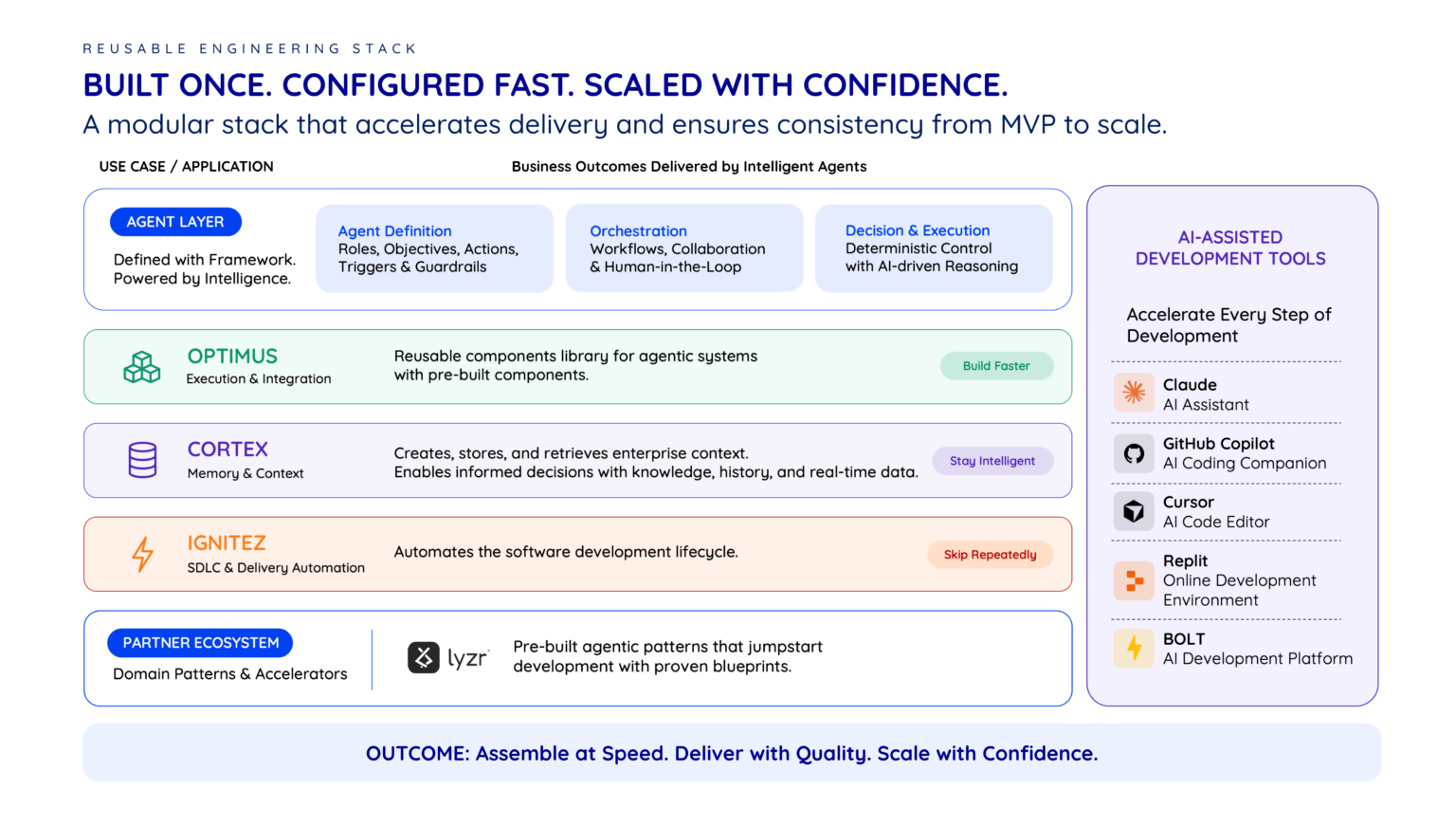
At the core of this stack is Optimus, which provides the fundamental building blocks required for agentic systems. These components are modular and configurable, enabling rapid assembly of solutions without compromising flexibility.
Complementing this is Ignitez, which accelerates the software development lifecycle by automating key SDLC activities such as requirements, build pipelines, testing workflows, and deployment processes. This reduces manual overhead and ensures that development progresses in a structured and repeatable manner.
Cortex serves as the memory and context layer, enabling agents to access structured knowledge, historical data, and contextual information required for decision-making. By standardizing how context is created, stored, and retrieved, Cortex ensures that intelligence is applied consistently across the system.
In addition to internal accelerators, we leverage a partner ecosystem including platforms like Lyzr , which provide domain-specific agentic blueprints for common workflows. These pre-defined patterns further reduce development effort and enable faster alignment to business scenarios.
Modern AI-assisted development tools such as Claude, GitHub Copilot, Cursor, Replit, and BOLT are used to compress development timelines by accelerating coding, testing, and integration activities.
Together, this combination of reusable components, automated engineering processes, and AI-assisted development enables a fundamental shift from building systems piece by piece to assembling and configuring them at speed. The result is not just faster delivery, but higher consistency, reduced engineering effort, and a strong foundation for scaling solutions beyond the MVP stage.
How We Achieve 9 to 12 Weeks
Delivering an MVP in 9 to 12 weeks is not driven by aggressive timelines, but by a structured combination of design, engineering, and tooling.
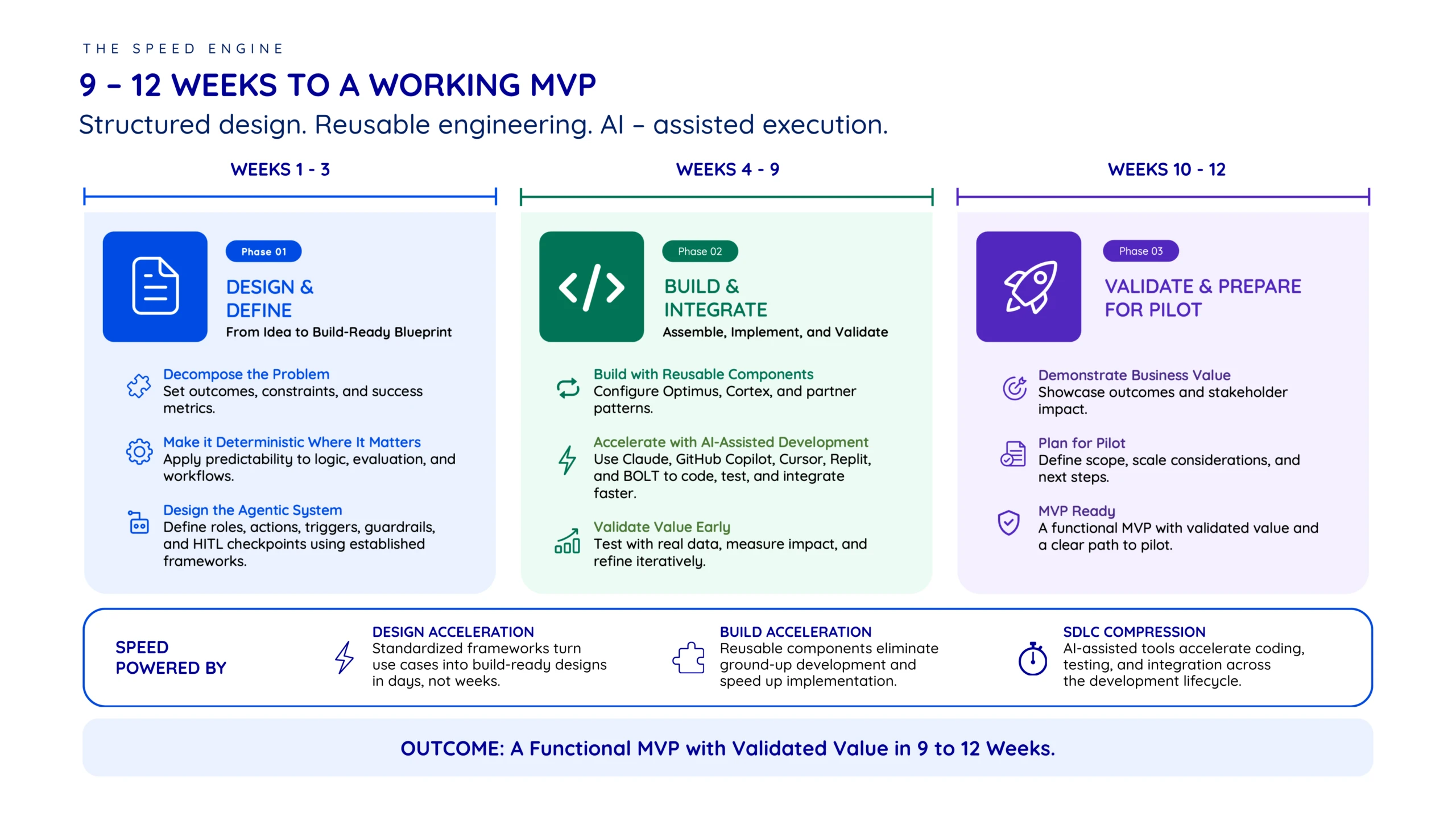
Speed is achieved through three key levers.
First, design acceleration ensures that use cases are quickly translated into build-ready blueprints using standardized frameworks such as the Agentic Definition Framework and PRIMAL Core.
Second, build acceleration is enabled through reusable components in Optimus, Ignitez, and Cortex, eliminating the need for ground-up development.
Finally, SDLC compression is achieved using AI-assisted development tools like Claude, GitHub Copilot, Cursor, Replit, and BOLT, which accelerate coding, testing, and integration.
Together, these elements enable rapid execution without compromising on structure, resulting in a functional MVP with validated business value within 9 to 12 weeks.
Ready to define your first MVP build?
An AI Workshop with Zuci takes your team from a prioritized idea to a build-ready POC design, with scope, success metrics, and an execution path locked before you start.
Built for Scale from Day One
A common challenge in AI initiatives is that MVPs often need to be reworked or rebuilt before they can be deployed in real-world scenarios. Our approach avoids this by ensuring that every MVP is designed with a clear path to pilot and scale from the outset.
By leveraging standardized design patterns, reusable components, and a structured architecture, the MVP is not treated as a temporary prototype, but as the foundation of the final solution. This ensures continuity in design, engineering, and execution as the solution evolves.
As a result, the transition from MVP to pilot becomes a focused expansion rather than a reinvention, enabling faster adoption and reducing overall time to value.
Where to Go From Here
This is the fourth blog in this series on the enterprise AI journey. If you are starting your journey, begin with the earlier posts in the series before moving into execution.
- Blog 1 – Building the decision-making infrastructure before you pick a use case.
- Blog 2 – The 6-filter framework for separating viable candidates from expensive distractions.
- Blog 3 – Using the 2×2 matrix to sequence your first investments for momentum and transformation.
If you have a prioritized use case and are ready to move into execution, book an AI Workshop with Zuci. In one focused engagement, your team will define the problem, apply the prioritization framework, and leave with a build-ready POC design, clear scope, success metrics, and a defined execution path.
About Zuci Systems
Zuci Systems is an AI-first digital transformation partner specializing in quality engineering for AI systems. Named a Major Contender by Everest Group in the PEAK Matrix Assessment for Enterprise QE Services 2025 and Specialist QE Services, we’ve validated AI implementations for Fortune 500 financial institutions and healthcare providers.
Our QE practice establishes reproducibility, factuality, and bias detection frameworks that enable enterprise-scale AI deployment in regulated industries.
Explore more at Zuci Systems
Frequently Asked Questions
1. What is the difference between a POC and an MVP in enterprise AI?
A proof of concept is a controlled experiment with one job: prove that AI can solve the hardest part of a specific problem. It is not designed for real users or real workflows. An MVP is a production-grade, limited-scope system that has to hold up when actual people use it in actual conditions. Teams that build a POC and call it an MVP discover the difference when real users arrive.
2. How realistic is a 9 to 12 week timeline for an enterprise AI MVP?
3. What does Determinism by Design mean in practice?
4. How do you ensure an MVP does not need to be rebuilt before pilot?
Author's Profile

Head, Gen Al Center of Excellence, Zuci Systems

Srinivasan heads Zuci’s Generative AI Center of Excellence, leading initiatives that unite AI, engineering, and enterprise transformation.
With over 20 years of experience in technology strategy and digital platforms, he helps organizations design scalable AI systems that balance creativity and control.
Share On


AI Use Case Prioritization: How to Sequence Quick Wins Before Strategic Bets
Scaling AI from Pilot to Enterprise: The 7-Layer Control System You Can't Defer
Author’s Profile

Head, Gen Al Center of Excellence, Zuci Systems|