Blog
AI Use Case Prioritization: How to Sequence Quick Wins Before Strategic Bets
22 May, 2026
- 12 min read
Share On




Key Takeaways
- The most ambitious use case on a shortlist almost always comes with the heaviest delivery burden. Teams that lead with it tend to underestimate the effort, overestimate the speed of adoption, and end up with a large initiative that produces results that are hard to attribute to AI.
- Revenue impact should lead the value scoring. Use cases tied to win rates, leakage reduction, or measurable operational outcomes survive budget conversations in a way that productivity gains rarely do.
- Quick wins build the data pathways, governance patterns, and stakeholder confidence that make the harder bets fundable.
- Organizations that stay in quick win mode produce motion without transformation. The quick win earns the right to make the strategic bet.
The instinct on most leadership teams, once a filtered shortlist exists, is to lead with the most ambitious use case. If the organization is committing to AI, the argument goes, it should go after the biggest opportunity available.
In practice, the most ambitious use case on a shortlist almost always comes with delivery complexity that was not visible when the idea was first championed. Dependencies surface late, data access turns out to be harder than assumed, and the path to a visible result is longer than the original framing suggested. By the time that becomes clear, the initiative has consumed enough time and credibility that the next funding conversation is harder than it needed to be.
The sequencing decision deserves as much discipline as the filter that produced the shortlist.
This is the third article in a five-part series on the enterprise AI journey. Blog 1 covered why AI programs stall before they have picked the right problem. Blog 2 covered the filter that separates viable candidates from ideas that cannot survive a POC. This article covers: which candidate to fund first, and how to make that decision defensible to the leadership team that has to approve it.
The path your first use case takes
Before going into how to sequence your options, it helps to understand where this decision sits in a broader execution path. Because the choice you make here does not just determine what gets built first, which in turn determines how the rest of your AI journey unfolds.
Moving an AI use case from idea to production typically follows four stages:
- Initiation: Identify, filter, and prioritize use cases, then design the POC plan. This is where the sequencing decision lives.
- POC: Run a focused 9 to 12 week build that proves AI can solve the hardest part of the problem. Treat it as a test that de-risks the core assumption before you commit to a full build, not as a shippable product.
- Pilot: Deploy a production-grade mini version to real users in real workflows. Validate that the solution works in practice, not just in a controlled environment.
- Scale: Roll the validated solution out across functions, sites, or geographies with the operating patterns and stakeholder confidence you built in earlier stages.
The use case you choose to move first determines how quickly you reach the end of that path, and whether the results you produce along the way are strong enough to earn the next investment.
Are you still figuring out where to begin with AI and how to align it to business priorities?
Read our blog, it lays out the foundation for identifying the right opportunities before prioritization.
Enterprise AI Strategy: The POC vs. Pilot Mistake That Derails Most Programs
Why the first use case decision matters so much
The instinct for most teams is to start with the most ambitious option. If you’re going to invest in AI, go after the biggest opportunity. It’s a reasonable instinct. It’s also the one that most reliably leads to disappointment.
The most transformational use case on paper almost always comes with the heaviest delivery burden, more dependencies, messier data, broader workflow changes, more stakeholder coordination, and a much longer path to any visible result. Teams underestimate the effort, overestimate the speed of adoption, and end up with a large initiative that takes longer than expected and produces results that are genuinely hard to attribute to AI.
The first use case also shapes how the business will judge AI from that point forward. A first initiative that drags, overruns, or fails to produce clear results makes the next investment conversation significantly harder. A first initiative that delivers value builds the internal credibility that makes everything else possible.
Before prioritization: does your list need filtering first?
If your list of AI ideas is still long and unfiltered, prioritization alone will not give you a reliable answer. Plotting too many ideas on a matrix produces noise, not clarity.
The step before prioritization is filtering; running every idea through a set of yes-or-no questions that separate the viable from the interesting-but-unbuildable. The filter checks six factors: strategic alignment, GenAI fit, data and tech readiness, business value potential, implementation feasibility, and adoption readiness. Ideas that fail on data readiness or risk are disqualified immediately, regardless of how strong the value case looks.
If your AI ideas are still sitting in a long, unfiltered list, you’re jumping ahead. Before you score anything on value versus effort, you need to run every idea through a hard filter. The previous post in this series walks through that framework in detail, the prioritization matrix only works when you’re applying it to a shortlist that has already survived that screen.
The 2×2 Framework: Business Value vs. Implementation Effort
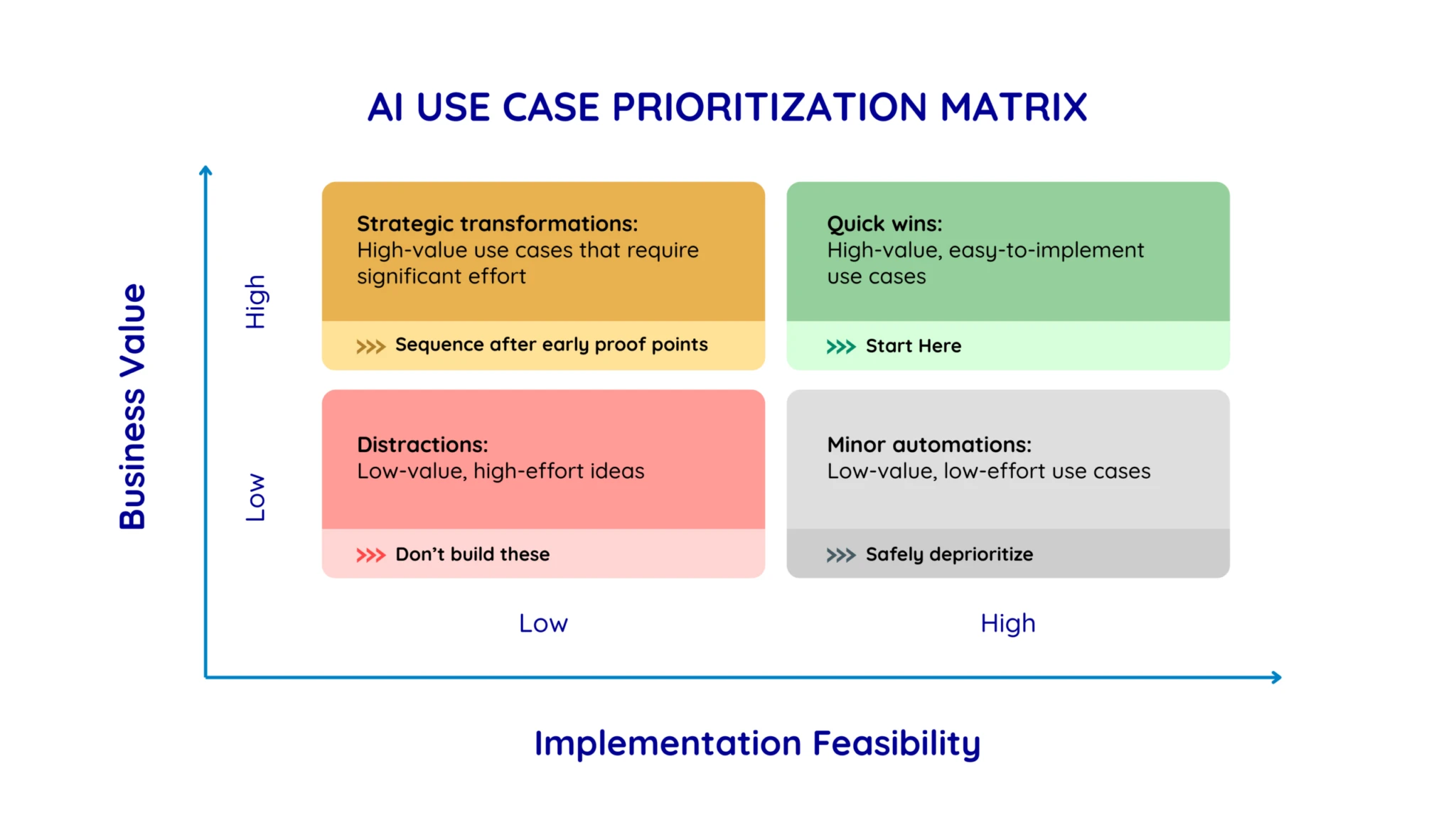
Once your list has been filtered down to the genuine AI candidates, the prioritization question becomes tractable. Which use case should you lead with? What follows?
A simple two-by-two matrix, business value on one axis, implementation effort on the other, gives leadership a clear view of trade-offs before committing budget and delivery capacity.
The four quadrants
| Quadrant | What It Means | What To Do |
|---|---|---|
| Quick Wins | High value, low effort | Start here |
| Strategic Bets | High value, high effort | Build toward these |
| Minor Automations | Low value, low effort | Deprioritize unless they fill a real gap |
| Distractions | Low value, high effort | Park them for now |
The matrix works because it forces two separate questions to be answered separately. The first, “is this worth doing?” was answered by the filter. The second, “is this the right place to start?“ is answered here.
What business value actually means
Business value should connect to outcomes that leadership already tracks. Revenue growth, win-rate improvement, leakage reduction, new revenue from a segment carries more weight than productivity or cost savings alone. Its impact is observable within a realistic decision window and harder to dismiss in a results conversation.
A strong use case should answer two questions cleanly:
- Does it move a metric the business already tracks?
- Can the impact be seen within a timeframe that matters?
How to assess implementation effort realistically
Implementation effort is where teams often become overly optimistic. In practice, effort includes data readiness, workflow quality, integration burden, the human review model, change management, and the speed at which the business can absorb a new process.
When teams underestimate effort, almost every idea starts to look urgent. The issues that weren’t pressure-tested in the first discussion — weak data access, unclear ownership, missing validation steps, process friction — surface later, at much higher cost.
Why Start with Quick Wins When Strategic Bets Are More Exciting
Strategic bets promise bigger change, broader impact, and stronger executive visibility. In practice, they are rarely the right first move.
Quick wins are high-value use cases with a shorter path to proof. Starting there is not about thinking small — it is about building the operating discipline that broader AI adoption depends on.
Quick wins:
- Prove value on metrics leadership already tracks
- Surface data, governance, and human review issues earlier and at lower risk
- Are easier to operationalize inside existing workflows
- Create internal sponsors who can support the next initiative
The first use case also produces something that did not exist before: working data pathways, clearer governance patterns, a better view of where human review matters, and earned confidence from business stakeholders. That is what makes the next bet easier to absorb.
The trap to avoid
Some organizations get comfortable living in quick win mode — choosing smaller, safer projects because they are easier to approve and easier to fund. This creates a familiar problem: plenty of motion, not enough transformation. Quick wins are a starting point, not a destination.
Not sure how to consistently evaluate and sequence your AI use cases?
Use our AI Prioritisation Playbook to score, compare, and build a clear execution roadmap.
The Path from Quick Wins to Strategic Transformation
A strong prioritization matrix does not force a choice between quick wins and strategic bets. It creates a sequence.
In a financial services engagement, a client came to us with seven possible use cases. After filtering, four serious candidates remained. Plotting those four on the 2×2 made the sequence clear: one use case — a calibration problem in a controlled part of the process — became the quick win. A more complex resolution use case, which required broader change management and deeper data work, became the strategic bet to build toward.
The POC on the first use case proved the approach could work on the hardest part of the problem. By the time the pilot ran with real users, the team had cleaner data pathways, clearer governance patterns, and stakeholder confidence that hadn’t existed at the start. That’s what made funding the strategic bet a straightforward conversation rather than a leap of faith.
This is how quick wins fund strategic bets in practice. Once a use case demonstrates value, the next investment conversation is easier — stakeholders have seen something work, and the delivery team is not starting from zero.
The move toward strategic bets typically makes sense when three things are true: one use case has already shown measurable value, the team has reusable capabilities from the first build, and stakeholders trust the delivery process enough to expand scope.
The question most teams face at this point is not what to do next. It is how to move fast enough to keep the momentum alive while setting up the strategic bet to succeed.
This is where structure matters. At Zuci, we use the G.O.A.L framework to take a prioritized quick win from decision to demonstrated impact in as little as eight weeks.
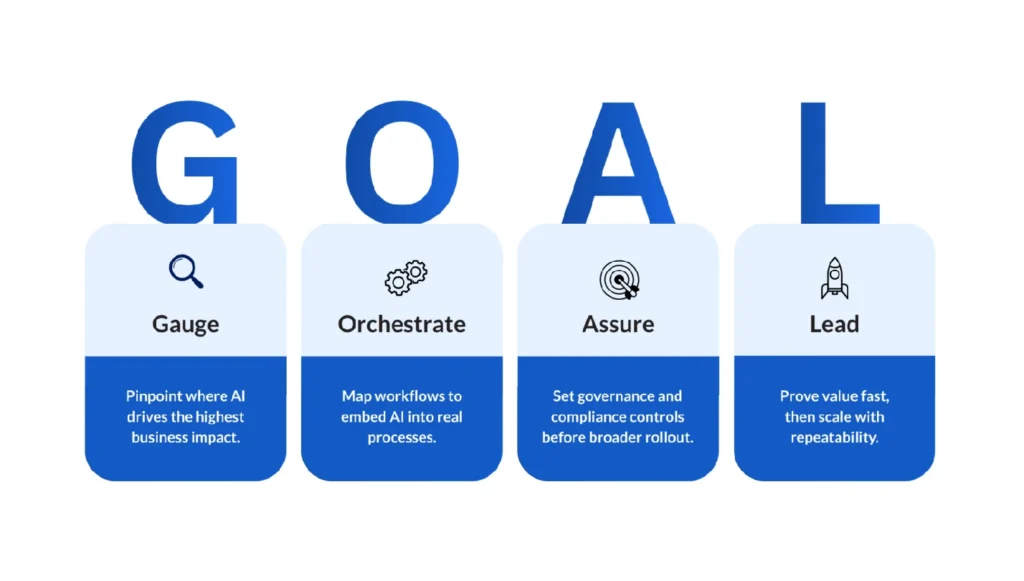
Gauge. The current state of the process is benchmarked against metrics leadership already tracks. This sets a clear baseline and defines what measurable improvement means for the use case.
Organize. The problem is broken down to identify where the bottleneck sits, what data is available, and whether the systems and inputs needed for the build are actually in place.
Align. The execution plan is tied to a single business KPI that can move within the eight-week window. Stakeholders agree upfront on what the outcome should look like and who owns it.
Lead. Execution begins with the narrowest scope that can prove the point. One workflow, one team, one measurable result, delivered fast enough to inform the next investment decision.
A quick win executed through this framework produces a business result along with the data pathways, governance patterns, and stakeholder trust needed to fund the strategic bet that follows.
Want a structured path from prioritized use case to demonstrated impact?
Zuci’s AI Enablement Playbook is built around the G.O.A.L framework and designed to move enterprises from experimentation to production AI with speed, governance, and confidence.
A Real-World Example: The Site Operations Case Study
A recent Zuci Systems engagement with a global energy leader shows what this sequence looks like in practice.
The business problem
The client operates hundreds of industrial facilities worldwide and was mid-way through a large-scale digital transformation. Manual and fragmented Digital Readiness Assessment processes were slowing rollout and increasing cyber risk. They needed a standardized, scalable way to evaluate IT/OT maturity, identify vulnerabilities, and prioritize high-impact sites.
Defining the right starting point
Stakeholder workshops were used to define the problem, establish business goals and KPIs, and identify the key issues. Root causes were classified into deterministic problems — scoring logic, validation rules, prioritization — and probabilistic ones such as voice and image inputs, reconciliation, and anomalies. That distinction defined where AI should assist and where logic needed to stay rule-based.
Building and validating the solution
The POC combined voice- and image-based data capture, a centralized data repository, an AI-driven site scoring engine, and rule-backed recommendations — with mock reports and dashboards to visualize outcomes. It demonstrated reduced manual effort, improved data quality, objective site readiness scoring, and proof of value.
The solution was then piloted at a single site with real users. Testing and feedback loops drove improvements to user experience, operational workflows, and data validation logic. Architecture was designed on GCP to support full rollout.
The outcome
Rollout approved across 100+ sites, with a site prioritization strategy, an established operating model for scale, and an implementation kickoff scheduled.
The strategic lesson
The team didn’t start with a hundred-site transformation. It scoped the problem precisely, proved the approach in a POC, validated it with real users, and built a sequenced path to full scale — exactly what this framework is designed to produce.
Ready to move from ideas to a PoC-ready shortlist?
In a focused AI workshop, we help you evaluate use cases, apply prioritisation filters, and define your first set of build-ready opportunities.
Next Steps : Sequence Your Way to Transformation
The sequencing decision is where most AI roadmaps either gain traction or quietly stall. Getting the first use case right builds the internal credibility, data pathways, and governance patterns that make every subsequent investment easier to approve and faster to deliver.
This is the third article in a five-part series on the enterprise AI journey.
The next article helps you move a prioritized use case into execution. Blog 4 covers the structured path from validated idea to working MVP in 9 to 12 weeks, built to scale from day one.
If you have something working and are trying to move it into production at enterprise scale, Blog 5 covers the control layer that makes a validated system trustworthy under real operating conditions.
If you would like to work through the sequencing decision with your team before committing to a build, book an AI Assessment Workshop and we will help you arrive at a prioritized shortlist with a defensible execution sequence attached.
About Zuci Systems
Zuci Systems is an AI-first digital transformation partner specializing in enterprise-grade AI agent design and multi-agent orchestration. We help Fortune 500 companies in banking, insurance, and healthcare design and deploy AI systems that are predictable, explainable, and production-ready.
Our approach combines structural discipline (7 design principles), intelligence design (PRIMAL Core framework), and enterprise controls (Trust Layer) to create agents that work reliably in regulated, high-stakes environments.
Contact: connect@zucisystems.com | www.zucisystems.com
Frequently Asked Questions
1. Should generative AI use cases be scored differently from traditional AI or automation use cases?
The value and effort scoring applies equally, but generative AI use cases carry additional evaluation criteria that traditional automation does not. Output quality, human review requirements, and governance overhead all affect the real implementation effort in ways that are easy to underestimate at the scoring stage. A use case that looks low-effort on the matrix can shift quadrants entirely once those factors are accounted for.
2. Who should own the prioritization decision?
3. How do you get leadership alignment on an AI investment decision?
Author's Profile

Head, Gen Al Center of Excellence, Zuci Systems

Srinivasan heads Zuci’s Generative AI Center of Excellence, leading initiatives that unite AI, engineering, and enterprise transformation.
With over 20 years of experience in technology strategy and digital platforms, he helps organizations design scalable AI systems that balance creativity and control.
Share On


The 6-Filter Framework for Evaluating AI Use Cases Before You Commit a Sprint
From Validated AI Use Case to Working MVP in 9–12 Weeks: The Execution Model
Author’s Profile

Head, Gen Al Center of Excellence, Zuci Systems|