Blog
Enterprise AI Strategy: The POC vs. Pilot Mistake That Derails Most Programs
22 May, 2026
- 8 min read
Share On




Key Takeaways
- The success of any AI program depends on the strategic decisions made around filtering and prioritizing use cases.
- When teams build proof of concept but consider it as a pilot see a sharp decline in user adoption and end up in pilot purgatory.
- Applying a structured filter to AI ideas before the first sprint begins eliminates risk to the program.
- The use case an organization funds first becomes the reference point against which every AI investment after it gets judged.
- You need to make five decisions in order: what problem to solve, which ideas survive a hard filter, what to fund first, how to build the first working system, and how to scale it under control.
Enterprise leaders are no longer debating whether to invest in AI or which model to build on. The harder question now is why so much of the work already underway is failing to produce outcomes that can be defended in a board setting.
Gartner reported in 2024 that only 48% of AI projects reach production, with the ones that do taking an average of eight months to get there. What connects these failures is the sequence in which decisions get made. Teams optimize for building the right system before resolving whether the problem is worth building for.
This is the first of five articles covering the enterprise AI journey from strategy through production scale. The series is structured around five decisions that have to be made in sequence: identifying the right problem, filtering the idea list to what is actually buildable, sequencing what to fund first, building the first working system, and scaling it under governance that holds at enterprise volume.
The first decision in that sequence, and the one most programs get wrong, is the distinction between a proof of concept and a pilot.
Pilot vs POC
Most organizations use “POC” and “pilot” interchangeably. But they are not the same thing, and conflating them is one of the most reliable ways to end up stuck.
A POC (Proof of Concept) is a controlled experiment. Its job is to prove that AI can solve the hardest part of a specific problem. It’s not meant to be shippable. It’s not meant to touch real users. It’s meant to answer one question: is this technically feasible and does it show value?
A Pilot is entirely different. It’s a production-grade, limited-scope version of the solution that is built for real workflows, real users, and real edge cases. It has to hold up when actual people use it.
When these two things are conflated, the team builds what they call a pilot, but it’s actually a POC. It works beautifully in a controlled environment. It impresses stakeholders in a demo. But when real users use it, it falls apart because it was never built to survive that.
This plays out in recognizable ways. A sales team wants win-rate improvement, so a team builds a summarization tool. The summary is clean. But it never touches pricing decisions, approvals, or the actual moment a deal is won or lost. Or operations wants to reduce revenue leakage, so a POC is built on sample data that is clean, curated, and nothing like the messy reality of live systems. The POC breaks in the first week when real users try to use it.
The business and technical teams are both working hard. But they’re optimizing for different things, and nobody connected the work to a measurable business lever. That’s pilot purgatory. It happens because the path from POC to pilot was not designed.
Is you AI project stuck in pilot?
Let’s figure out why. Book a 30-minute call with our team. We’ve taken several AI agents from pilot to production, and we’ve seen firsthand where things tend to break down.
Step one: Filter before you build
The fix starts before anyone writes a line of code.
If you have ten AI ideas in the room, which is usually what a good ideation session produces, you don’t need to run ten experiments to find out which ones are viable. You need a structured filter that tells you upfront which ideas have the ingredients to survive real-world constraints, and which ones will hit a wall three weeks into a POC.
At Zuci, we use a six-criteria framework that acts as a go/no-go gate. Every use case goes through it before any build decision is made.
- Strategic Alignment – Is there a specific KPI this use case is meant to move, and does someone own it? AI work that isn’t anchored to a business owner with a clear metric tends to drift. This criterion prevents you from building something impressive that nobody is accountable for.
- GenAI Fit – Is this actually a problem for GenAI, or would a deterministic rule or a simpler automation do the job better? Forcing GenAI onto structured, rules-based problems is a common and expensive mistake. The right question is whether the problem involves unstructured inputs, reasoning, or content generation — that’s where GenAI earns its place.
- Data & Tech Readiness – Does the data exist, is it accessible, and can the necessary systems actually be integrated with? A surprising number of POCs stall not because the AI doesn’t work, but because the data environment wasn’t ready. This criterion surfaces that blocker before it costs you weeks.
- Business Value Potential – What’s the expected revenue impact? Cost reduction? Risk reduction? The hierarchy matters here. Use cases that move a revenue or margin lever should rank above those that save internal time — more on why in a moment.
- Implementation Feasibility – Can this realistically be built to a point of value within a reasonable timeframe? Long, open-ended POCs that never reach production are often the result of not stress-testing effort and dependencies upfront.
- Adoption Readiness – Will the people who need to use this actually use it? A technically excellent solution that sits unused is worth nothing. This criterion forces an early assessment of change management needs, workflow integration, and whether the end users have been part of the conversation at all.
We ran this exact framework with a financial services client across seven use cases they had identified, all of them plausible, all of them genuinely interesting. Three were eliminated by the filter. Context-Aware Sanctions Screening was cut on Data & Tech Readiness, the underlying data wasn’t accessible enough to build on reliably. Perpetual KYC failed both Data Readiness and Implementation Feasibility. Removing them early was a decision worth making in a workshop rather than discovering six weeks into a build. Four use cases moved forward.
👉 We cover this filtering framework in detail here:
The 6-Filter Framework for Evaluating AI Use Cases Before You Commit a Sprint
Step two: Sequence what you build first
Passing the filter gets you to a shortlist. But you still have a decision to make: where do you start?
A simple 2×2 matrix – business value on one axis, implementation effort on the other – gives you a clean answer.
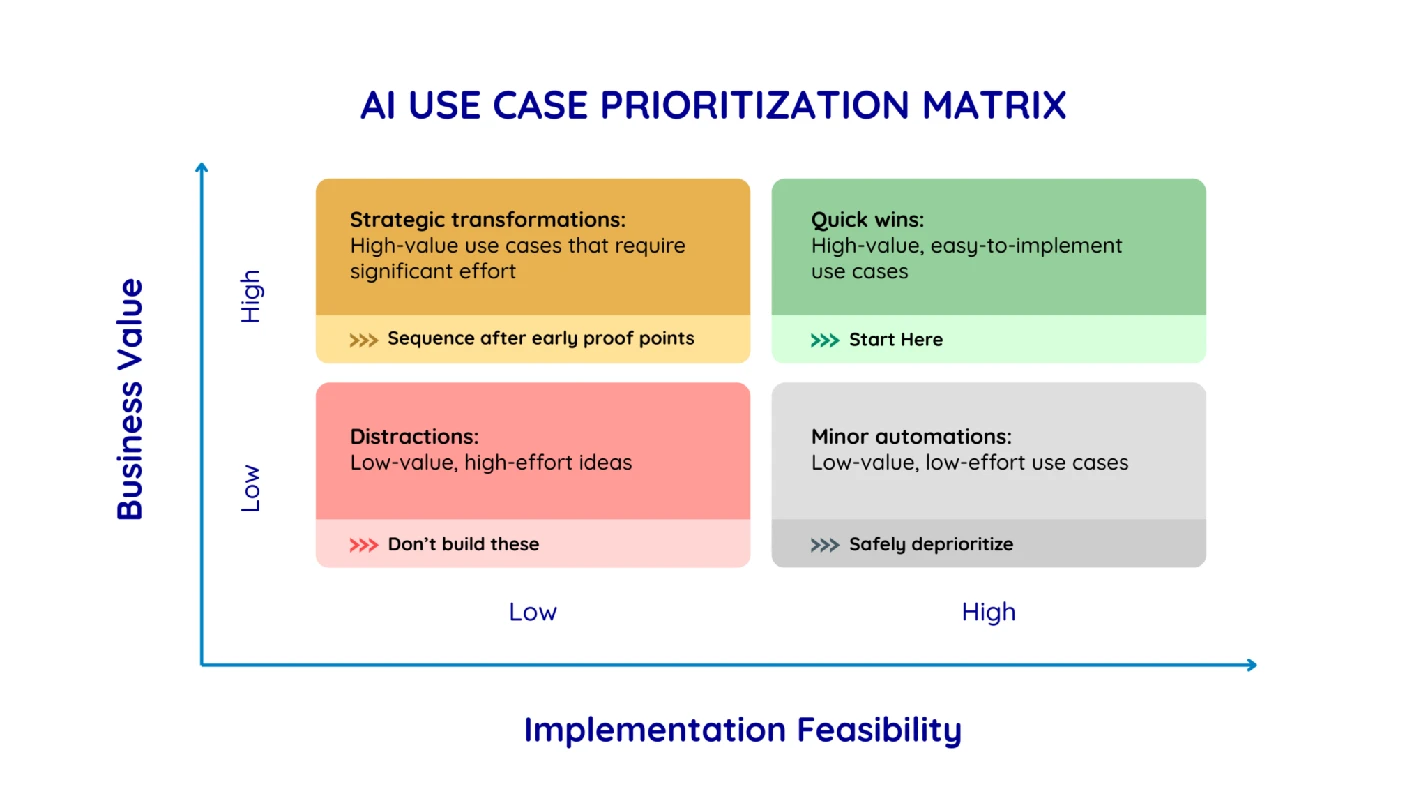
- Use cases that score high on both value and feasibility are your Quick Wins: start here.
- Use cases that score high on value but require significant effort are Strategic Transformations: sequence these once you have early proof points in place.
- Low value and low effort are minor automations you can deprioritize.
- Low value and high effort – just distractions. Don’t build them.
The more important discipline, though, is in how you define “business value.” Most teams default to productivity gains such as hours saved, manual effort reduced. Those matter. But they shouldn’t lead the prioritization.
Revenue impact should lead prioritization. Use cases that improve win rates, reduce revenue leakage, lift conversion, or open new revenue streams create visible proof that AI works for your business. That visibility is what builds the organizational trust and appetite for the harder, more transformational work that comes next. Productivity wins are often invisible to the people who approve AI budgets. Revenue and margin wins aren’t.
In the financial services example, Transaction Monitoring Threshold Calibration landed as a Quick Win with high business value, achievable within a realistic timeframe. UBO Resolution and Risk Flagging was positioned as a Strategic Transformation: high impact, but with dependencies that needed to be sequenced carefully. That distinction changed what the team built first and in what order.
👉 For a deeper breakdown of prioritization approaches:
AI Use Case Prioritization: How to Sequence Quick Wins Before Strategic Bets
Where to go from here
If your organization is at the “we’re exploring AI” stage and progress has stalled, running one more experiment won’t solve the issue. If you’ve already built something and can’t get it out of pilot, the question to ask is if the right use case was selected and if the scoping was structured enough to survive the transition to production.
What works is a structured starting point: a way to take the ideas already in the room, pressure-test them against business-led criteria, and come out with a prioritized shortlist with clarity on what to build first, what the POC needs to prove, and what success looks like.
That’s what Zuci’s AI Assessment Workshop delivers. In four to five weeks, we move from ideation to a prioritized use case backlog and a detailed POC design plan built with your team, grounded in your business context, and designed to survive contact with real users.
Ready to turn your AI ideas into an execution plan?
We work with your team in a focused workshop to identify, filter, and prioritize the right AI use cases — so you walk away with a clear roadmap to move forward.
The rest of the series covers the full journey from deciding what to build to operating it at scale:
- Blog 2: How to Identify High‑Value AI Use Cases and Filter Out Noise
- Blog 3: Balancing Quick Wins and Strategic Bets for Business Leaders
- Blog 4: Structured path from a prioritized use case to a working system in 9 to 12 weeks, built to scale from day one.
- Blog 5: Control layer that makes a validated MVP trustworthy at production scale, covering governance, observability, and continuous quality assurance.
About Zuci Systems
Zuci Systems is an AI-first digital transformation partner specializing in quality engineering for AI systems. Named a Major Contender by Everest Group in the PEAK Matrix Assessment for Enterprise QE Services 2025 and Specialist QE Services, we’ve validated AI implementations for Fortune 500 financial institutions and healthcare providers.
Our QE practice establishes reproducibility, factuality, and bias detection frameworks that enable enterprise-scale AI deployment in regulated industries.
Explore more at Zuci Systems
Frequently Asked Questions
1. What is the difference between a POC and a pilot in enterprise AI?
A proof of concept is a controlled experiment designed to answer one question: can AI solve the hardest part of this problem? A pilot is a production-grade, limited-scope deployment built for real users, real workflows, and real edge cases. Conflating the two is the most reliable path to building something that impresses in a demo and fails in production.
2. Why do most enterprise AI programs struggle to move beyond pilot?
3. How should enterprises decide which AI use case to fund first?
4. What does a structured path from AI exploration to production actually look like?
Author's Profile

Head, Gen Al Center of Excellence, Zuci Systems

Srinivasan heads Zuci’s Generative AI Center of Excellence, leading initiatives that unite AI, engineering, and enterprise transformation.
With over 20 years of experience in technology strategy and digital platforms, he helps organizations design scalable AI systems that balance creativity and control.
Share On


Legacy Modernization in the AI Era - What IBM's $30B Week Taught Me
The 6-Filter Framework for Evaluating AI Use Cases Before You Commit a Sprint
Author’s Profile

Head, Gen Al Center of Excellence, Zuci Systems|