Blog
AI Use Case Framework: How to Identify High-Value AI Use Cases - Blog 2 of 5
22 May, 2026
- 8 min Read
Share On




Key Takeaways
- To decide which use cases are worth building, you need a disciplined filtering approach.
- A use case that fails the binary filter on data access, KPI ownership, and implementation feasibility has no viable foundation, regardless of how the value case reads on paper.
- If the problem can be solved with rules-based logic, GenAI is unnecessary cost and risk. The filter catches this before engineering does.
- Revenue impact is the value lens that survives a budget conversation. Efficiency claims without a measurable metric attached are a stop signal at the filter stage.
- Filtering tells you what is worth building. Prioritization tells you what to build first.
By the time an AI initiative reaches the ideation stage, most organizations already have more candidates than they can act on. Generating ideas is rarely the constraint. What is missing is a disciplined method for deciding which ones deserve engineering time before anyone commits a sprint to finding out.
What tends to fill that gap is organizational enthusiasm. A senior stakeholder champions an idea, a team begins scoping, and three weeks into the build the hard questions surface:
- The data is locked in a system nobody has API access to.
- The use case has no owner with a KPI attached to it.
- The workflow they designed around does not reflect how users actually work.
The initiative stalls at a cost that a structured filter applied at the idea stage would have avoided.
This is the second article in a five-part series on the enterprise AI journey. Article 1 established why AI programs stall at the front and what the distinction between a POC and a pilot costs organizations that conflate them. This article covers the filter: a six-criteria framework that acts as a go/no-go gate for every AI idea before a build decision is made. What survives is a shortlist of candidates that are viable, tied to measurable outcomes, and structured well enough to hold up when they meet real users.
The 6-Filter Framework: From Ideas to Viable Candidates
We use a six-filter framework to separate viable AI candidates from interesting but unbuildable ideas. Each filter is a simple gate designed to catch a specific failure mode before it costs you a sprint. What survives is a shortlist that’s actually executable: the right scope, the right data, and a clear line to business impact.
At every stage the question is binary: does this idea clear the bar or not. Use cases that receive mostly yes decisions move forward and eventually into a prioritization matrix. Ideas that stall on multiple gates are either reframed or parked, no matter how exciting they sound in the room.
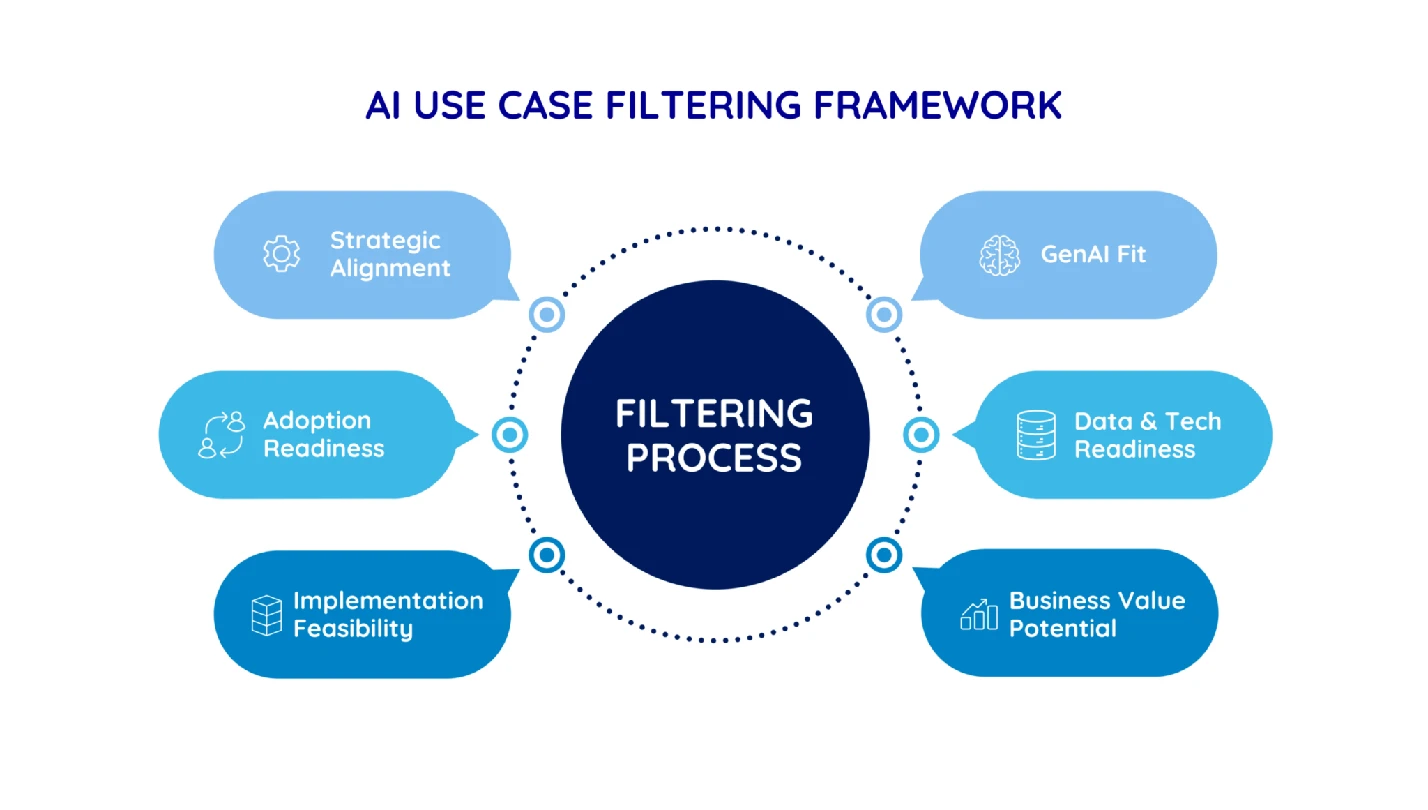
Filter 1: Strategic Alignment
Tests whether the use case supports core business priorities and KPIs. Any idea that focuses on technology for its own sake – rather than solving a documented business problem – is flagged immediately. In banking, for example, a use case must directly correlate to metrics like customer retention or operational cost reduction to clear this first gate.
Filter 2: GenAI Fit
Tests whether the problem truly needs GenAI by checking for unstructured data, voice, documents, complex reasoning, or creative generation. If a use case can be handled with simple if then else rules, GenAI is treated as unnecessary cost and risk. This filter flags deterministic tasks, like fixed data entry requiring 100 percent accuracy, as poor candidates for GenAI.
Pro tip: Confused whether GenAI is the right fit for your enterprise?
Read what Janarthanan Poornavel, Chief Technology Officer at Zuci Systems, has to say about choosing the right AI technology, effective AI adoption strategies and ways to measure AI project success.
Filter 3: Data and Tech Readiness
Checks whether your current tech stack and data can actually support the use case by examining availability, accessibility, quality, legacy systems, and missing history. Zuci verifies that the required data is both accessible and good enough to train or ground an AI model. Use cases that depend on real time feeds from inaccessible legacy systems or on historical data that does not exist are flagged as not ready.
Filter 4: Business Value Potential
Assesses whether the use case has a clear value hypothesis in terms of time saved, cost reduced, risk reduced, or revenue increased. Zuci looks for directional numbers, even if rough, such as lower alert handling time, higher collection rates, or revenue uplift in a product line, with revenue growth as a primary lens. Ideas that only claim to “improve efficiency” without any measurable metric are treated as stop signals.
For example, in Zuci’s work with one of the global companies, the value was clear: solving an unsolvable collection problem across 80 sites by allowing non-IT site operators to use natural interfaces.
If the potential ROI cannot be projected with reasonable confidence, the use case is de-escalated in favor of those that offer a clearer path to significant financial or operational gain. We consider revenue growth to be a key value dimension.
Not sure which AI use cases are worth pursuing from a business value standpoint?
Sign up for our AI workshop. During this 3-days workshop, we work with your team to understand your use cases, prioritise them based on our filters, and define PoC-ready opportunities.
Filter 5: Implementation Feasibility
Looks at process fit, resource needs, and expected time to value. Zuci favors use cases that can reach a POC in four to six weeks to keep momentum high. Ideas that demand multi year core system overhauls just to be viable are flagged, since even high value use cases are not practical if they cannot be delivered within current constraints.
For example, in manufacturing, a use case must integrate with current shop-floor hardware without requiring a complete infrastructure overhaul to pass the implementation feasibility gate.
Filter 6: Adoption Readiness
Focuses on whether people will actually use the solution once it is deployed. It looks at stakeholder buy in, the organization’s ability to manage change, and clarity on who the real end user is. Tools built without end user input are flagged, since even a strong AI solution will fail if users do not trust it or fit it into their daily workflows.
Applying the Framework: A Use Case in Banking
This methodology played out in a recent project for a banking client with seven potential use cases under consideration. Each idea was run through all six filters. Only those that cleared enough gates moved forward:
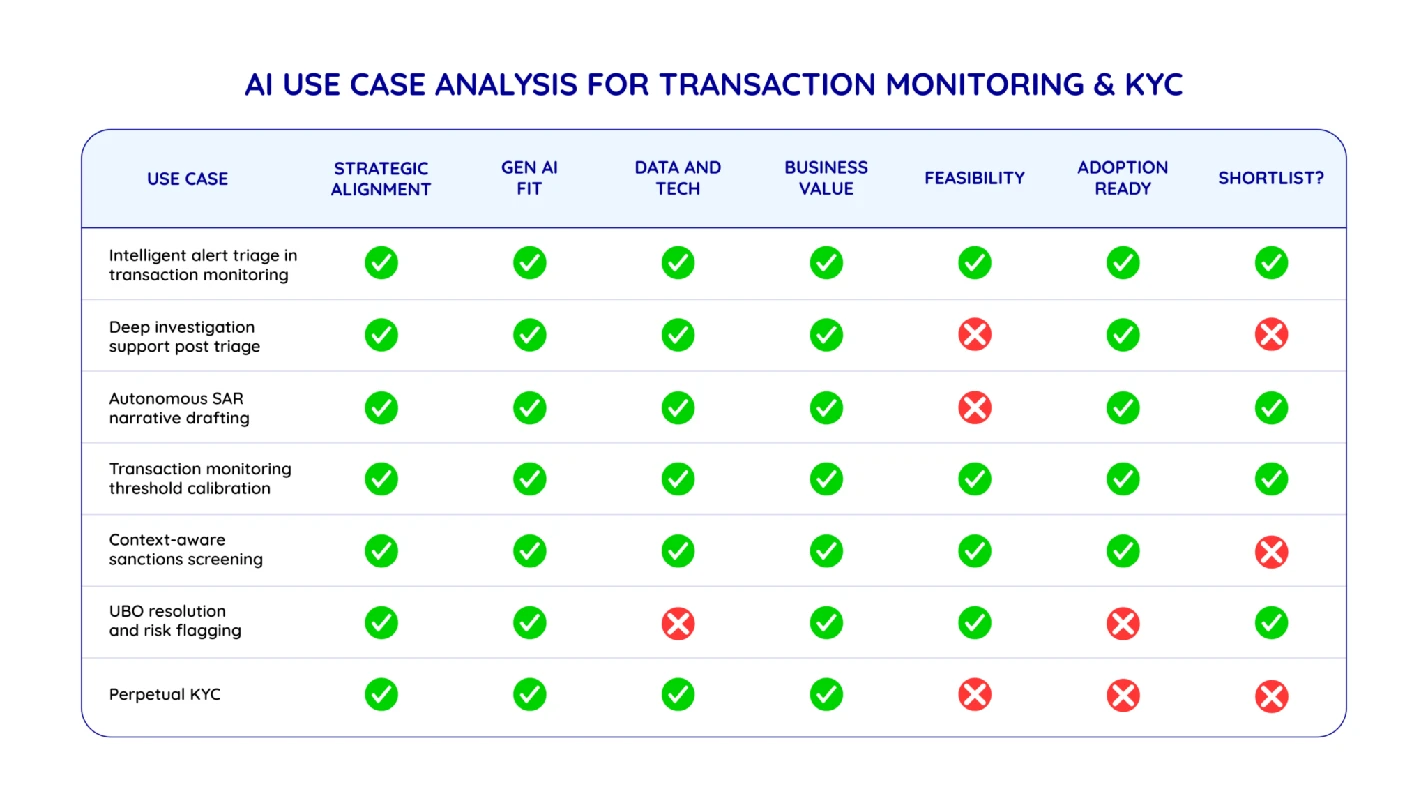
Three findings from this exercise:
- “Intelligent alert triage” cleared all 6 filters, making it a good choice for AI
- “Deep investigation support” failed on feasibility. Despite strong strategic alignment, the implementation complexity made it unviable for the current wave.
- “UBO resolution” was strategically important but had data access issues and low adoption readiness. Hence was shortlisted with caveats and additional remediation work required before POC.
What Next After Filtering?
Filtering answers the first question: what is even worth doing. Once a shortlist exists, a simple two-by-two matrix of business value versus effort determines sequencing.
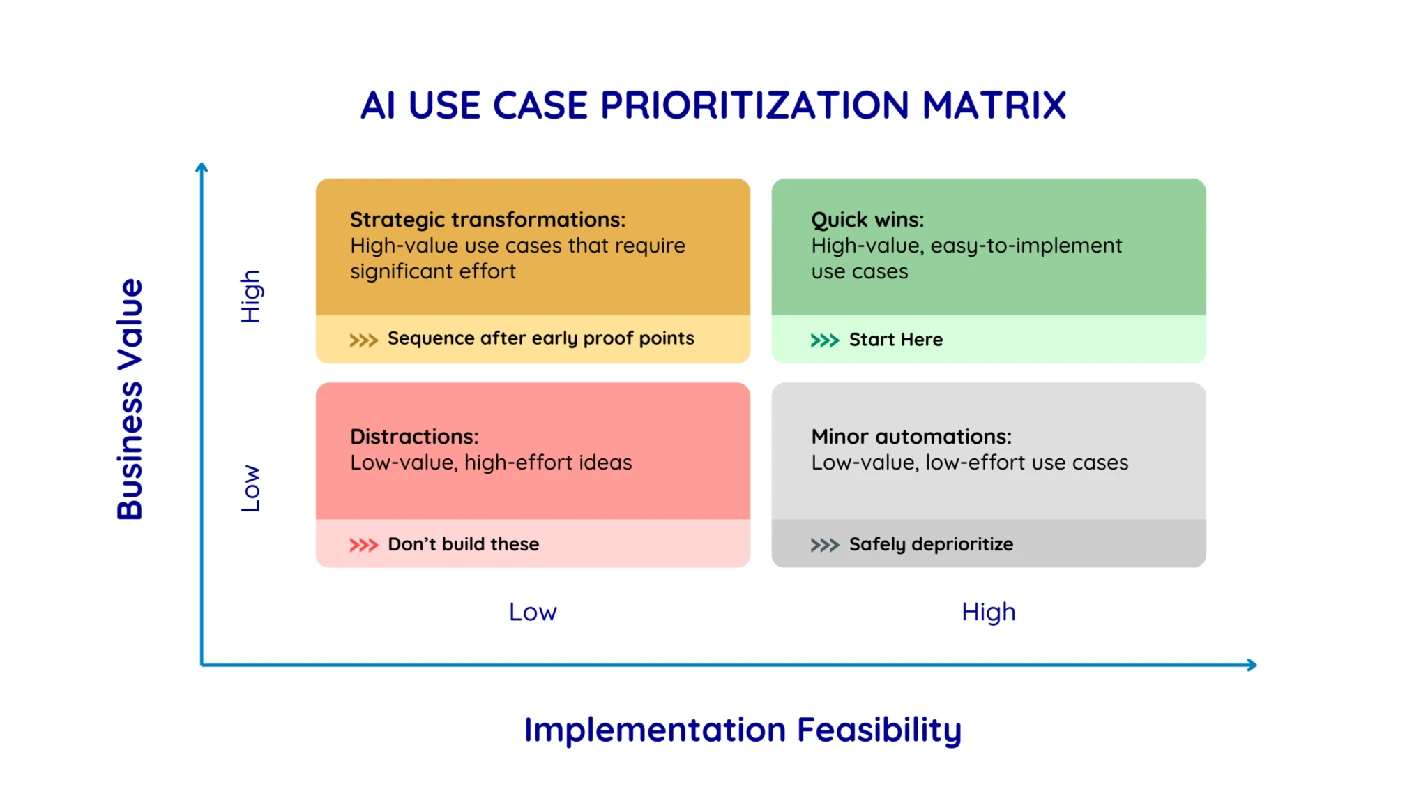
High value, low effort use cases become quick wins – The right place to start POCs because they prove value fast and build internal momentum.
High value, high effort use cases become strategic bets – They need more design and change management, but they are the ones that move the needle on growth over the medium term.
Low value, high effort use cases are resource traps – They consume significant time and investment while delivering little in return. These are the most dangerous ideas on a long list because they often sound technically ambitious, which can make them feel like progress. They are not.
Low value, low effort ideas are distractions – They may be minor automations or nice-to-have optimizations, but they do not belong in the first wave of AI investment regardless of how easy they are to build.
Putting discipline at the front of the funnel is how you avoid paying for AI that never ships. A hard filtering and prioritization method turns AI from a collection of experiments into a steady flow of pilots and production deployments that actually show up in your results.
Want a structured way to apply this across your pipeline?
Download the AI Prioritisation Playbook to map, score, and sequence your use cases with clarity.
Download the Playbook→
Next Steps
This blog is part of a series on moving from AI curiosity to a roadmap you can execute.
If you’re still at the stage of figuring out where to begin and not yet at the point of having a list of ideas to filter, then start with the first post in this series: Enterprise AI Strategy: Where Should You Start Your AI Journey?. It covers how to anchor on the right business priorities and surface the use cases worth bringing into this framework.
If you’ve run your ideas through the six filters and have a shortlist in hand, the next question is sequencing: which use cases do you fund first, and in what order? That’s what the next post covers : Prioritize your AI use cases to identify the quick wins and strategic bets for business value, where we go deeper on how to plot your shortlist against business value and effort, and how to build a phased roadmap that leadership can actually get behind.
Not sure which use cases on your list will actually survive a POC?
Our team can help you run the filter in a focused 30-minute session — no pitch, just a straight look at what’s viable.
Book your AI Strategy Session →
About Zuci Systems
Zuci Systems is an AI-first digital transformation partner specializing in quality engineering for AI systems. Named a Major Contender by Everest Group in the PEAK Matrix Assessment for Enterprise QE Services 2025 and Specialist QE Services, we’ve validated AI implementations for Fortune 500 financial institutions and healthcare providers.
Our QE practice establishes reproducibility, factuality, and bias detection frameworks that enable enterprise-scale AI deployment in regulated industries.
Explore more at Zuci Systems
Frequently Asked Questions
1. Why do most AI proofs of concept fail to reach production?
As POCs move to production, they fail because they were never planned to face real world challenges but built in controlled environments. In most scenarios, data turns out to be inaccessible, the workflow the solution was designed around does not reflect how users actually work, or there is no accountable owner with a KPI attached.
2. How do you build a defensible business case for an AI use case?
3. How do you evaluate AI use cases before committing budget to a build?
4. How do you get leadership alignment on which AI use cases to fund?
5. How do you identify the right AI use case for your business?
Share On

Enterprise AI Strategy: Where Should You Start Your AI Journey? - Blog 1 of 5
Prioritize your AI use cases to identify the quick wins and strategic bets for business value - Blog 3 of 5
Author’s Profile

Head, Gen Al Center of Excellence, Zuci Systems|
Author's Profile

Head, Gen Al Center of Excellence, Zuci Systems

Srinivasan heads Zuci’s Generative AI Center of Excellence, leading initiatives that unite AI, engineering, and enterprise transformation.
With over 20 years of experience in technology strategy and digital platforms, he helps organizations design scalable AI systems that balance creativity and control.